
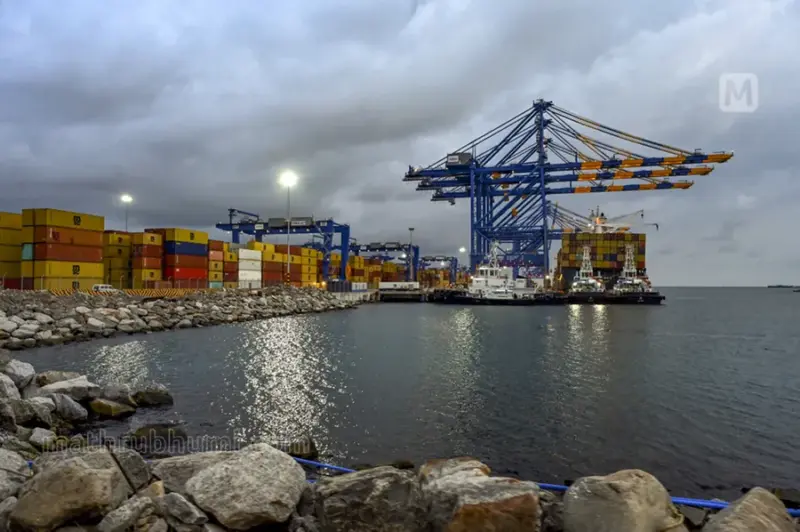

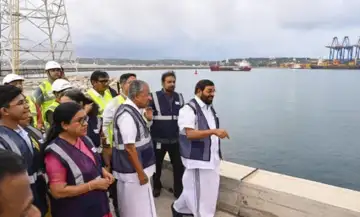
As Kerala stands on the cusp of the Vizhinjam Port inauguration by Prime Minister Narendra Modi on May 2, a crucial conversation is taking shape about the future of Cochin Port and its role in India's maritime strategy.
Predictably, much of the discourse has been reduced to false binaries, often involving the tiresome intra-mural rivalry between Kochi and Travancore, with sections of the media portraying Vallarpadam ICTT as becoming obsolete in the wake of Vizhinjam's emergence. However, such simplistic narratives fail to grasp the true nature of Kerala's maritime potential.
In his new book, Resurgent Cochin: The Past, the Present, and the Future of Cochin Port and Its Hinterland, N. Ramachandran-a now-retired IPS officer who formerly served as Chairman of Cochin Port Trust-offers a bold, pragmatic counter-perspective that rejects this misplaced rivalry and instead advocates for a far-reaching expansion of India's port infrastructure. His argument is as simple as it is compelling: Kerala, and indeed India, needs many more Vallarpadams and Vizhinjams, not fewer.
Globally, ports serve as economic accelerators, facilitating trade, attracting investment, and generating employment. Yet, India's maritime capacity remains woefully inadequate, especially when juxtaposed against China's extraordinary growth. While China handled over 330 million TEUs (twenty-foot equivalent units) in 2025, India managed a mere 20 million-a stark reminder that we are falling drastically short of realizing our full potential.
Ramachandran argues that Vizhinjam and Vallarpadam are not competitors but complements, serving distinct market segments. Vizhinjam, with its deep natural draft, is ideally positioned to attract large transshipment vessels, offering an alternative to Colombo, Dubai, Singapore and Tanjung Pelapas. Conversely, Vallarpadam remains indispensable as a gateway port for southern India, catering to coastal and hinterland cargo, as well as mainline international services. Together, these ports can dramatically expand India's limited cargo handling capacity, placing Kerala at the forefront of maritime growth.
But a maritime vision cannot exist in isolation-Kerala's economic progress depends on bold reforms that cut across infrastructure, labour, and policy frameworks. What sets this book apart is its insider perspective on the extraordinary transformation of Cochin Port-from an inefficient, heavily unionized legacy institution to a digitally-enabled hub of modern logistics -- demonstrating that change is possible with political will and administrative resolve. Ramachandran recounts how his team overcame bureaucratic inertia and entrenched labour practices, implementing reforms that made Cochin India's first e-Port. His candid reflections on labour rationalization, digital transparency, and institutional discipline offer valuable lessons for Kerala's wider political economy. Ramachandran's experience offers critical lessons for Kerala's wider political economy, especially in dismantling entrenched inefficiencies like nokkukooli.
In his book's provocative final chapter, "Notes from Willingdon Island," Ramachandran makes a powerful case for Kerala to diversify its economy, shedding its historical stagnation. He outlines a roadmap that includes leveraging Cochin's LNG terminal, expanding shipbuilding, capitalizing on the blue economy, and developing sustainable blue tourism. His message is clear: Ports are the engines of growth, but Kerala must embrace broader structural reforms to unleash its full potential. (I could add to this list of economic opportunities for Kerala, but Ramachandran is understandably focused on the maritime aspects, and this is indeed a useful strategy for Kerala to pursue.)
As I have often argued, the greatest obstacle to Kerala's economic resurgence is inertia-the tendency to prioritize short-term political considerations over long-term structural growth. Our willingness to surrender to bureaucratic over-regulation, and our resigned acceptance of negative and damaging political practices and entrenched habits, are other banes that have impeded our development. What Kerala needs is not piecemeal adjustments, but a comprehensive maritime policy that:
- Encourages investment by removing bureaucratic hurdles and implementing investor protection laws.
- Modernizes labour policies, ensuring that trade unions evolve into responsible stakeholders rather than obstacles to progress. We must outlaw such outdated, regressive and frankly destructive practices as hartals and nokkukooli.
- Promotes sectoral innovation, integrating Kerala's strengths in education and technology with new avenues in shipbuilding, logistics, and marine research.
Kerala has never lacked human capital, intellectual depth, or natural advantages. Nor has it lacked ideas, initiative or inclination. What has been missing is the political resolve to translate potential into performance. Ramachandran's vision for resurgence is not merely about ports; it is about rethinking Kerala's economic trajectory altogether. His book, despite its unfortunate title that will make readers assume it is only about Kochi, is a wake-up call to leaders, policymakers, and citizens alike-urging Kerala to shed its hesitations, embrace pragmatic reform, and position itself as a global maritime powerhouse. His roadmap for Kerala's future is both scathing and hopeful, animated by personal experience and written with candour, wit, and a deep concern for the state's development.
For anyone invested in Kerala's progress-whether in maritime development, public sector reform, or ethical governance-this book is an essential read. Ramachandran's insights are not just a testament to his leadership but a blueprint for Kerala's revival, offering a vision that is as ambitious as it is achievable.
The question, then, is not whether Kerala can achieve this vision-but whether it will muster the courage to do so.