
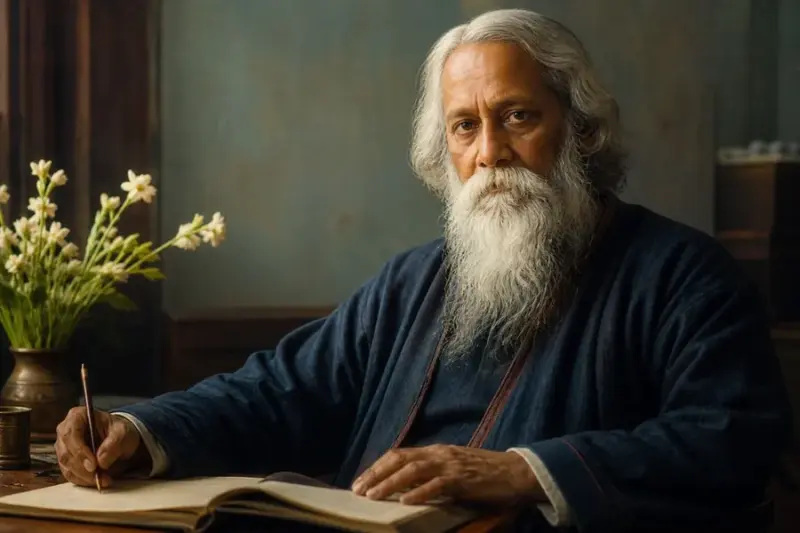

Rabindranath Tagore Jayanti, popularly known as Rabindra Jayanti or Poncheeshe Boishakh in Kolkata, is celebrated every year to honour the birth anniversary of Nobel laureate Rabindranath Tagore, one of India's greatest literary and cultural icons.
Born on May 7, 1861, in Kolkata, Tagore's contributions to literature, music, education, and philosophy continue to inspire generations across the world.
As India commemorates the 164th birth anniversary of Tagore, people remember not only his literary genius but also his role in shaping modern Indian thought and culture.
In West Bengal, Rabindra Jayanti is traditionally observed according to the Bengali calendar on the 25th day of Boishakh, which falls on May 9 this year. However, in many other parts of the country, celebrations are held on May 7.
A literary giant who transformed Indian literature
Tagore began writing at a very young age and penned his first short story in 1877. Over the years, he emerged as one of the most influential voices in Bengali literature.
His timeless works include novels, poems, songs, plays and essays that continue to be widely read and performed.
Some of his most celebrated literary creations include 'Gora', 'Ghare Baire', 'Shesher Kobita', 'Rakta Karabi', 'Tasher Desh', 'Dena Paona' and 'Shanchayita'. His short stories, such as 'Kabuliwala', 'Atithi' and 'Kshudita Pashan' remain classics in Indian literature.
Tagore's masterpiece 'Gitanjali', a collection of deeply philosophical and spiritual poems, earned him the Nobel Prize in Literature in 1913, making him the first non-European to receive the prestigious honour.
He also composed India's national anthem 'Jana Gana Mana' and Bangladesh's national anthem 'Amar Shonar Bangla', cementing his place in the cultural history of the subcontinent.
Beyond poetry: Tagore's vision for education and society
Apart from being a celebrated poet and writer, Tagore was also a visionary educator and social reformer.
He founded Visva-Bharati University in Santiniketan to create an education system that encouraged creativity, learning through nature, and holistic development.
Tagore strongly believed in universal humanism, harmony, and the celebration of cultural diversity.
Through his writings and educational philosophy, he advocated compassion, freedom of thought, and social reform. His ideas continue to influence discussions on education, nationalism, and humanity even today.
Known affectionately as Gurudev, Kabiguru, and Biswakabi, Tagore remains one of the most respected figures in Indian intellectual history.
Why Rabindranath Tagore Jayanti remains important today
Rabindranath Tagore passed away on August 7, 1941, but his legacy lives on through his literature, music, and ideas.
Every year, Rabindra Jayanti is marked by cultural programmes, poetry recitations, Rabindra Sangeet performances, and discussions on his works, especially in West Bengal and Bangladesh.
The occasion serves as a reminder of Tagore's enduring influence on art, literature, and society.
Decades after his death, his works continue to inspire writers, artists, musicians and thinkers across the globe, proving that his message of humanity and creativity remains timeless.