




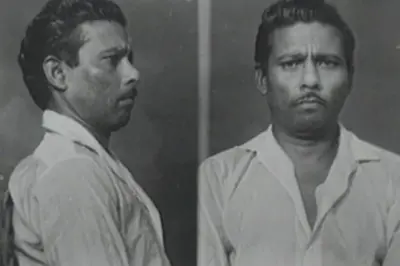

Bombay, 1968 - The city that never sleeps found itself suffocating beneath a shroud of terror. Nights once filled with laughter and music faded into silence as an unseen predator stalked the slums.
By dawn, as the city's first train rumbled out of Churchgate, bodies cooling in their beds- skulls caved in, blood pooling on broken cots- were found on a regular basis. The man behind this reign of terror would soon become a name whispered with fear and fascination: Raman Raghav, India's own Jack the Ripper.
Bombay in 1968 was not the city of glass towers and neon billboards it is today. It was a city of shadows, of shanties and alleyways, where hope and hunger lived together. Some evil thing haunted the night, slipping in and out of the labyrinthine slums along the Ahmedabad highway, the duct-line and beyond.
The killer moved like a jungle cat, with surgical precision. His weapon of choice: an iron club. His victims were the poor, the tired, weary and asleep, the helpless. Random people who lived in shanties, slums or were homeless. One time, the focus of his predatory gaze targeted a woman who was playing with her infant. Her gold chain glimmered-a promise of riches, a motive, perhaps.
Like an expert stalker, he returned, watching, waiting. On the fifth night, fate-or perhaps just exhaustion-lulled the family into sleep. Raghav slipped inside, wielding his iron rod. What followed was a massacre: the husband's skull was bashed in, the wife murdered as she screamed, the infant silenced in a single blow. Raghav had sex with the corpse of the woman, and then snatched the chain, a prize now smeared in blood, and faded into the darkness. Another time he killed a man in his hut, for a tin of dalda and a wristwatch!
When the city's newspapers weren't protesting, they gave him the moniker "India's Jack the Ripper." The tabloids screamed about a demon loose in the night that fanned the city's panic.
Bombay, the city of dreams, was also a city of anonymity. Here, Sindhi Dalwai, as he was known before he became Raman Raghav, arrived in 1950 from Tamil Nadu, one of millions seeking a new life. But what he brought was not hope, but a capacity for violence. Petty thefts, jail stints, and erratic rages peppered his early years, but nothing hinted at the brutality to come.
The police were under great pressure. The best detectives of the city police - Inspector Vakatkar, Deputy Commissioner Ramakant Kulkarni and others burnt the midnight oil, chasing shadows and dead ends. The killer was smart. He changed his hunting grounds, used different names and left only the faintest trace.
Record these figures, for they are more than statistics; they are the sum total of a city's nightmare:
Case 1: Family of three butchered in Malad, blood all over, necklace taken.
Case 2: A tea-seller in Talegaon is the victim of a cheating customer. The tea-seller is fortunate to escape when the killer is caught in the act of theft.
Case 3: An old man, watch stolen, skull broken, cot full of blood.
Case 4. A night watchman murdered in the middle of a meal, his supper eaten by the murderer.
Case 5: Shantabai, mother of two, raped in her sleep, her children pushed aside as the killer violated her body.
The stories became more grotesque with each iteration. It seemed that no one was immune to this faceless terror.
Fear did more than freeze; it provoked. The Bombay police threw out patrols that worked round the clock, combing the eastern suburbs, the slums, the railway sidings. Usually the Crime Branch was happy to go after smugglers and pickpockets; now they were on high alert. There were thick rumours in the air. Some said the killer was a sadhu who could disappear into thin air, others that he was a shape-shifter who could change into a parrot or a cat or a dog to avoid capture.
And then, by some luck, police patrols found a shady figure loitering in Mulund. He was arrested and brought in to be questioned. He said his name was Raman Raghav. The police took his fingerprints, ran him through the system and came up with a string of aliases: Sindhi Dalwai, Tambi, Veluswami, Anna, Talwai. Nine arrests, five years in the can, a rap sheet longer than a monsoon night.
Inspector Vakatkar interrogated him, convinced that he was the phantom killer. But the courts could do nothing without evidence. Raghav said nothing, expressionless. The police, at their wits' end, resorted to a legal device called externment (tadipaar): they expelled him from Bombay for a period of two years. And the killing stopped. For some time.
When the monsoon returned two years later, so did death. The pattern was evident; the killings had resumed in the same haunted corridors of the city. The message was clear. The killer was back and ballsy as hell.
The police tried harder, but the city was going berserk. Vigilante mobs formed, attacking anyone they deemed suspicious. Innocent sadhus and beggars were beaten, lynched or driven out of town. Fear was running high in the city, a dark tide that threatened to drown reason itself.
By 1966, corpses began appearing in the eastern suburbs of Bombay. The victims, their skulls caved in by a blunt weapon, were all attacked in their sleep. Nineteen in total-nine dead, the rest left battered and bewildered. The killer was a phantom, striking where the city's poorest lay defenceless.
Word and panic spread across the poorer parts of the city. The residents became vigilant. Every night families huddled together, doors locked, crude weapons in trembling hands. The watchmen patrolled in shifts, their eyes open and their nerves frayed. Superstition thrived-children were told not to mention the murders, lest the killer's spirit come for them.
The press stoked the fires. "It's when public imagination ran amok," said crime chronicler and film director Sriram Raghavan. People swore they saw the killer change into animals, disappear into shadows, walk through walls. Each night the poor of the city huddled together, waiting for the next blow to fall.
Frustration grew within the police force. Officers like Kulkarni and Vakatkar drove themselves to exhaustion, each morning haunted by fresh corpses. The Crime Branch plotted the murders, red dots exploding over the city's sprawl on the map of Bombay. Oshiwara. Goregaon. Malad. Kandivali. Borivali. Dahisar. A constellation of horror.
But the killer was always one step ahead, always a shadow in the darkness.
And Kulkarni was no ordinary cop. He studied not the crimes, but the mind of the criminal. He'd read of the geometry of crime, the theory that killers struck from a comfort zone, close enough to be familiar with but far enough away to escape recognition. So, he zeroed in on the areas around Malad, Jogeshwari and Kandivali for his search.
He read through old case files, and came upon the the failed arrest two years ago, the externment. He thought of it being too much of a coincidence. Kulkarni put out a citywide lookout for Raman Raghav, gathering everyone from old mill friends to neighbourhood maids who could identify him.
The net was approaching. In Poisar village, a maidservant, Manjulabai, saw him. Khaki shorts, blue shirt, brown canvas shoes, umbrella in hand. Police raced to the scene, broadcasting descriptions on the radio. Forensic teams compared fingerprints from old murder scenes to the ones in Raghav's file. A perfect match. They had proof at last. But Raghav was always on the run, disappearing before they could catch him.
Then a break: two more bodies were found at a cattle shed in Chincholi, Malad. This time a 13-year-old boy saw the killer run away with a bloodied rod. The police remembered that the murder weapon in previous crimes had always been a truck axle, an iron rod, found at the scene.
The Crime Branch buzzed with excitement. They were close, so close they could almost taste the relief of the city.
And on August 27, 1968, fate intervened, in the form of Police Sub-Inspector Alex Fialho. On the way to Dongri station, Fialho saw a man who fit the now-infamous description. The man did not react to the sight of the police uniform. That in itself was suspicious.
Fialho followed him, his heart pounding. Blood on his clothes. A wet umbrella, a detail that connected the man to the Malad murders on a rainy night. Fialho made his move when the crowd of Bhendi Bazaar was threatening to swallow them both: tap on the shoulder, a quiet command. Raghav meekly followed, like a dog after its master.
At the station, in the bright glare of a single bulb, Raghav gave another fake name. But the evidence was piling up. The bloody clothes, the murder weapon, and soon enough the fingerprints. The city's nightmare was finally chained up. They shoved him into the interrogation room and started grilling him.
Initially, Raghav was silent, untouched by threats and violence. The city needed answers, but the man before them was a mystery. It was only when offered the comforts he'd long been denied-food, hair oil, a comb-that he began to talk. In chilling detail, he led police to his hiding places, demonstrating how he killed, showing off his "friend," the iron rod he called akada.
Raman Raghav confessed to over 40 murders-a confession that shook the country's conscience. The sheer randomness of his violence, the disproportionate brutality for trifling gains, stunned even hardened detectives.
He took the police to his hideouts, showed them where he'd buried his "friend"-the bent, bloody iron rod. He giggled and acted out his killing technique, mimicking the fatal blows.
The city breathed out, but in relief, and horror. His crimes were beyond imagining in their enormity. He killed for trinkets, for flour, for fun. He killed because the urge was too strong; motive be damned.
Raghav's trial was a show. The defence said he was insane. Psychiatrists probed his mind and diagnosed chronic paranoid schizophrenia, hallucinations, delusions of persecution and grandeur. He said there was a radio inside his head, from which he heard voices, messages from "Qanoon," divine orders to kill. He viewed himself as a warrior in a cosmic war against the forces that endangered his manliness.
The late Khushwant Singh, then a journalist, covered the trial, and wrote Raghav's "hatred of women is a dominant aspect of his character." The killer was obsessed with his manhood, terrified of being turned into a woman, haunted by a betrayal by an ex-wife.
His delusions did not move the court, which condemned him to death. But after a long series of appeals and re-examinations, Raghav's sentence was changed to life imprisonment. He died in 1995 at Sassoon Hospital, his mind gone mad, his body finally at rest.
Raman Raghav case changed Bombay forever. It demonstrated how fine a line separates order from chaos, safety from terror. One man held a city hostage for months. A man whose madness turned myth. A man whose crimes became cautionary tales whispered in the night.
He gave nightmares and novels and films and a generation of cops who'd never let the city fall into darkness again. But the true legacy is the lesson. That evil sometimes wears the face of a man, and that in the city of dreams, nightmares are real.
(Anirban Bhattacharyya is a bestselling true crime author)