





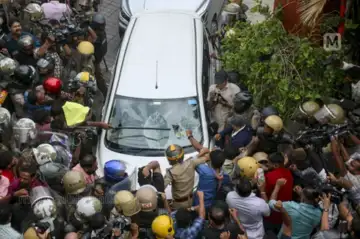
The most striking image from the aftermath of the Enforcement Directorate search connected to Pinarayi Vijayan's daughter, Veena Thaikkandiyil, was not the arrival of central agencies, not the party workers flooding the streets, not even the now familiar led theatre of siege and resistance.
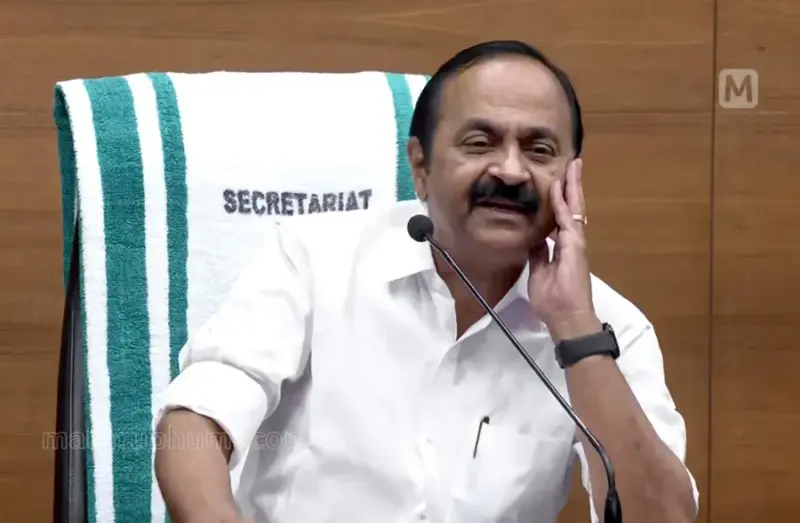
It was the silence of V.D. Satheesan. Journalists repeatedly asked the Chief Minister questions. They chased the Congress leadership for reactions. They wanted the usual spectacle that now passes for political communication. But Satheesan simply refused to perform. He spoke little, and most often not at all. Others, like Ramesh Chennithala and K Muraleedharan, addressed the press, while Satheesan stood back and watched the political choreography unfold.
That silence has unsettled the CPI(M) far more than outrage would have. Because Satheesan seems to understand something the party itself does not fully realise. The Enforcement Directorate investigation into the financial dealings surrounding Exalogic and CMRL was politically dangerous to the CPI(M) only as long as it remained a question of alleged corruption, influence, patronage and proximity between political power and corporate interests. The moment the party successfully transformed it into an "attack on Pinarayi Vijayan," the terrain changed. A wounded cadre suddenly rediscovered emotional purpose.
The CPI(M) had entered this moment politically damaged. The electoral defeat was not merely numerical. Something deeper had happened over the last decade, particularly during the second term of Pinarayi Vijayan. Large sections of ordinary Left workers, sympathisers and voters had become exhausted by the centralisation of power, by arrogance masquerading as political discipline, by the suffocation of inner party criticism, and by the transformation of a communist movement into a tightly controlled leadership ecosystem orbiting one man and his court. Many of them voted for the UDF.
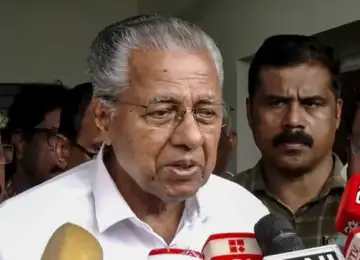
That was the real danger facing the CPI(M). Not the BJP and not the Congress, but the erosion of emotional loyalty within its own base. The ED searches arrived at precisely the right moment for the party leadership. Suddenly, uncomfortable questions about Veena Vijayan's financial dealings, about CMRL, about consultancy agreements, about loans, about dormant companies, and about political proximity could all be reframed as something emotionally far more useful. Delhi was attacking not Veena Vijayan, not Exalogic, but Pinarayi Vijayan himself. The party was under siege again. The old muscle memory returned. The cadre reorganised emotionally around persecution rather than introspection.
And Satheesan has understood the trap. Had he celebrated the ED action too loudly, the CPI(M) would have gained exactly what it desperately needed after the election debacle. A martyr, a battlefield, and an external enemy large enough to erase internal fractures. Instead, he remained silent, and the silence was not weakness. It was denial. Denial of oxygen to a political machine trying to convert allegations into emotional consolidation. This is what seems to terrify the CPI(M) leadership today. Not merely that Satheesan leads the government, but that he understands the political psychology of the present moment better than they expected. He has stood consistently against the culture Pinarayi Vijayan built around the party and the state. He has spoken about the visible proximity between sections of the BJP and the CPI(M), a charge many dismissed as rhetoric until Kerala's political patterns themselves began feeding the suspicion. The suspicion does not emerge because the CPI(M) and the BJP are ideological allies. They are not. Kerala's history is soaked in the blood of violent conflicts between RSS and CPI(M) cadres, especially in Kannur. But politics is not governed by ideology alone. It is also governed by utility. And utility creates strange arrangements.
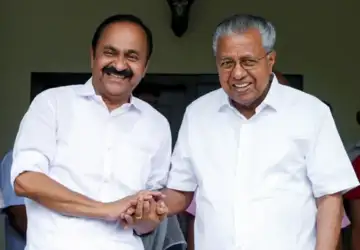
The BJP's long-term political objective is not merely defeating the CPI(M). It is the weakening of the Congress as the principal pole around which anti-BJP politics gathers. A Congress reduced to permanent fragility serves the BJP nationally and regionally. The CPI(M), too, benefits from a weakened Congress. The rise of a strong Congress leadership in Kerala threatens both. That is why the current moment appears so politically peculiar. For years, allegations involving Pinarayi Vijayan and his ecosystem generated enormous public heat. The gold-smuggling controversy, Life Mission, financial allegations, and questions about administrative proximity and corporate networks. Yet the movement of central agencies often appeared selective, theatrical or strangely incomplete. Even controversies involving Sabarimala, a shrine central to the BJP's own Hindutva politics, did not produce the sort of relentless institutional aggression one would ordinarily expect elsewhere in India. Naturally, people began asking questions. The questions became sharper because Kerala remembers history. Pinarayi Vijayan is not a leader for whom engagement with the Sangh has historically been unthinkable. The controversy regarding RSS support during the 1977 elections survives precisely because it was not entirely denied away into oblivion. Political memory in Kerala is long, and it rarely forgets tactical accommodations. None of this proves a formal alliance. But politics does not always require conspiracies, and often, overlapping interests are enough.
And the ED episode has benefited both sides. The BJP once again becomes central to Kerala's political conversation without possessing substantial electoral strength. The CPI(M) regains ideological relevance through confrontation with Delhi. A damaged cadre regains emotional unity. The Congress risks becoming trapped between two narratives carefully feeding off each other.
Satheesan appears to recognise this. That is why his silence matters. A lesser politician would have lunged for immediate advantage and walked directly into the trap. Satheesan instead delegated responses, allowed senior Congress leaders to engage tactically and refused to emotionally personalise the spectacle. The CPI(M) social media ecosystem has relentlessly targeted him ever since he took charge precisely because it recognises the danger he represents. Not merely electorally, but structurally.
Kerala has thus far resisted the BJP's rise to a major political force despite possessing one of the country's densest RSS organisational networks. That resistance emerged because the Congress and the Left together occupied enough political space to prevent the consolidation of Hindutva. But if the Congress weakens too far and if anti-Left sentiment loses a credible democratic vehicle, Kerala's political equilibrium itself could change. That is the dangerous game now unfolding.
The tragedy for the CPI(M) is that it increasingly seems incapable of distinguishing between defending a movement and defending a power structure. Every criticism becomes betrayal. Every question becomes conspiracy. Every investigation becomes fascism. And, to top it all, every electoral defeat becomes the fault of enemies rather than the consequence of political decay. And so the party rushes again into the streets, fists raised, voices sharpened, convinced history is repeating itself.
Perhaps it is. But not in the way they imagine. The CPI(M) once built itself through ideological conviction, sacrifice, intellectual seriousness and organisational discipline rooted among ordinary people. Today, increasingly, it appears animated by the survival instincts of a political establishment terrified of losing control over the ecosystem it built around power. That may be the real obituary now being written in Kerala. Not of a party's electoral prospects. Parties recover. But of a moral and political imagination that once convinced generations of people that communism meant something larger than the defence of one leader, one family, and one system of power.
(The author is a National Award winner for Best Narration and an independent political analyst. Views expressed are personal.)