
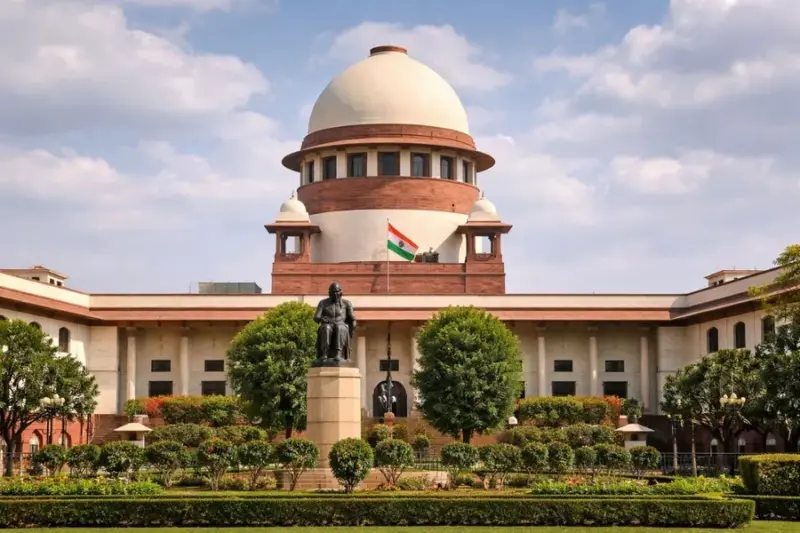

The Supreme Court has ruled that a candidate's OBC "creamy layer" status cannot be decided solely on the basis of their parents' salary income.
The judgment is expected to affect many civil service aspirants across India.
A bench of Justices P.S. Narasimha and R. Mahadevan dismissed appeals filed by the Union Government and upheld earlier decisions of the Madras, Delhi and Kerala High Courts, which had ruled in favour of OBC candidates.
The case, Union of India v. Rohith Nathan, centred on whether a 2004 clarification issued by the Department of Personnel and Training (DoPT) could override the original 1993 government order that sets the rules for identifying the creamy layer among OBCs.
The Court said determining creamy layer status only on the basis of income limits, without considering other criteria mentioned in the 1993 order, was not legally valid.
"Determination of creamy layer status solely on the basis of income brackets, without reference to the categories of posts and status parameters in the 1993 Office Memorandum, is unsustainable in law," the bench said.
The judges noted that authorities had been using the 2004 clarification to include salary income when calculating whether a candidate's parents crossed the ₹8 lakh annual income limit.
This affected candidates whose parents worked in public sector undertakings, banks or private companies.
The Court said salary income should not be added mechanically in a way that defeats the purpose of reservation policies. It also observed that treating children of PSU or private-sector employees differently from those of government employees amounted to "hostile discrimination".
Background of the Case
The dispute arose from a group of Civil Services Examination candidates who sought reservation benefits under the OBC Non-Creamy Layer category.
Impact on civil service aspirants
The ruling has immediate implications for civil service candidates whose OBC non-creamy layer status had been revoked because their parents' salaries crossed the ₹8 lakh limit. Under the 1993 framework, salary and agricultural income were explicitly excluded from the income test, which was intended only as a secondary filter in cases where status-based criteria could not be applied.
The Court directed the Department of Personnel and Training to reassess affected candidates' claims within six months. It also ordered the creation of supernumerary posts, where required, to accommodate candidates who qualify following reassessment, while ensuring that the seniority of existing employees remains unaffected.
ALSO READ | Keralites bask in Civil Service glory - stories of grit and determination
For future civil service examinations, authorities have been instructed to prioritise valid OBC non-creamy layer certificates issued by district magistrates or tehsildars. Salary-based rejection of such certificates is expected to cease.
Wider policy debate
The judgment comes amid an ongoing national debate over the criteria for determining the creamy layer among OBCs. The current income ceiling of ₹8 lakh has remained unchanged since 2017. A parliamentary committee recently recommended revising the limit after consultations with stakeholders.
The Union Government has also been exploring ways to standardise equivalence criteria across government, public sector and private-sector employment.
By reaffirming the principles laid down in the 1992 *Indra Sawhney* case, the Supreme Court emphasised that the creamy layer concept was designed to exclude only the socially advanced sections within OBC communities, rather than families whose income is primarily derived from salaried employment.