





Female bonding, specially the mother-daughter relationship in cinema continues to provide a rich seam of source material for filmmakers around the world.
Filmmakers have deployed a wide range of cinematic languages and genres, from fictional narratives through dramatised documentary to experimental and avant-garde forms, to explore questions of identity. However, it may be noted that unlike in the West, with special reference to women filmmakers, there has been no obvious attempt to structure films on autobiographical or quasi-autobiographical narratives.
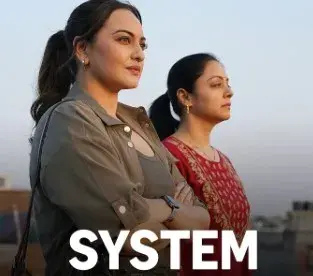
The issue of female bonding arises against the recent release of the film System, in Hindi on an OTP channel. Directed by Ashwini Iyer Tiwari, this courtroom drama that deals with a father-daughter conflict over a murder case, is strongly underwritten with a strange female friendship between a young, fledgling lawyer Neha Rajvansh (Sonakshi Sinha) and an ordinary but firm court stenographer Sarika Rawat (Jyotika) a famous actress from the South.
The friendship is strange because the two women are as different as chalk from cheese. While Neha is the legally educated daughter of the famous lawyer (Asutosh Gowarikar) and is affluent, sophisticated and umarried with a boyfriend who dotes on her but she is not all that interested. Sarika (Jyotika) is married to a husband permanently maimed in a fierce fire in his workplace and has a growing daughter. She also sleeps with a police officer as 'this is the only way I can pay through for my fight.' When the mystery of the murder is solved and Neha learns who the real killer of the young woman was, she still wins the case and though Sarika assumes that their friendship has ended, it has not. A beautiful portrayal of female bonding in Indian cinema.
This harks back to films that focus on female bonding not necessarily linked to any romantic segment but only commenting on the solid bonding that two or three women can form. Neither are they always linked to sister-sister or mother-daughter relationships that were the focus on earlier Southern and Indian cinema.
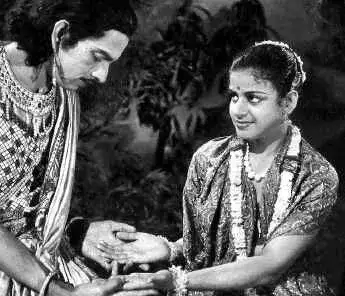
One of the earliest ventures in celluloid sisterhood happened in the 1940s in the Tamil film Sakuntalai starring MS Subbalakshmi. The film was drawn from a mythological tale in which the leading lady is surrounded by a bevy of female friends who form a strong support system for Sakuntalai which underwrites that female friendship was not a stranger to Tamil society even in the 1940s.
In another film, Adhe Kangal (1967), in one of the earliest scenes, Kanchana comes home with a group of her girlfriends and says that they will be staying with her for the vacation. This explains that women were not only studying away from their homes, but were also allowed to stay over at their friend's place for the holidays. This is telling of the period in which this film was made.
Jeevan Dhaara is a 1982 Indian Hindi-language film directed by T. Rama Rao. The film is a remake of the 1974 Tamil film Aval Oru Thodar Kathai. With Rekha in the female lead, there was a sub-theme. This showed how a playboy was successfully seducing both mother and daughter. The two women do not know that the man they are involved with is the same. When they discover the truth by a strange irony of a nervous tic of the man they unconsciously imitate, they enter into a suicide pact. If this were a Hollywood film, the closure perhaps would have been different. This underscores the culture-specific nature of cinema as a medium of mass entertainment. What works well in the West, does not necessarily have to work in an Indian ambience.
Many years ago, there a film called Phir Bhi depicted a daughter's obsession for her dead father. Yet, there is a close bonding with the mother. There is a moving scene in the film showing the daughter decking up the mother. But there is a cathartic change in the mother-daughter bonding when the daughter (Bambi) discovers that the mother (Urmila Bhatt) is in love with another man. She feels this to be a betrayal of her dead father. In her own relationship with her boyfriend, it is her father's image that persistently overlaps their rendezvous. Towards the closure, there is a suggestion of the revival of the relationship on an empathetic plane. By then, the daughter has purged herself of her father-fixation and her mother understands what happened and why.
Another Tamil film that places emphasis on the bonding between two females in the 1975 film Mayangukiral Oru Maadhu shows a beautiful bond between its lead character Kalpana (Sujatha) and her friend Revathy (Fatafat Jayalakshmi). Kalpana is cheated by a lover and ends up having to deal with an unwanted pregnancy. However, one must regretfully admit that in the film, the friend who stood by her when she was at her lowest and helped her brave the storm, all but vanishes in the second half.
Do women keep in touch with friends from their childhood? The film Magalir Mattum 2 directed by Bramma released in 2017, tackled this issue. Bramma said that the story of the film was inspired from the director's observation of her mother's life when he witnessed how, his mother, married at 16, was filled with memories of her childhood friends and how she recounted her relationship with her friends to him when he was growing up.
Latha and Sumitra enact childhood friends in S.P. Muthuraman's 1978 film Vattathukkul Chadhuram. Both of them run away from home which was unique at the time in Tamil cinema. The girl played by Sumitra becomes a junior artiste who sometimes doubles up as an escort. But her friend, played by Latha takes up the same profession not out of choice but to support the educational ambitions of her close friend. Is this stretching the cinematic imagination enough to question reality?

An Utopian bonding is portrayed in the film Aruvi (2017). They are equals in every way and they offer solid support when one of them is in need, and vice versa. These are all Tamil films and unlike the generally patriarchal slant of Tamil cinema, these are a few colourful pebbles that stand out as solid examples of female bonding. Among these, is the rare exception of the Rajanikant starrer Veera where two women become friends without realizing that they are married to the same man. This is absurdity at its worst because the climax shows the two women having accepted each other in their positions as women, as friends and as co-wives of the same man.

Suhasini will be remembered as a leading lady who is strong and powerful but in some way, bends down to patriarchy in the films Gopurangal Saivathillai (1982)and in Sindhu Bhairavi (1985.) Kalloori in 2007, briefly discusses a possessive relationship between two friends Shobana (Tamannaah) and Kayalvizhi (Hemalatha), but just towards the tragic ending, they make up to prove their friendship.
Friendships between women have traditionally been ignored. Writing in 1868, William Rounsville Anger notes the "small number of recorded examples of the sentiment," as well as the common belief that "strong natural obstacles make friendship a comparatively feeble and rare experience with (women.)"i Lillian B. Rubin writes - "just as women have been invisible in public life throughout the ages, so their private relations with each other have been unseen as well."ii
Rather than seeing the mother-daughter relationship as necessarily mired in hatred - the Freudian scenario - Nancy Chodorow stresses the importance of positive maternal identification as a central figure of a young girl's development. In Reproduction of Mothering, Chodorow writes: "For a girl…there is no single Oedipal mode or quick oedipal resolution, and there is no absolute 'change of object.' Psychoanalytic accounts clarify that a girl's libidinal turning to her father is not at the expense of, or substitute for, her attachment to her mother….Instead, a girl develops important oedipal attachments to her mother as well as to her father."iii It would therefore seem, that the conventional psychological view of women's rivalry speaks of an unspoken fear of female bonding - be it parent to child, or sibling to sibling, or political 'sister' to 'sister.'
In contrast, male relations, writes Rubin, have been valorized. Robert Bell finds an absence of any ancient myths of female friendship comparable to those of Achilles and Patrolocus or Roland and Oliver.iv At one place, he writes:
The "traditional wisdom" about female friendships has been to see them as inferior to those of men. This undoubtedly has been a reflection of a more general notion of female inferiority.v
Lilian B. Rubin says that at every life stage between 25 and 35, women have more friendships, as distinct from collegial relationships or work-mates, than men, and the differences in the content and quality of their friendships are marked and unmistakable. Relations between women are more numerous and substantial than those that obtain between men. Fischer suspects that the derogatory images that circulate about female friendship are, in fact, male projections of their own discomfort with friendship. Women are seen to have had more success than men in establishing interpersonal ties because the social structures in which they conventionally operate (home, family, and community) are more conducive to forming friendships than are those of men.
One of the boldest films on female bonding within Indian cinema is Snegithiye (2000). The film features Jyotika and Sharbani Mukherjee as close friends. So close that the character portrayed by Jyotika does not bat an eyelid to bury a dead man to cover a crime to protect her close friend.
Simone de Beauvoir made clear that the conventional view of woman as a dual creature (as mother and whore, as Life and Death) is not an essential quality of her being but rather, a mark of man's own ambivalence toward her. Similarly, the Freudian notion of female sexuality is hopelessly polarised between the incompatible domains of masculinity and femininity.