
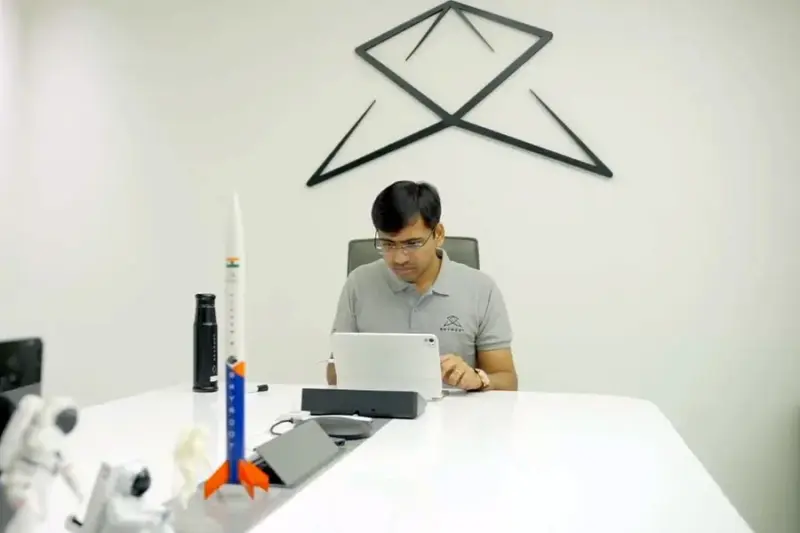

India stands on the threshold of a historic transformation in its space journey as Skyroot Aerospace prepares to move Vikram-1 to the Satish Dhawan Space Centre for its landmark maiden orbital mission.
Founded in 2018 at a time when private spaceflight in India lacked both regulatory clarity and investor confidence, Skyroot has emerged as the country's leading private launch pioneer.
With Vikram-1 positioned as India's first privately developed orbital rocket, the company is not only validating years of indigenous technological innovation but also reshaping India's role in the global commercial space economy.
In this exclusive interaction with Mathrubhumi English, Pawan Kumar Chandana, co-founder and CEO of Skyroot Aerospace, discusses the significance of this mission, the challenges of building a private launch ecosystem from scratch, India's evolving regulatory support, and the company's long-term ambition to become a global force in dedicated satellite launch services.
Vikram-1 is being positioned as India's first privately built orbital rocket, what does this moment mean personally for you and for India's private space sector?
This is a defining milestone, not just for Skyroot, but for India's private space ecosystem. Personally, it is a validation of a belief that you could build private space launch vehicles in India. While the first flight of Vikram-1 will be a developmental flight, it marks a big leap forward for India's private space-tech capabilities.
Orbital launch vehicles represent the foundational infrastructure for the global space market. Whether it be for launching Earth observation satellites, communications satellites, or providing logistical support to space stations, launch vehicles are the foundational layer. With the upcoming flight, we are now making the most meaningful step toward building that.
You founded Skyroot Aerospace in 2018, before there was regulatory clarity, what were the biggest uncertainties you faced in those early days, and how did you navigate them?
When we started in 2018, there was no formal framework for private space companies to operate and launch rockets. There were no venture capital funds with a space thesis in India. But at Skyroot, we had a firm belief that India needed private commercial operators to make a significant impact in the global space market. It was a matter of when, not if. So, we took the leap and began building.
We focused on developing core technologies from propulsion systems to avionics and flight controls, to advanced carbon composite structures and mechanisms. These included many firsts for India's private space sector: the Raman-series liquid engines, Dhawan-series cryogenic engines, and Kalam-series solid stages. This approach helped us establish technical credibility early on.
Then in 2020, India announced the opening of the space sector and subsequently established the Indian National Space Promotion and Authorisation Centre (IN-SPACe), providing a formal framework for private companies to operate, obtain clearances, and access India's existing test facilities and launch sites.
Skyroot was well-positioned to leap forward in this new landscape. In November 2022, we launched Vikram-S, India's first private rocket to reach space. And now we are on the threshold of launching Vikram-1, India's first private orbital launch vehicle.
With Vikram-1 now heading to Satish Dhawan Space Centre, what are the key milestones that remain before launch, and what challenges do you anticipate during the final integration phase?
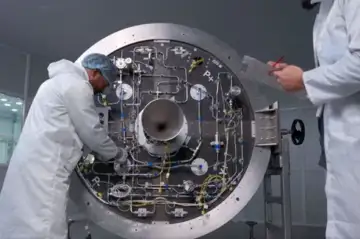
Rockets are a system of systems. Vikram-1 is a multi-stage rocket with three solid fuel stages and an upper stage called the Orbital Adjustment Module, powered by the liquid fuel Raman-2 engine. Then there are the inter-stages that house all the avionics, separation mechanisms, a bevy of flight sensors, and provide the structural rigidity that holds the rocket together.
We have completed flight qualification tests for all stages and integrated inter-stages -- meaning the propulsion systems, avionics, separation mechanisms, and subsystems are all qualified for flight.
Now, as the vehicle moves to the spaceport at Satish Dhawan Space Centre, we begin the final integration and launch campaign. We will be integrating the rocket at the launch site, conducting end-to-end system checks, and running a series of pre-launch readiness checks. This is where all the individual pieces come together as one launch-ready vehicle for the first time.
Skyroot has emphasised building most of its technology in-house, from propulsion systems to 3D-printed engines. How critical has this approach been in maintaining cost, speed, and innovation?
Building in-house has been fundamental to how we operate. It gives us end-to-end control across design, manufacturing, and testing, which directly translates into faster turnaround times, tighter quality control, and significantly lower dependency on external supply chains.
In a domain like launch vehicles, where timelines, precision, and reliability are critical, this level of control is a meaningful advantage.

The global small satellite launch market is becoming increasingly competitive. How does Vikram-1 differentiate itself from established players, and where do you see Skyroot's competitive edge?
The global launch market remains structurally supply-constrained, with very few reliable launch service providers despite rapidly growing demand. To put this in context, over 95% of all satellites launched today are small satellites weighing less than 500 kg. These satellites often need dedicated launches that drop them precisely to their target orbit, on their own timeline.
Also See: NASA opens its powerful simulation tool 'LAVA' to the world | VIDEO
And yet, outside of China, no new small-lift launch vehicle had entered the market since 2022. The gap between satellites ready for orbit and available dedicated launch opportunities continues to widen.
Vikram-1 is designed to address exactly this gap. We operate it as a cab to space - launches aligned to customer timelines rather than fixed schedules, delivering satellites precisely to their destination in orbit.
Combined with our modular architecture that enables rapid integration and turnaround, we can offer satellite operators the flexibility and responsiveness that larger, busier launch vehicles simply cannot.
This launch is being conducted under the authorisation of IN-SPACe with oversight from ISRO. How important has this evolving regulatory ecosystem been in enabling private players like Skyroot?
The close collaboration and support that government agencies provide to private companies is one of the strengths of India's space sector. IN-SPACe has been instrumental in this, formalizing how private companies engage with national infrastructure, authorization processes, and mission oversight. This has introduced clarity and predictability, which are essential for long-term planning in a capital-intensive, high-risk domain like space.
At the same time, ISRO continues to provide a strong technical benchmark and ecosystem foundation, bringing decades of operational expertise in range safety and launch operations that private companies can build on directly. That support is invaluable and gives us the confidence to take this next step.
Looking beyond this mission, what is your long-term vision for Skyroot are you aiming for frequent launch operations, reusable systems, or expansion into other areas of the space economy?
Our immediate focus is establishing flight reliability for Vikram-1 through multiple developmental launches, building toward a reliable and responsive launch cadence that scales up to more frequent missions over the next few years.
Looking ahead, we are developing Vikram-2, which will more than double our payload capacity and open up a wider range of mission profiles for our customers. In the next five years, our goal is to be among the top five dedicated launch service providers for small satellites globally, a market that continues to grow faster than available launch capacity. Reusability is on our long-term roadmap as well. It is the next frontier for cost reduction and launch frequency.
The broader vision, though, remains unchanged: to make access to space faster, more affordable, and more reliable.
Finally, what message would you like to give to young engineers and entrepreneurs in India who are inspired by Skyroot's journey into the space sector?
Space remains one of the most complex and underexplored sectors globally, with a large portion of launch capability still concentrated in a few countries. At the same time, the demand for space-based services is expanding rapidly, creating meaningful opportunities for those willing to take on difficult challenges.
Also Read: 'Tower in the sky' over Vijayawada: Near-Space tech to bridge India's urban-rural digital gap
For engineers and entrepreneurs, the key is to focus on building real capability and solving some of the most complex engineering problems. This is not a space for quick wins, it requires deep technical rigour, resilience, and patience.
What is encouraging today is that the ecosystem in India is far more enabling, with stronger policy support, better access to capital, and a growing talent base.
If you are willing to engage with complexity and stay the course, there is a significant opportunity to build globally competitive companies from India and contribute to shaping the future of the space economy.