
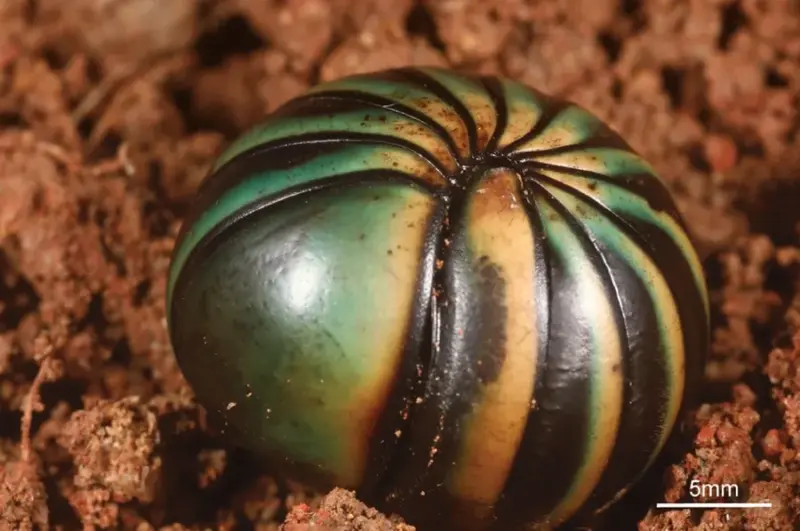

Researchers from Kerala have unveiled a detailed study of the vibrant green pill millipede, Arthrosphaera lutescens, an endemic species found in the Western Ghats.
The findings, published in the prestigious journal Scientific Data, provide a comprehensive map of the creature's complex exoskeleton.
The multi-institutional effort was led by Priyanka Palakkaparambil and Ajaykumar A. P. from Sree Neelakanta Government Sanskrit College in Palakkad, alongside experts from NIT Calicut, the Kerala Forest Research Institute, and other Indian and international centres.
High-tech probe into nature's armour
To understand how these "rollers" survive, the team collected specimens from the moist forest regions of Seetharkundu in Palakkad. They subjected the shells to a battery of sophisticated tests, including Scanning Electron Microscopy (SEM) and Atomic Force Microscopy (AFM), to examine surface features at the nanoscale. They also used Raman spectroscopy and solid-state NMR to identify the chemical building blocks of the shell. By dissecting the dorsal tergites-the hard plates on the millipede's back-they explored how minerals are deposited to create a natural armour that resists bending without becoming too thick.
A biological marvel of the Western Ghats
This forest-dweller is known for its striking olive-green body marked with yellow and black bands. However, its beauty is more than skin-deep. The researchers found that the shell is a complex "biocomposite" made of a chitin-protein matrix strongly reinforced by crystalline, carbonate-based minerals.
One of the most intriguing aspects studied was the shell's hydrophobicity. By placing water droplets on the surface and measuring the contact angle, the team examined how the exoskeleton interacts with moisture. This water-repelling quality is essential for survival in the humid, damp environments of the Western Ghats.
Why this data matters
This study is more than just a biological catalogue; it provides a blueprint for bioinspired surface design. By understanding how nature creates surfaces that are tough, flexible, and water-repellent, scientists can look for ways to develop new lightweight materials. The dataset is now openly available, allowing researchers worldwide to compare this species with other arthropods and explore new frontiers in materials science, evolutionary biology, and environmental research.