




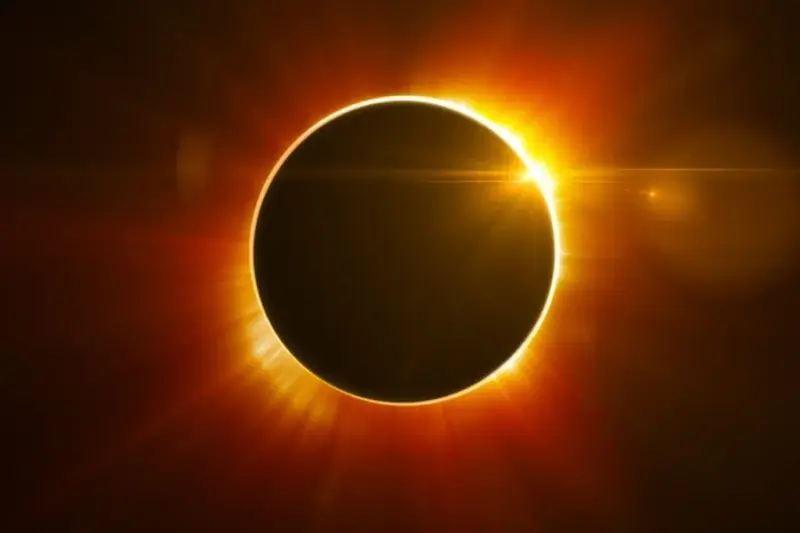

Skywatchers across parts of the Southern Hemisphere are set to witness a striking celestial display in February 2026, when an annular solar eclipse creates the much-anticipated "Ring of Fire" effect.
During this event, the Moon passes in front of the Sun without fully covering it, leaving a bright circular ring visible in the sky.
Solar eclipses occur when the Moon moves between the Earth and the Sun, blocking sunlight either partially or entirely. This alignment is possible because the Moon's orbit is angled in relation to Earth's path around the Sun. In the February 2026 eclipse, the Moon will appear slightly smaller than the Sun, producing a glowing rim rather than complete darkness.
Solar Eclipse February 2026: Date, time and key details
The annular solar eclipse will occur on Tuesday, February 17, 2026. The peak phase will last for up to 2 minutes and 20 seconds, beginning at 12:11 UT, which translates to around 5:30 PM IST. Due to this timing, the event will not be visible from India, as the Sun will be below the horizon.
Solar Eclipse February 2026: Cities where the eclipse will be visible
The annular phase will be visible over Antarctica, with partial visibility across surrounding regions. The eclipse path will stretch across the southern Indian Ocean, pass close to Antarctica's coastline near the Ronne Ice Shelf, and conclude over the southern Atlantic Ocean. Observers in parts of southern Africa may catch a partial view, including cities such as Cape Town, Johannesburg, Durban, Windhoek, and Gaborone.
How to watch the solar eclipse February 2026 safely
Viewing a solar eclipse requires proper eye protection. Certified ISO 12312-2 solar viewing glasses or approved handheld solar viewers should be used at all times. Those without specialised equipment can opt for indirect methods, such as a pinhole projector, to observe the event safely. Regular sunglasses, cameras, binoculars, or telescopes must not be used, as looking at the Sun without protection can cause permanent eye damage.