
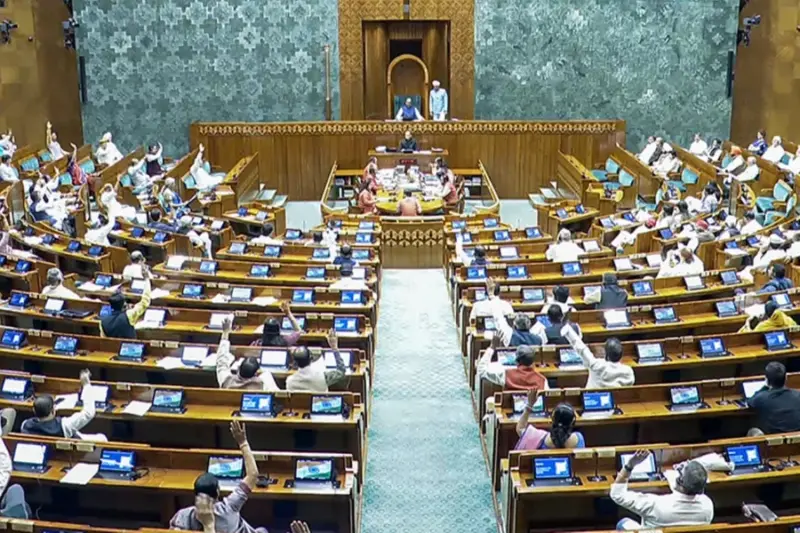

Parliament's special sitting begins today (April 16, Thursday), setting the stage for a high-impact debate on three crucial bills that could shape India's political future.
At the centre of the agenda are proposals to implement women's reservation in the Lok Sabha, redraw constituencies across the country, and amend laws governing Union Territories.
The government is set to introduce the Constitution (One Hundred and Thirty-First Amendment) Bill, 2026, the Delimitation Bill, 2026, and the Union Territories Laws (Amendment) Bill, 2026. Together, these bills aim to operationalise the long-pending women's reservation while simultaneously restructuring how parliamentary and assembly constituencies are defined.
The Women's Reservation Amendment: What it seeks to do
The Constitution amendment bill is designed to implement the Nari Shakti Vandan Adhiniyam, which provides for 33% reservation for women in the Lok Sabha and state assemblies. The government plans to roll this out from the 2029 general elections, using the 2011 Census as the basis.
Prime Minister Narendra Modi has called for unanimous support, stating, "This is the wish of every sister and daughter of this country, and we must fulfil it with unanimity."
The move is being positioned as a landmark step toward improving women's representation in Indian politics, an issue that has seen decades of delay despite broad political agreement.
The Delimitation Bill: Redrawing India's political map
Alongside women's reservation, the government will push the Delimitation Bill, which proposes a comprehensive redrawing of constituencies and a reallocation of seats across states and Union Territories.
One of the most important aspects is the possibility of increasing the Lok Sabha's strength from 543 to up to 850 seats. The exercise will determine:
- How many seats each state gets
- How constituencies are geographically divided
- Representation in both Parliament and state assemblies
This is intended to reflect population changes and ensure proportional representation, but it has also become the most contentious part of today's agenda.
Union Territories Laws (Amendment) Bill: What it covers
The third bill to be introduced deals with laws governing Union Territories, particularly those with legislative assemblies. While it has received less public attention, it is part of the broader restructuring exercise tied to representation and governance.
What the Opposition is saying
Even before the debate begins, opposition parties have made their stance clear: they support women's reservation, but strongly oppose the way it is being linked to delimitation.
Leaders across parties have reiterated that they are in favour of reserving seats for women. Mallikarjun Kharge said, "We are all in favour of the Women's Reservation Bill, but the way in which they have brought it, we have got reservations."
The opposition wants the quota implemented without delay and without being tied to delimitation, arguing that there is enough time to roll it out before 2029 within the current framework.
The sharper criticism is directed at the Delimitation Bill. Opposition leaders fear that the exercise could alter the balance of political power between states, particularly disadvantaging regions with lower population growth.
Jairam Ramesh called the proposal "dangerous," while Rahul Gandhi alleged, "One of the BJP's dangerous plans is to 'gerrymander' all Lok Sabha seats to its advantage for the 2029 elections."
Concerns also extend to the process itself, with allegations that the government may gain excessive control over the Delimitation Commission, raising questions about neutrality and transparency.
Several opposition leaders have warned that the proposed changes could weaken India's federal balance. There are fears that southern, northeastern, and smaller states could see their relative representation shrink, even if absolute seat numbers increase.
They are also demanding that clear guidelines and broader consultations be part of any delimitation exercise to ensure fairness across regions and communities.
With ANI inputs