
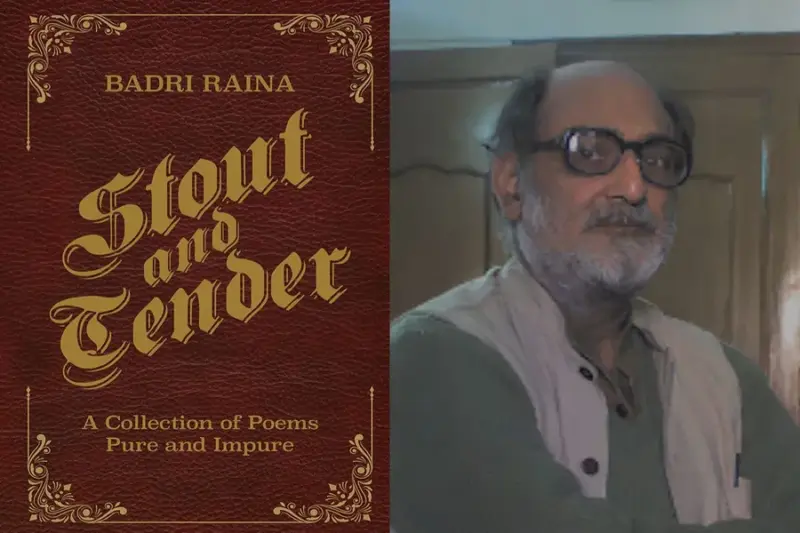

In the vast, often self-indulgent landscape of contemporary poetry, Badri Raina's "Stout and Tender" arrives like a sharp intake of breath on a cold morning.
It is a substantial collection - his third and largest anthology-that refuses the easy comfort of "pure" aesthetics. Instead, Raina, an academic-turned-poet with the heart of a journalist and the soul of a philosopher, offers a work that is as much a moral compass as it is a literary achievement.
To read "Stout and Tender" is to encounter a mind that is deeply, almost painfully, awake. Raina does not merely observe; he engages. He takes the "stout" realities of our era - the brutalities, the ironies, and the slow erosion of humanism - and meets them with a "tender" insistence on empathy.
The poem "Pure Poet" serves as the central manifesto for the collection, highlighting Raina's commitment to social remedy over abstract art. One of the most striking aspects of this collection is Raina's rejection of the "ivory tower" poet. In this poem, the "Pure Poet" addresses the criticism that he is too concerned with the world's failings, rather than the abstract beauty of verse. His response is a manifesto for the socially conscious writer:
"But when I see a shattered bone,
Or famine in the eye,
I would much less a poet be,
More a remedy."
This verse sets the tone for the entire volume. Raina is "askance" at any empathy that remains at a distance. He compares a pure thought that doesn't lead to action to a "vase of filigree fine, / With no flowers in it." It is this desire to be "the flowers"-the living, breathing evidence of concern-that drives the collection.
Raina's wit is perhaps at its most "assuming" when he turns his gaze toward the modern Indian middle class. In his "Hippopotamus" series, he uses a rhythmic, almost nursery-rhyme cadence to deliver stinging critiques of societal apathy. He describes a class that "ogles at the fop in front, / and quarantines its rear," a group more concerned with "Pentium perfection" and "Philips underwear" than the crumbling democracy outside their windows.
There is a light, satirical touch here that makes the "stout" truth easier to swallow, yet the landing is always heavy. He writes of the middle class:
"It simply cannot understand
Why people live in the nation."
It is a devastating line, a commentary on the disconnect between the affluent and the "people" who actually constitute the country's backbone. Through these verses, Raina captures the "viscerality" of a culture that drowns its grouses in whiskey at farm-house weddings while its parents lie in ICUs, comforted only by "Archies Cards."
Raina does not shy away from the most contentious issues of our time, particularly the shifting landscape of Kashmir. Raina is himself a former captain of the Jammu & Kashmir Ranji Trophy team, which, decades after his time, has won the trophy this year. But his concerns are with less joyous matters. In his poem "Normalcy," he adopts a chillingly calm tone to describe the aftermath of political upheaval. The poem is a masterclass in irony, where the "stout" hand of the state is felt in every line:
"The trust of the people will be won
Through propagation.
And, if that does not work,
Through the pellet gun."
The "tender" element here is found in the heartbreak behind the irony. He notes that while landlines may be up and schools open, "no normalcy can be lasting / Without an element of fear." It is a sobering reminder that the "nation" often abides at the expense of its "people".
Perhaps the most haunting poem in the collection is "Good Samaritan." It recontextualizes the biblical parable within the "stout" brutality of contemporary mob violence. Raina describes a scene where bystanders prioritize the "purity" of their cause over the life of a dying man:
"They made sure the cows were home
While his lungs spouted blood;
They made sure their tea was warm,
While he waited to be dead."
The juxtaposition of the mundane (warm tea, bringing cows home) with the horrific (spouting blood) is profoundly effective. It captures the "stabbing death of humanism" that Raina laments throughout the book. He identifies these actors not as monsters, but as people who believe they are "serving a primal rage" to usher in a "pure spiritual age."
Despite the heavy themes, my review of this book must remain "warm" because Raina's underlying motive is one of deep love. He is a poet who believes that the world can be set aright, even if he is "accused of penchant" for trying. His verses are "stout" because they are unyielding in their pursuit of truth, but they are "tender" because they never lose sight of the individual - the child whose toys are destroyed, the parent in the ICU, the "wasted corpse" that is brought back to life by the persistent memory of injustice.
The collection is a relentless map that leads the reader from "perfidy to perfidy," yet it also offers the balm of recognition. In a world of vacuous content, Raina provides nuance, complexity, and a necessary, critical grammar.
"Stout and Tender" is not just a book to be read; it is a book to be used as a mirror. It asks us where we stand: with the "predators of the realm" or with those who would "much less a poet be, / More a remedy." It is a vital, stirring addition to the canon of Indian English poetry, proving that the most effective verses are those that refuse to look away.
and intellectually dense. His use of language is deceptively simple-often employing rhyme and meter that mimic traditional forms-only to subvert them with "polemicist" energy. The type quality of his verse is "stolid" yet fluid, moving from the satirical "Hippopotamus" rhythms to the stark, unadorned truth of a "wasted corpse."
A Final Thought
Stout and Tender is a relentless map of our times. It is a work that insists on being a "remedy" rather than just a "vase of filigree fine." In an age of "Philips underwear" and "Pentium perfection," Raina reminds us that the only thing truly worth spinning is the yarn of our shared humanity.
Here, Raina's empathy is more palpable than in his verses on the "Indian girl child." He captures the specific "stabbing death of humanism" that occurs when society ignores its most vulnerable, viewing her not as a "success in the soul" but as a burden. His language here is "youthfully acerbic," stripping away the polite euphemisms of development to reveal a "skeletal palm" waiting for balm.
The collection also features a significant section dedicated to Kashmir, the backdrop of his childhood. Raina's writing on the region is a "noble tryst in tatters," where the beauty of Srinagar is overlaid with the "stout" reality of the "pellet gun." He navigates this terrain with a unique authority, blending the nostalgia of a lost home with a fierce critique of the "normalcy" imposed through force.