




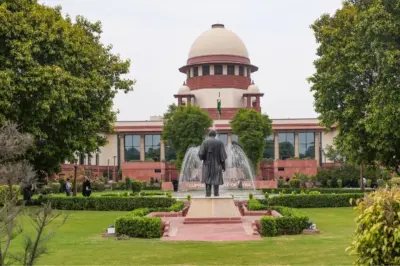

New Delhi: The Supreme Court of India ruled on Tuesday that individuals who profess a religion other than Hinduism, Sikhism, or Buddhism cannot be classified as members of a Scheduled Caste (SC), affirming that such status is forfeited immediately upon conversion.
A bench comprising Justices Prashant Kumar Mishra and N.V. Anjaria upheld a prior decision by the Andhra Pradesh High Court. The justices declared that the legal bar against claiming SC status after converting to faiths like Christianity or Islam is "absolute and admits no exception."
"No statutory benefit, protection or reservation or entitlement under the Constitution or enactment of Parliament or state legislature can be claimed by or extended to any person who, by operation of clause 3, is not deemed to be a member of the Scheduled Caste," the bench stated. "A person can't simultaneously profess and practice a religion other than the one specified in clause 3 and claim membership of the Scheduled Caste."
The High Court Precedent
The ruling follows an April 30, 2025, judgment by the Andhra Pradesh High Court, which determined that the caste system is fundamentally "alien to Christianity." Consequently, the court found that Christian converts are prohibited from invoking the Scheduled Castes and the Scheduled Tribes (Prevention of Atrocities) Act.
That decision effectively quashed criminal charges filed by a complainant who had converted to Christianity but sought protection under the anti-atrocity law. The individual, identified as a pastor named Chinthada Anand, subsequently challenged the high court's findings in the apex court.
Facts of the Case
The Supreme Court noted that the Constitution (Scheduled Caste) Order, 1950, is explicit: conversion to a non-specified religion results in the immediate loss of SC status, regardless of an individual's birth.
In the case of the appellant, the court found substantial evidence that he had functioned as a pastor for over a decade. "On the contrary, the evidence establishes that the appellant continued to profess Christianity and has been functioning as a pastor for more than a decade, conducting regular Sunday prayers at the houses of the village," the court observed.
The bench added that there was no evidence the petitioner had reconverted to his original faith or been re-accepted into the Madiga community. "These concurrent facts leave no room for doubt that he continued to remain a Christian on the date of the occurrence," the justices noted.
Background of the Dispute
The legal battle originated from a 2021 criminal complaint filed by Anand against an individual named Akkala Rami Reddy. Anand alleged that while he was performing pastoral duties and leading Sunday prayers in an Andhra Pradesh village, he was assaulted and subjected to death threats.
He further claimed that he and his family were targets of caste-based abuse. However, the courts have now determined that his status as a practising Christian pastor precludes him from seeking the specific legal remedies reserved for members of the Scheduled Castes.
With inputs from PTI