




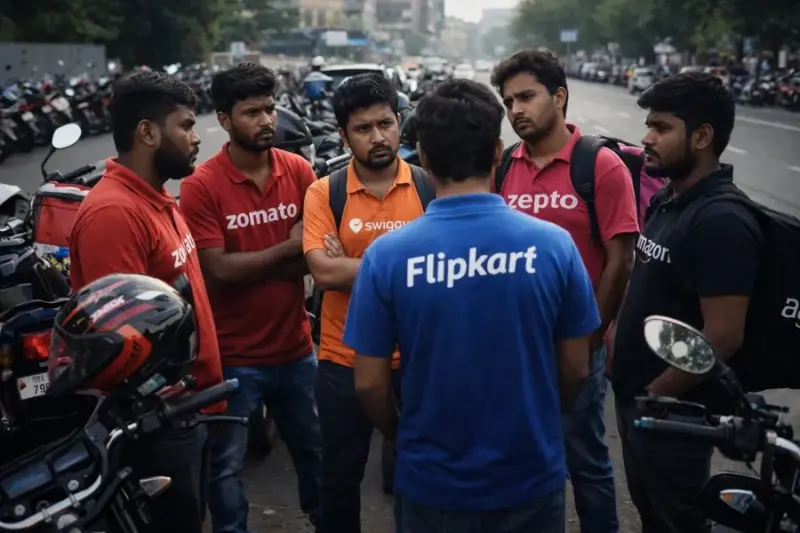

Thousands of app-based delivery and transport workers logged off their platforms on Saturday, after the Gig & Platform Service Workers Union (GIPSWU) called for a five-hour nationwide shutdown of services to protest rising fuel costs and stagnant payouts.
In a statement issued ahead of the protest, the union urged gig and platform workers to switch off their apps between 12 pm and 5 pm, affecting food delivery, ride-hailing, e-commerce logistics and other app-based services across major cities.
The union is demanding that the government and digital platforms fix a minimum service rate of ₹20 per kilometre for delivery and transport work to offset the spike in operational expenses.
GIPSWU estimates that around 1.2 crore gig and platform workers nationwide could be directly impacted by the recent increase in fuel prices, which they say has sharply eroded take-home earnings for workers who rely on motorcycles and scooters and often drive long hours in harsh weather.
First major fuel hike in four years
Oil marketing companies (OMCs) raised petrol and diesel prices by about ₹3 per litre this week, marking the first major nationwide retail fuel hike in nearly four years.
Petrol in Delhi now costs around ₹97.77 per litre, while diesel is priced near ₹90.67, with similar revisions in Mumbai, Kolkata, Bengaluru and Chennai. The hike comes amid elevated global crude prices and instability in international energy markets linked to the ongoing conflict in West Asia.
GIPSWU President Seema Singh said the fuel hike, coupled with higher LPG cylinder prices and rising living costs, has "intensified financial pressure on workers who were already operating on razor-thin margins". She warned that many gig workers could be forced to quit the sector if per-kilometre rates and delivery payouts are not revised in line with escalating expenses.
"The platforms keep pushing more orders and tighter timelines, but our per-km rates and incentives have barely moved," Singh said, calling the shutdown a "warning shot" to both the government and aggregators.
Swiggy, Zomato workers among most exposed
The union said workers attached to platforms such as Swiggy, Zomato, Blinkit and other quick-commerce and ride-hailing apps are especially vulnerable, as their income depends heavily on per-order and per-kilometre payouts while they bear all fuel, vehicle maintenance and insurance costs.
Many delivery partners already work 10-12 hour days to meet weekly earning targets and platform incentives, workers' groups argue, leaving little cushion when fuel prices jump.
The union also flagged concerns over algorithms that penalise workers for rejecting long-distance orders with low payouts, effectively forcing them to absorb the higher fuel costs.
Part of a broader wave of gig worker unrest
Saturday's shutdown follows a series of protests and flash strikes by gig workers over pay, safety and social security. In December 2025, delivery and quick-commerce workers staged nationwide actions demanding the removal of ultra-fast 10-minute delivery promises and restoration of earlier payout structures, arguing that unrealistic timelines put both workers and road users at risk.
Those protests, organised under federations such as the Indian Federation of App-Based Transport Workers (IFAT), saw thousands of workers log off on key festive and year-end shopping days, disrupting as much as 50-60 per cent of orders in some cities.
While platforms tweaked some incentives, unions say core demands -- such as minimum per-delivery or per-kilometre wages and legally enforceable social security -- remain unmet.
Call for regulatory intervention
GIPSWU has urged the Union and state governments to recognise app-based workers as a distinct category under labour and social security laws and to mandate a transparent, inflation-linked minimum service rate across platforms.
The union argues that without regulatory intervention, price shocks such as the current fuel hike are simply passed on to individual workers, while platforms maintain or expand their commissions.
Labour economists say the latest shutdown highlights the fragility of India's rapidly growing gig economy, which has become central to urban consumption but remains largely outside traditional wage and welfare protections.
With fuel prices rising and competition among platforms intensifying, pressure is building on policymakers to move beyond advisory codes and consider binding standards on gig work compensation.
For consumers, the immediate impact of Saturday's action may be delayed orders or unavailable services during the five-hour window. For millions of gig workers, union leaders say, it is about "whether app-based work remains viable at all" in the face of mounting costs.