
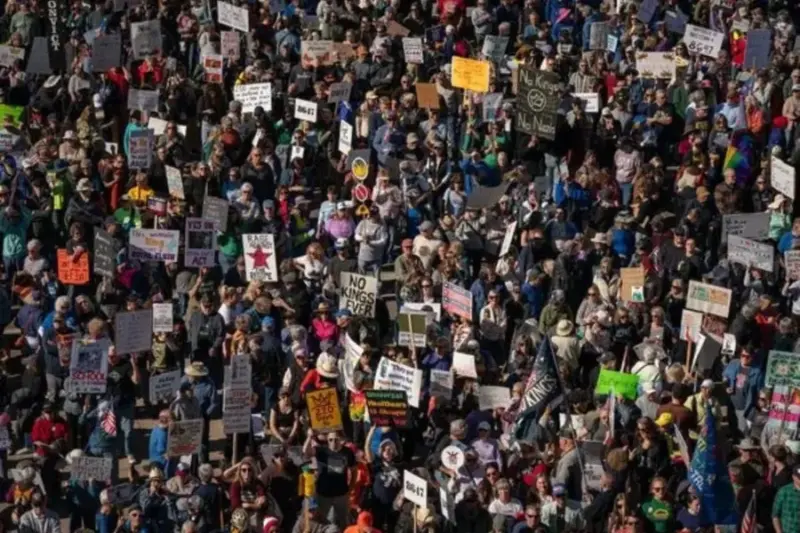

On March 28, 2026, something profound awakened in the heart of the United States. Across all 50 states, more than 3,200 massive rallies erupted in what organisers and protesters alike hailed as one of the largest mobilisations in American history.
From New York and Los Angeles to quiet cities, ordinary citizens poured into the streets under the banner of "No Kings". In Minnesota flagship, estimates claimed the numbers surpassed previous records and approached three lakhs.1
These rallies were not mere protests: they represented a collective awakening against the bloodthirsty and destructive policies of a state, which is now dominated by mad rulers. For too long, critics argue, US Foreign and domestic policies marked by endless wars, aggressive deportations - economic exploitations, and a disregard for human life - have crossed global stability and American democracy itself. Only the American people possess the power to end this cycle.
From past protests to the "No Kings" movement
To understand the significance of March 28, one must trace the lineage of American dissent. The US had witnessed mass uprisings of the slaves and natives to the civil rights marchers of the 1960s and anti - Vietnam war rallies. In recent decades, however, protests have often been fragmented - occupy wall street in 2011, Black lives Matter in 2020, and scattered anti-terrorist actions post 9/11. What distinguishes the "No Kings" series is its scale, coordination and explicit framing as a rejection of monarchical power in a republic. The movement began in June 2025 with roughly 4-6 million people across 2,100 cities, followed by a second wave in October 2025 that drew about 7 million.2
By March 2026, the third wave had swelled to over 3,200 events, where organisers estimates 8-9 million people protested in the streets.3
Leading media outlets, from Reuters to the Associated Press, framed these rallies as backlash against Trump's second term agenda. Key grievances included the US - backed war in Iran launched around late February 2026, which has already claimed civilian lives, US service members, and driven up global energy prices. Domestically, operation Metro Surge - an aggressive Immigration and customs enforcement (ICE) campaign involving thousands of police personnel. In Minnesota, this operation led to the deaths of American citizens - Renee Good and Alex Pretti - shot by police during enforcement actions, galvanizing local protests.4 These incidents, widely reported yet often downplayed in official channels, fueled accusations of authoritarian overreach and a "destruction of humanity" through militarised domestic policy. Protesters in the rallies pointed to a pattern: endless military entanglements abroad (Iraq, Afganistan, Palestine, now Iran) that bleed treasure and lives, coupled with these policies that support oligarchic economic interests over the working class. As one Reuters interviewee in Los Angles stated, "All Trump is Doing is making Himself Wealty, while taking away regular Americans"5.
This sentiment resonates with broader data on inequality, where wealth concentration has reached Gilded Age Level amid rising costs of living. (The Gilded Age (1865 - 1914) was a transformative period in the US economy marked by rapid insutrialisaiton, urbanisation, technological innovation (rail roads - steel, oil, electricity and the rise of powerful industrialists, often called "robber barons". The term "Gildaded Age" coined by Mark Twain and Charles Dudley Warner in their novel titled The Gilded Age: A Tale of Today. The term refers to the thin "gilding" of prosperity that masked deep social problems; extreme wealth inequality, political corruption, labour exploitation, poverty, immigration tensions and urban slums. "Gilded Age Levels" refers to the stark social and economic stratification of the era, with a tiny elite at the top, and the vast majority at the bottom)
The spectacle of March 28
The sheer logistics of March 28 defy easy dismissal. Organisers from groups like Indivisible coordinated more than 3,200 events. A 40% increase in smaller communities compared to previous rounds. Protests spanned urban centres and rural heartlands with two thirds occurring outside major cities. This geographic breadth signals a national awakening, not confined to 'coastal cities'; clashes were minimal but notable. Counter protests in Dallas (including former proud Boys leader Enrique Tarrio) and arrests with tear gas in Los Angels highlighted tensions yet the vast majority remained peaceful.6
Minnesota's rally stood out as a flagship, chosen for its history of defiance during Operation Metro surge. Estimates varied: Minnesota state Petrol reported around 1,00,000 while organisers and local media like Minnesota Reformer cited 2,00,000. When factoring in satellite marches from St Paul College, Harriet Island, and Western sculpture park, streets clogged miles and buses overflowed. The atmosphere was electric yet solemn, with homemade signs honouring the fallen ("No Kings", No. ICE, No War") and chants rejecting authoritarianism.7
Cultural icons amplified the message. Bruce Springsteen debuted "Streets of Minnesota", a raw protest ballad, lamenting the bloody mist" of ICE actions. "Here in our home they killed and roamed / In the winter of "26". Joan Baez, Maggie Rogers and Tom Morello joined for Bob Dylan's "The times they are A-changin" and civil rights anthems. Governor Tim walz in flannel declared "radicalised by compassion, decency and due process democracy" and vowed resistance to "Wannabe dictator" tactics. Senator Barnie Sanders warned, "we will not allow this country to descend into authoritarianism or oligarchy. We, the people, will rule". Representative Ilhan Omar declared Minnesota "built different'8. These were not abstract grievances. The Iran war, framed by some as unnecessary escalation risking wider conflict - drew explicit condemnation. Protesters like Morgan Taylor in Washington said, "Nobody is attacking us… We don't need to be there"9 .
Domestically, ICE's "unrestrained aggressive thugs" symbolised a broader erosion of rights, from due process for immigrants to free speech for citizens. Leading reports including CNN and the Washington Post, noted the rallies's focus on "trampling democracy", with signs decrying fascism greed, and war profiteering. 10
Underlying causes
The Iran conflicts, barely a month old by March 28, had already produced civilian casualities, US troop losses, and economic fallout (spiking gas prices). Reports linked it to broader Middle East Strategy involving Israel, with protesters denouncing US complicity in regional instability. Immigration enforcement meanwhile morphed from policy to spectacle: thousands of federal agents in Minnesota alone sparked unrest, including fatal shooting that organisers call "state terrorism"11
Economically Trump's actions - deregulation favouring the wealthy, attacks on labour rights - exacerbated inequality.12 Theressa Gunnell, a Los Angels protester summarised it: "it is important for everybody to make a stand against authoritiarianism, fascism and greed'; Chris Brendel in Dallas credited Trump ironically with, "mobilising the dissenters" for his children's future".13 These voices show that American people, long complacent, are finally rejecting the rulers who prioritise power and wealth over humanity.
Skeptics in mafia reports (mainstream outlets) sometimes portrayed protesters as "far-left" or fringe, citing Republican spokespeople who labeled events "Hate American Rallies". Yet even critical coverage acknowledged the movement's breadth, including suburban participation, polling dips and midterm anxieties underscored real public discontent. Historians cited in coverage drew parallels to the 1960s or even pre-revolutionary eras, warning of a republic's fragility when governors ignore the governed. 14
Organisers like Indivisible's Leah Greenberg highlighted surges in Republcan strongholds, suggesting a potential realingment ahead of midterms.15 Intentionally, the protests signaled to allies and adversaries that US Policies, domestic pushback, potentially constrain escalations in Iraq or elsewhere. As Bernie Sanders noted, Minnesota's resistance to ICE" deserves a special chapter in history books for courage against occupation.16
Yet this invocation of revolutionary heritage invites deeper scrunity, while the "No kings" rallies chant anti authoritarian, anti-war, anti-tyranny slogans. The American State and significant sections of the White American Society have long carried a deeply conservative and racist psyche.
To understand the rallies's limitations, one must revisit the "American Revolution" not as a pure grand act of emancipation but as what historican Gerald Horne terms "the counter - revolution of 1776" Horme's Seminal work The counter Revolution of 1776: slave Resistance and the origins of the United States of America argues that colonial dites declared independence partly to safeguard their right to enslave Africans and to displace indigenous peoples without British interference.17
By the 1770s, London was shifting toward abolitionist policies exemplified by the somerset case (1772), which limited slavery in England and arming enslaved people against rebellious planters during the war.18 The Declaration of independence's grievances against king George III notably omitted any critique of slavery; instead it accused the crown of inciting "domestic insurrections" (i.e., slave revolts) and alliances with "merciless Indian Savages" Far from a universal liberty, 1776 preserved a racial hierarchy, while colonialists retained control over chattel slavery and westward expansion, while Black and indigenous populations faced intensified oppression. As Horne documents, enslaved Africans often sided with the British, viewing them as a lesser evil than colonial masters.
This central revolutionary foundation embedded a deep conservatism into the American Polity. Unlike the French or Haitian revolutions, which explicitly challenged class and racial orders, the US founding mythologised elite rebellion as universal freedom while codifying slavery in the constitution (eg The Three fifths compromise). The Three -Fifths compromise (also called the Three fifths clause) was an agreement reached at the 1778 US constitutional convention between delegates from Northern and Southern states. At the Convention, a major dispute arose over representation. Southern states, based on slavery wanted to count their entire enslaved population fully to gain seats in the House of representatives (and thus more political power in congress and the Electoral college) Northern states, with far freer enslaved peoples, opposed this arguing that enslaved individuals had no rights, could not vote and should not boost southern influence. The compromise stated that southern states could count three - fifths (60%) of their enslaved population for representation and taxation purposes. This gave slaveholding states significantly more congressional seats and electoral votes than if only free persons were counted - without granting any rights or freedom to the enslaved peoples themselves.
Today, "No King" protesters invoke revolutionary rhetoric (No King, NOICE, No War) yet their demands. Policy tweaks - echo Misinherited limitation. Minnesota's rally, while massive, celebrated "compassion" and "due process" within the existing republic, not its dismantling without confronting this counter - revolutionary foundation, the movement risks replicating the very structures it protests.
The mindset is firmly rooted in the nation's founding, which represented a revolution rather than a genuine revolution committed to universal human equality and freedom. The declaration which proclaimed that "all men are created equal", was signed by 56 white men, 41 of whom were slave holders. For the signers, it appears that Black and indigenous peoples were not "fully human", to be entitled to the equality they rhetorically espoused. This constitutes a profound yet carefully camouflaged betrayal at the heart of American Independence. For the millions of enslaved Africans and Indigenous nations, the Declaration was not a charter of liberty, but rather an inhuman act that legalised the continuation of chatted slavery and facilitated the systematic genocide and dispossession of Native Peoples.
Equally constraining is the entrenched influence of the pro-Israel zionistlobbying groups within the American military industrial financial complex, a factor high lightened by many protesters amid the Iran conflict. Organisations like the American Israel Public Affairs Committee (AIPAC) have long shaped US Middle East Policy through Campaign Contributions, legislative advocacy, and bipartisan alliances. In fiscal year 2026, congress authorised over $500 million in missile - defense cooperation alone, part of the longstanding $3.8 billion annual aid package that funnels taxpayer dollars back to US defence contractors (eg Raytheon, Lockheed Martin) Critics at the rallies, decrying the Iran escalations, point to this nexus as fuel blood thirsty interventions - AIPAc - backed provisions in the National Defense Authorisation Act prioritise US - Israel integration, even as the war drives up domestic gas prices and risks wider conflict. The resignation of a senior intelligence official in March 2026 underscored perceived external pressures on war decisions, though mainstream analyses frame it as standard lobbying rather than zionist control. Still, the dynamic illustrates how foreign - policy lobbies intersect with profit driven militarism, limiting presidential or congressional independence. Protesters in Los Angeles and Washington chanted against endless wars, yet without addressing this structural grip, rallies may fail to alter the Iran trajectory or broader entanglements.
Finally, the weakness of the left forces undermines sustained impact. Unlike the right's disciplined networks (think tanks, media ecosystems, grass root PACs), the American left remains fragmented - divided by identity politics, reformist NGOs and electoral pragmatism. Indivisible and allied groups coordinated the "No kings" events effectively, yet broader leftist infrastructure lacked revolutionary cohesion. Democratic socialists of America and progressive groups influence discourse but rarely challenge the Democratic party's shameful complicity in militarism or corporate power. Media "mafia" outlets often marginalise radical voices, framing protests as emotional outbursts rather than systemic critiques. Historical precedents abound: the 1960s New Left fractured over Vietnam and civil rights. The Occupy Wall Street movement dissipated without institutional gains. Today, despite 8-9 million marchers, polling shows limited midterm shifts, and counter - protesters (including proud Boys remnants) highlight right - wing resilience. Sander's call for "people power" resonate, but absent unified strategy - perhaps a mass labour party or sustained general strikes - the left's energy dissipates into symbolic weekends.19
In conclusion, the March 28 rallies signal public discontent but confront an America forged in counter revolution, beholden to powerful lobbies, and hobbled by a divided left. Only by reckoning with these truths - beyond chants and spectacles - can the people truly end mad rulers' policies. The awakening is real; its revolutionary potential remains unproven.
References
1.Tim Reid and Brad Brooks, Anti-Trump "No Kings" rallies pop up in thousands of US cities, March 28, 2026, Reuters.
2.Alyssa Chen and Michille Griffith, "Flagship: No kings protest draws tens of thousands to St Paul, March 28, 2026. Minnesota Reformer.
3.Tim Reich and Brad Brooks, ibid.
4.KVAL News Staff, "No kings" draw estimated 8 million in the largest single day US non violent protest, March 28, 2026.
5.Alyssa and Michille Griffith, ibid.
6.Tim Reid and Brad Brooks, ibid.
7.Tim Reid, ibid.
8.Alyssa Chen and Michelle Griffith, ibid.
9.Alyssa Chen and Michille Griffith, ibid.
10.Tim Reid and Brad Brooks, ibid.
11.Washington Post, March 28, 2026
12.Alyssa Chen and Michille Gretteth ibid.
13.Tim Reid and Brad Brooks, ibid.
14.Tim Reid, ibid.
15.Alyssa Chen, ibid.
16.Tim Reid… ibid
17.Alyssa Chen, ibid.
18.Gerald Horne, The counter Revolution of 1776, Slave Resistance and the origins of the United States of America (New York: New York University Press, 2014)
19.Gerald Horne, ibid. Ch. 9, pp. 184-209
20.Lex Mc Menamin, Fabiola Cineas, Rachel Leingang and Amy Qin, "Third No king Protests draw 8 million worldwide to push back on Trump administration" (The Guardian, 29 Mar. 2026).