

The United States produces more oil than any other country in the world. President Trump constantly talks about it - "Take the oil.
Keep the oil. Drill, baby, drill." But here's something puzzling: if America has so much oil, why is Trump interested in getting more from places like Venezuela? The answer lies in understanding that not all oil is the same.
The Chocolate Analogy
Think of oil like chocolate. You have dark chocolate, milk chocolate, and white chocolate. They all look different, taste different, and feel different, but they're all chocolate. Crude oil works the same way. Depending on how thick it is, how much sulfur it contains, and how easily it flows, oil gets classified from "light sweet crude" at one end to "heavy sour crude" at the other. There are actually over 160 different varieties of crude oil in the world, reports BBC.
Why Different Types Matter
Light crude oil is easier to refine. Once processed, it becomes gasoline for your car and jet fuel for airplanes. Heavy crude oil is thicker and harder to refine, but it's used for ship fuel, road asphalt, and even lip balm. Because light crude is easier to work with and makes more valuable products, it costs more money than heavy crude.
America's Oil Puzzle
Here's where it gets interesting. In 2025, the United States sold 13.4 million barrels of oil every single day. But at the same time, it bought nearly two million barrels daily from other countries. Why would America sell oil and buy oil at the same time?
The answer is simple: America produces the wrong type of oil for its refineries. About 80% of American oil is light crude, but most of the oil refineries along the Gulf Coast were built to process heavy crude. These refineries were constructed decades ago when America was importing heavy oil from Latin America and Canada. Once you build a refinery for heavy oil, changing it to process light oil requires millions of dollars and isn't practical.
The Smart Business Move
Actually, this mismatch works in America's favor financially. The country sells its light crude at higher prices and buys heavy crude at lower prices. It's just good business sense.
Enter Venezuela
Look at the countries with the biggest oil reserves in the world. Many of them, including Venezuela, Iran, and Russia, have heavy crude oil. Three of these countries are under US sanctions, but Venezuela's relationship with America goes back over a century.
When Venezuela discovered oil, American companies helped build their oil industry. This partnership worked well throughout most of the 1900s. Even when Venezuela nationalized its oil industry in 1976, taking it under government control, relations remained positive.
The Breakdown
Everything changed in 1999 when Hugo Chavez became president. He tightened government control over oil and imposed tough conditions on foreign oil companies. The US government and American oil companies didn't like this. When Chavez died in 2013, Nicolas Maduro continued these policies.
In 2019, a World Bank tribunal ordered Venezuela to pay compensation to US oil companies, but Venezuela never paid. This is what President Trump means when he says Venezuela "stole" American oil rights. Trump claims, "They took our oil rights. We had a lot of oil there. They threw our companies out, and we want it back." Venezuela denies these accusations.
Recent Developments
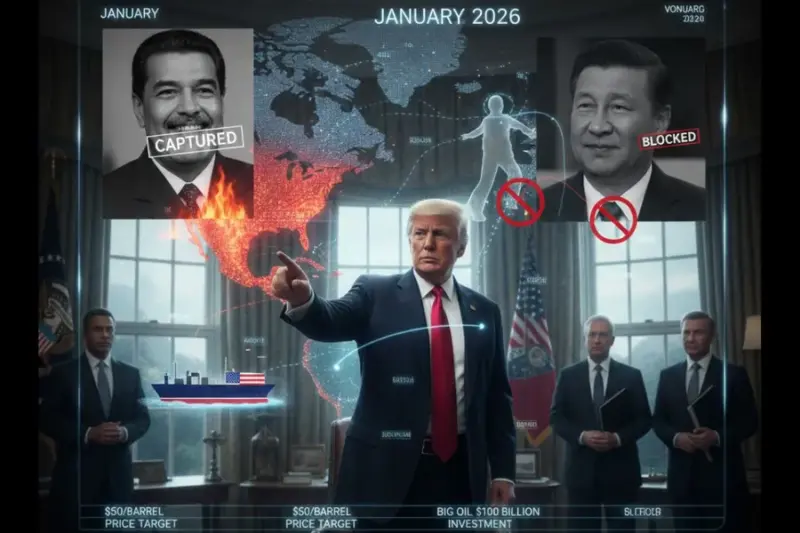
Things escalated dramatically at the end of 2025. The US military seized oil tankers and blockaded Venezuelan ports, citing narco-terrorism concerns. On January 3rd, American troops captured Nicolas Maduro and his wife, bringing them to the United States to face drug charges.
Following this intervention, Trump outlined his vision: "We'll have the greatest oil companies in the world go in and invest billions and billions of dollars and take out money, use that money in Venezuela, and the biggest beneficiary are gonna be the people of Venezuela."
The China Factor
There's another reason why Trump wants influence in Venezuela. Over the past decade, US sanctions created a vacuum that China filled. China now buys around 90% of Venezuela's oil and has become a major trading partner throughout South America, purchasing oil, copper, and soybeans. The Trump administration wants to stop this Chinese influence. As Trump said, "We wanna be surrounded by countries that aren't housing all of our enemies."
The Reality Check
Even with American interest, Venezuelan oil won't flow quickly. Despite having the world's largest known reserves - around 303 billion barrels - Venezuela currently exports less than one million barrels daily. Years of sanctions, underfunding, and mismanagement have devastated the infrastructure. Experts believe it will take three to four years before Venezuela can produce meaningful volumes again. Some infrastructure needs to be completely rebuilt from scratch.
The Bottom Line
Oil remains crucial to global power, even as the world pushes toward renewable energy. Over two centuries, the oil industry has become worth trillions of dollars, transforming nations overnight. For America, controlling access to heavy crude oil isn't just about fuel - it's about economic advantage, geopolitical influence, and keeping competitors like China at bay. That's why President Trump keeps talking about the oil.
(Girish Linganna is an award-winning science communicator and a Defence, Aerospace & Geopolitical Analyst.)