
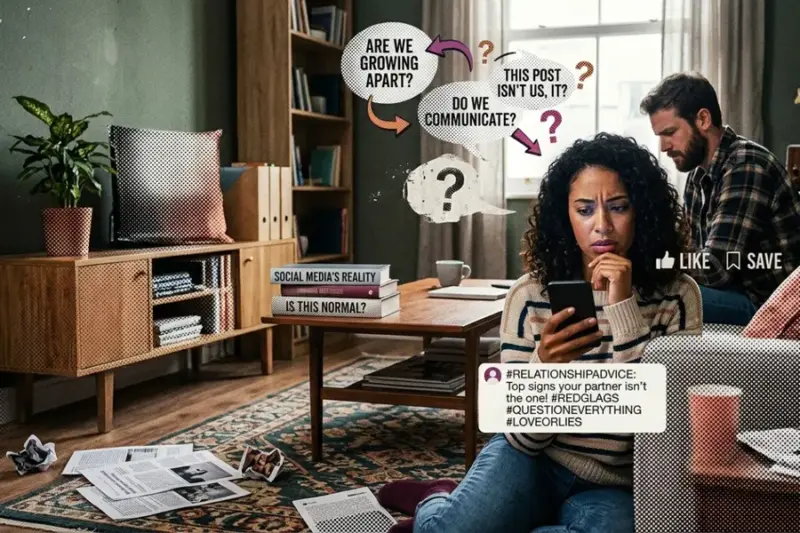

There is no shortage of people online telling you how love should look and feel. From "if they wanted to, they would" to "if it's meant to be...", there is always someone confidently explaining what love should look like, how your partner should behave, and what you absolutely must not tolerate.
But the more you listen, the more it can start to blur your own understanding of what is actually happening in your relationship.
A lot of viral relationship advice works because it is easy to understand and easy to share. The same phrases appear again and again until they begin to sound like facts. Over time, people start applying these ideas directly to their own relationships without stopping to ask a basic question: Does this actually fit my situation?

Therapists say this habit can create unnecessary anxiety. Instead of understanding their relationship better, people begin to doubt it.
One viral opinion can suddenly make something normal feel like a red flag, when in reality relationships are shaped by context, communication, past experiences, and the unique dynamic between two people.
"You shouldn't have to change for anyone"
This one feels empowering, and in some ways, it is true. You should not lose your core identity for a relationship. But that does not mean you never need to change at all.
In reality, relationships often bring out habits, insecurities, and behaviours that need work. Expecting your partner to grow while refusing to reflect on your own patterns creates imbalance. Growth has to go both ways for a relationship to move forward.

"Relationships are not meant to be hard"
Social media often paints love as effortless. If things feel difficult, it must be wrong. That idea sounds comforting, but it is also misleading.
Therapists point out that the closer two people become, the more their differences, fears, and past experiences come to the surface. That does not mean the relationship is failing. It often means it is becoming real.
There will be phases that demand patience, compromise, and emotional effort. Difficulty is not always a warning sign. Sometimes it is simply part of building a life together.
Putting too much weight on one person
Another common pattern is expecting your partner to be everything. Your best friend, emotional support, problem solver, and constant source of happiness.

Therapists warn that this can lead to codependency. A healthy relationship is important, but it should exist alongside friendships, community, and your own sense of self. Relying on one person for everything can slowly make you lose sight of who you are outside the relationship.
"If they wanted to, they would"
This phrase is everywhere, and it sounds convincing. The idea is simple. If someone truly cares, they will automatically do the right thing.
But experts say it is not that straightforward. People are not mind readers. Loving someone does not mean always knowing what matters to them. Unspoken expectations often lead to disappointment, not because the other person does not care, but because they were never clearly told what was needed.
The real question is not whether your partner guessed correctly. It is whether they are willing to listen and follow through once you have communicated your needs.
"If it's meant to be, it will be"
The idea of fate is romantic, but it can also be misleading. Social media often suggests that the right relationship will simply fall into place without much effort.
In reality, strong relationships are built, not found. They require communication, emotional maturity, and a willingness to repair things when they go wrong. Many relationships do not fail because the love was not real. They fail because love on its own was not enough.

"Never settle"
This advice is often shared as a reminder to know your worth. And yes, standards do matter. But online, it is sometimes twisted into the idea that anything less than perfect is not good enough.
The truth is, every relationship involves two imperfect people. There is a difference between settling for less than you deserve and accepting that no relationship will tick every single box. Walking away from something healthy just because it is not flawless can be just as harmful as staying in something unhealthy.
A better way to look at online advice
Before taking advice from social media and applying it to your own life, it helps to pause. Ask yourself whether it is helping you understand your relationship more clearly or just making you feel anxious, reactive, or doubtful.

The most useful advice is not the kind that gives you rigid rules. It is the kind that allows space for nuance. It encourages you to reflect, communicate, and pay attention to what is actually happening between you and your partner.
Because at the end of the day, no viral post can fully capture the reality of your relationship. Only you can.