
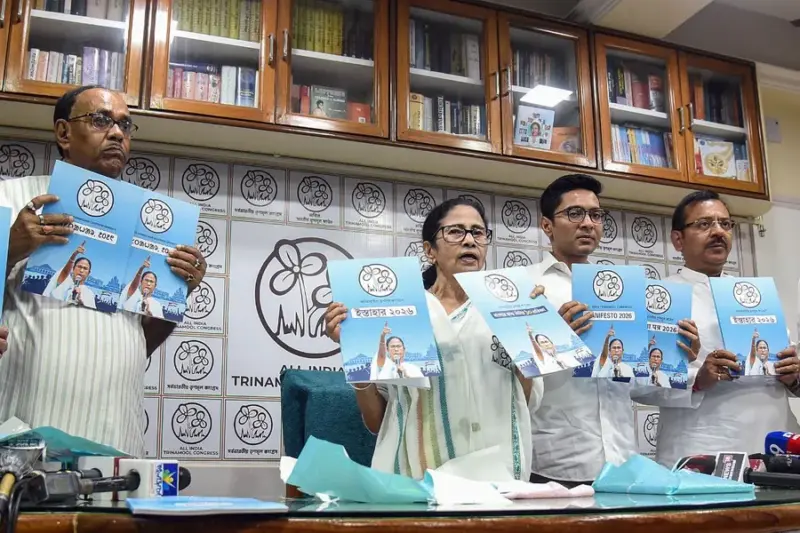

With the release of the Trinamool Congress (TMC) 2026 election manifesto, the party has signaled a strategic shift from the "introduction" of welfare to its "expansion".
Launching "Didi's 10 Pledges" (10 Protigya) on Friday, March 20, Chief Minister Mamata Banerjee presented a roadmap that doubles down on established social security nets while moving toward universal coverage and infrastructure.
The Election Commission of India has scheduled the West Bengal Assembly elections for April 23 and April 29, with results due on May 4, 2026.
Evolution of Promises: 2021 vs. 2026
| Feature | 2021 Manifesto (Didir 10 Ongikar) | 2026 Manifesto (10 Protigya) |
| Direct Cash Aid | Introduced Lakshmir Bhandar as a safety net (₹500/₹1,000). | Expanded aid to ₹1,500 (General) and ₹1,700 (SC/ST) per month. |
| Youth Support | Focused on Student Credit Cards for educational loans. | Shifts to direct aid with Banglar Yuba-Sathi (₹1,500/month stipend). |
| Agriculture | Promoted Krishak Bandhu income support. | Proposes a massive, structured ₹30,000 crore dedicated Agri-Budget. |
| Healthcare | Highlighted increased spending and Swasthya Sathi. | Introduces Duare Chikitsa for doorstep medical camps in every block. |
| Housing | Aimed to build more rural houses. | Pledges a permanent (pucca) house for every family in Bengal. |
| Education | Focused on affordable access and credit. | Emphasizes infrastructure (Banglar Shikshayatan) and school modernisation. |
| Industry | Focused on MSMEs and general job creation. | Positions Bengal as a Global Trade Hub with new ports and logistics parks. |
The 2026 manifesto reflects a transition from addressing basic needs in 2021 to scaling benefits and improving delivery systems for a fourth term.
Key Thematic Shifts
From Emergency Relief to Long-Term Infrastructure: While the 2021 promises were born out of pandemic-era recovery-focusing on free rations and immediate financial aid-the 2026 document pivots toward permanent assets like piped water for all 1.75 crore rural families and 100% pucca housing.
Administrative Reform: The 2026 manifesto introduces a geographical reorganisation, promising the creation of seven new districts and the expansion of urban local bodies to improve governance reach.
Welfare Continuity: The strategy relies heavily on "delivery memory," expanding existing successful schemes like Lakshmir Bhandar (which now supports 2.15 crore women) rather than introducing entirely new, untested policies.
The Trinamool Congress appears to be banking on this model of "deepening" welfare to counter the Bharatiya Janata Party, which has promised higher cash transfers specifically to women and the implementation of the 7th Pay Commission for state employees.
Here are the 10 Key Pledges (10 Protigya) from the TMC's 2026 manifesto:
- Increased Lakshmir Bhandar: Monthly financial aid for women rises to ₹1,500 (General) and ₹1,700 (SC/ST).
- Banglar Yuba-Sathi: Unemployed youth (ages 21-40) to receive a monthly stipend of ₹1,500 until they find a job.
- Dedicated Agri-Budget: A first-of-its-kind ₹30,000 crore budget specifically for farmers and agricultural infrastructure.
- Universal Pucca Housing: A guarantee to provide a permanent concrete house to every family currently living in temporary shelters.
- Piped Water for All: Ensuring 100% functional tap-water connections for all 1.75 crore rural households by 2028.
- Duare Chikitsa: Annual doorstep healthcare camps in every block and town for free diagnostics and consultations.
- Banglar Shikshayatan: Modernising all state schools into "Smart Campuses" with e-learning labs and high-speed internet.
- Eastern Trade Gateway: Developing Bengal as a global logistics hub through the Tajpur Deep Sea Port and new industrial corridors.
- Universal Senior Pension: Ensuring uninterrupted monthly pensions for all eligible senior citizens across the state.
- Administrative Expansion: Creation of seven new districts and 15 new Municipal Corporations to bring governance closer to citizens.