




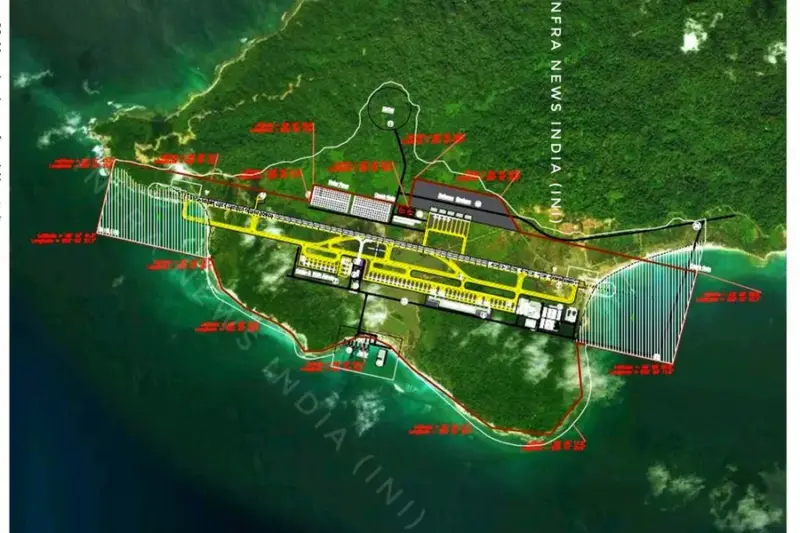

New Delhi: The Great Nicobar International Airport is a proposed greenfield airport on Great Nicobar Island, India's southernmost territory in the Andaman and Nicobar Islands.
Conceived as a dual-use facility, it is designed to support both military operations and civilian air traffic, forming part of a broader plan to enhance India's strategic presence in the eastern Indian Ocean.
According to official documents accessed by CNN-News18, the government has initiated the project by inviting consultants for strategic planning and development. The airport's location near the Six Degree Channel, one of the world's busiest maritime trade routes, is cited as a key strategic advantage, enabling faster deployment of defence assets and improved surveillance capabilities. Currently, the nearest major civilian airport at Port Blair is over 500 kilometres away, limiting rapid access to Great Nicobar.
Under the proposed model, airside operations and air traffic control will be managed by the Indian Navy, while civilian infrastructure such as passenger terminals and aprons will be operated by the Airports Authority of India. Initial operations are expected to handle medium-sized aircraft, with provisions for future expansion to accommodate larger platforms.
The airport site lies along the island's southern coast, between Gandhi Nagar and Shastri Nagar, around 30 kilometres from Campbell Bay. Due to surrounding hills and dense rainforest, partial cutting of nearby hills has been planned to meet aviation safety norms. Beyond defence, the government projects improved connectivity, economic activity, and long-term tourism potential, given the island's proximity to destinations such as Phuket and Langkawi.
However, the project has triggered significant concerns. Great Nicobar is largely part of a biosphere reserve, rich in biodiversity and vulnerable ecosystems. Environmental experts warn that forest clearance, terrain modification, and large-scale construction could cause irreversible ecological damage. The island also lies in a high seismic and tsunami-prone zone, raising questions about long-term safety and resilience.
Social concerns centre on the impact on indigenous Shompen and Nicobarese communities, among the most vulnerable tribal groups in India. Rights groups argue that large infrastructure projects risk displacement, cultural disruption, and health threats, and have questioned whether consultations with these communities have been adequate.
Passenger traffic estimates for the airport are based on projected future development rather than current demand, with annual traffic forecast at around 1.35 million by 2040. The master plan spans a 50-year horizon up to 2075, with phased construction. While the passenger terminal is proposed to be carbon-neutral and compliant with GRIHA-5 standards, critics caution that sustainability claims should be independently scrutinised.
Overall, the Great Nicobar airport project represents a high-stakes balance between strategic and connectivity gains on one hand, and environmental protection and indigenous rights on the other. While the national security rationale is widely acknowledged, experts stress that transparency, independent oversight, and genuine local consent will be critical in determining whether the project can be pursued responsibly and sustainably.