
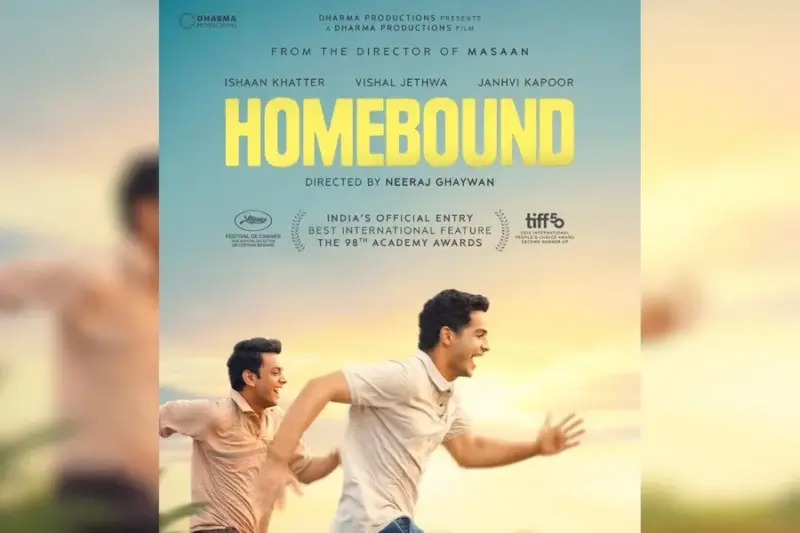

Till some years back, if someone asked me, what criteria I apply to a film to say that it moved me deeply, I would say, "I must begin to like it within the first 15 minutes of screening, then, I would need to carry the film with me outside the theatre to haunt me long after it was over and lastly, I would certainly try to catch the film again and again."
After watching Neeraj Dhaywan's Homebound I have added two more items to the above. These are - every single frame of the film should be read as a film unto itself and two, I should emotionally feel like I was a part of the film. So deep is the impact Homeland has made on me.
I am a high-caste Brahmin. In belief and in practice, I am not an agnostic at all. I am a believer who is also secular. Each one of these appears to have assumed very strong anti-Dalit and anti-minority connotations for all of us never mind if we are Dalit or migrant or belong to a minority community who live in the margins of society, work within extreme risks and lead inhuman lives away from their homelands and family.
Within this scenario, Homebound has made a very deep impact on my psyche for one, and underscored the power of cinema to haunt the audience, on the other. It demonstrates excellent technical command over the manner the story is told, the cinematography, the wide geographical ambiance spanning very uncertain and anxious times, the music, the editing and above everything else, the acting.
The term "homebound" does not have a dictionary meaning but in general terms, it perhaps signifies the inner desire of all migrants, irrespective of caste, creed, colour and race - to return, one day, to their native homes where their family lives, where they were born and brought up never mind even if it was in precariously deprived material conditions, by loving parents whose lives they promise to improve.
Homebound is based on a New York Times article Taking Amrit Home (now titled A Friendship, a Pandemic and a Death Beside the Highway) by Kashmiri journalist Basharat Peer. in 2020 which means that the film is based on a true story which invests the film with both logic and authenticity.
Homebound, almost without being aware of it, spans a host of significant agendas the country is riddled though it is now more than 75 years since Independence.
If we still point fingers at the British, why do we, till today, find newspaper stories on caste discrimination that threatens the very survival of a family steeped in poverty? Or, why does Shoeb (Ishaan Khatter) an extremely skilled salesman but not academically qualified, be forced to work like a peon-cum-servant in a plush office and be treated like a joke in human form just because he happens to be Muslim? Why do the results of a police exam get stuck for no reason at all? Why does Chandan Kumar (Vishal Jethwa) always check the "General" category and keep hiding his true caste despite the 'beneifts'? Why is his sister forced to work instead of being allowed to study? Because she is a girl? Why is Chandan's mother thrown out of her job as a cook in a school peopled with children of upper castes though the kids loved her cooking? And why does 'migration' or forced displacement for young men like Shoeb and Chandan give them the only escape route, not to freedom but to a search for some source of livelihood? And again, to try and migrate back home when their factory shuts down because of the Covid lockdown?
Both the director and the script do not offer any answers. They only show facts as they are because there are no answers. Period. Underlined and emphasized is the attention to the minutest of physical details the director has woven into the film. One is that of Shoeb's mother who has no slippers to wear to the farm because she loves to feel the soil beneath her feet. Or, the workers in Surat repeat that they must rush back because they are fed up of scraping the bottom of their empty pots when there is nothing left to eat. Or, the break-up between Chandan and his girlfriend (Janhavi Kapoor) on their differences on value and ambition. Or, the exchange between Chandan and the clerk in a police department when the latter comments on Chandan wanting to hide his caste.
The long-term friendship between Shoeb and Chandan which has nothing to do with their caste and creed differences forms the root of the film. Add to this, the unceasing love of Shoeb and Chandan towards their parental families for the upgrading of which they are ready to work in inhuman conditions just to earn money to send home - Chandan wants to build a pakka home to stop the leaking roof and Shoeb wants to save money for his father's expensive surgery.
At face value, Homebound might appear to involve an excess of issues beyond, perhaps, the necessity of too much atmosphere, action, crowds, discrimination on inhuman grounds. This is not just an excess of issues but the question of which issues are emphasized and which occupy just a sub-text? The answer is - none. Homebound is invested with a sense of emotional and social departure from the routine world into a realm that is simply different. We are aware that these inhumanities are omnipresent in India today. But becoming aware through films like Homebound and Masaan takes us out of our comfort zones with a shock we are not quite prepared for.
The story is rooted in real life, remember? In 2022, while the entire world reeled with shock and turned vocal about the very inhuman attack on internationally renowned writer Salman Rushdie, few people will ever hear of the nine-year-old Indra Meghwal who lost his life because he happened to drink water from an earthen pot reserved for students of upper castes. Of course, the attack on Salman Rushdie is to be condemned in no uncertain terms. It points to the tremendous hatred borne by one class of people against another right across the world along casteist and/or communal/racist lines. May I gently remind my readers that though distanced in terms of birth, geography, communal identity, class, education, upbringing, Indra Meghwal was a Dalit and Rushdie, a Muslim. Both belong to the 'margins' of the global world we live in. While Meghwal died a death more ignoble than Rushdie's attack, Rushdie too lost vision in one eye. Everyone appeared to forget that they were/are human.
The Dalit dynamics in Indian cinema began with Bombay Talkies' Achyut Kanya consolidated many years later by Bimal Roy's classic Sujata. Sujata (1959) narrated the tale of an untouchable girl brought up in a higher caste home who does not know that she is dalit. When she does learn the truth from her adoptive mother, it is as if her life collapses around her. Her upbringing has given her an upper caste mindset but it has not stripped her of the 'ignominy' of her birth.

There was a time when Hindi cinema created a Muslim ethos in a given category of films that came to be labelled "Muslim Socials." Historical films such as Pukar, Mughal-e-Azam, Anarkali, Laila-Majnu were fictionalised slices of history glamourised to pull in the mass audience! Muslim socials were almost always box office hits such as Chaudhvin Ka Chand and Mere Mehboob. Then there were the Muslim tawaif genre films like Pakeeza, Umrao Jaan, Benazir, etc. These films were aimed purely to entertain, to trigger the tear ducts to flow freely and for the mass audience to hum the tunes of the lovely songs and go home happy.
The picture is different today. It is as if the average Muslim is trapped in the identity of a terrorist or a mafia goon or a professional killer, almost without exception. A bit of 'lip service' is paid by putting in a few Hindu members of terrorist or mafia groups but one understands the psychology - it is 'lip service' for fear of reprisals on grounds of communal partisanism to the majority community. The Central Board of Film Certification, when it did function, sometimes put its foot firmly down in having scenes deleted from some films for fear of hurting the sensibilities of the minority community. They form a slice of the vote banks, remember?
Homebound distances itself from these clichéd portrayals to present a slice of life today in contemporary, globalised India as it sustained during the lockdown, deeply affecting the margins of society of which, Dalits and Muslims are but just a part, not the whole.
The agendas are so beautifully woven into the narrative and in its cinematic unfolding through music, jarring sounds of the machines in the workshop, the sound of water leaking through the roof of Chandan's shanty, through nuggets of incidents and events, the massive crowd at the railway station waiting for the ticket counter to open, that these tiny incidents each become an end unto themselves. Even the climax showing Shoab stepping into a different identity is very gently presented, in a subdued way and before you can realise this, the film is over!
Has this been possible because Neeraj Dhaywan himself is a Dalit though he is very highly qualified in the academic sense? Not really because though his earlier film Parched also tackled the story of a young engineering student born into a family of domes (those who burn dead bodies in Benares) his short film Juice made for an OTT platform kept away from caste and communal discrimination and dealt with the woman question. So, he is one of the most brilliant of filmmakers we have in the country today. Consistency is something we lack. Dhaywan has shown that he does not. Because, at the end of the day, by caste, identity, belief and practice, he is a filmmaker and a brilliant one.