




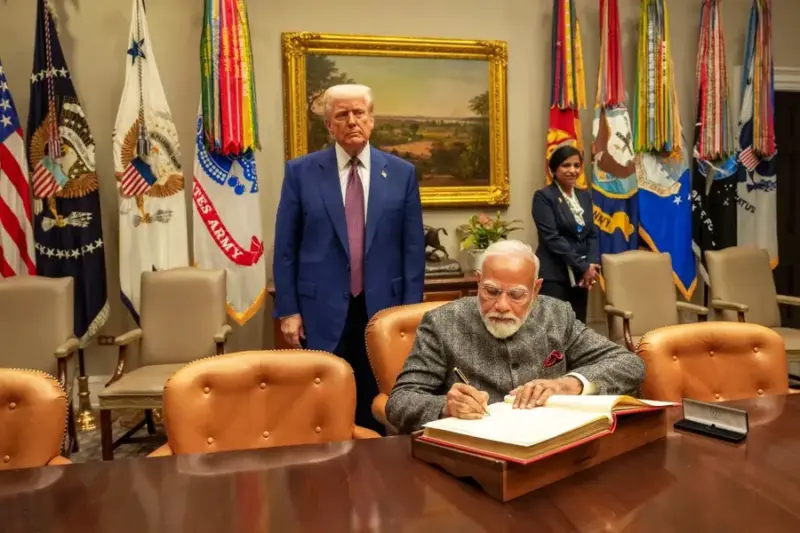

There was a time when India spoke the language of strategic autonomy with a certain confidence. One did not have to agree with every foreign policy decision taken in New Delhi to at least recognise that the country attempted to project the image of an independent civilisational state with interests of its own, compulsions of its own and, occasionally, the courage to say no to great powers.
That India now appears to have quietly checked itself into the American strategic ecosystem with the enthusiasm of an eager probationary intern. Marco Rubio's visit only reinforced the impression.
One watched the spectacle unfold and could not help but wonder whether the Ministry of External Affairs still exists as an institution with a mind of its own, or has now been reduced to ceremonial choreography while Washington conducts the actual briefing. There was a visible awkwardness to the entire exercise.
Also Read: India's invincible narrative suffers wardrobe malfunction
India, which speaks endlessly of becoming a Vishwaguru and a leading pole in a multipolar world, looked strangely diminished in the presence of an American administration whose own foreign policy resembles an intoxicated roulette wheel.
The tragedy is not alignment. Nations align all the time. The tragedy is the desperate attempt to market dependency as strategic genius. India today cannot even freely procure oil from suppliers willing to sell it at favourable rates without nervously glancing toward Washington for approval like a schoolboy seeking permission to leave the classroom.
Iran offers energy, Russia offers energy, and India desperately needs energy. In a rational world, that would conclude the matter. Instead, New Delhi behaves as though American displeasure is a force of nature rather than a negotiable diplomatic variable. One is repeatedly told that this is sophisticated statecraft and that India is balancing interests. That this is pragmatic realism.
Very well then. Let us examine this realism. Has India secured formal alliance guarantees from the United States? No. Has Washington shown the slightest hesitation in sanctioning partners and allies whenever convenient? No. Does America pursue its interests with ruthless clarity, irrespective of sentimental rhetoric about friendship and democracy? Absolutely. Then what precisely is India receiving in exchange for this extraordinary obedience, besides flattering speeches, choreographed hugs, and the occasional photo-op designed to trend on social media for six hours?
Also Read: Govt 'lost sight of the ball' amid economic warning signs
This is perhaps where the Modi era has altered not merely Indian diplomacy but also global perceptions of India itself. Diplomacy, at least traditionally, relied upon a certain calibrated restraint. Nations communicated seriousness through composure, institutional continuity and strategic ambiguity.
The Indian Foreign Service, whatever its flaws, cultivated that grammar for decades. One had seasoned diplomats who understood nuance, silence, timing and the art of saying very little while communicating a great deal. Today, much of Indian diplomacy appears to have been converted into an endless personality spectacle orbiting around one man and his camera angles. There is the perpetual grandstanding, the theatrical embraces, and the carefully staged laughter that arrives at moments where no one else in the room appears particularly amused, and the overfamiliarity with world leaders who themselves often seem faintly bewildered by the performance. Somewhere along the line, diplomacy began to resemble a travelling motivational seminar, interrupted occasionally by bilateral meetings.
And the problem with reducing foreign policy to personality management is that nations eventually stop taking the theatre seriously. Around the world, there is a growing perception that India's external posture has become excessively performative and excessively centralised. Decisions that would once emerge through layers of institutional deliberation now appear heavily concentrated within the Prime Minister's Office.
Career diplomats increasingly look less like policymakers and more like nervous translators of political messaging that has already been decided elsewhere. The result is painfully visible. Spokespersons often appear defensive, evasive or strangely disconnected from the substance of the questions being asked.
Also Read: Cockroach Janta Party and the anxiety of power in India
One saw shades of this in the now widely discussed performance of Mr Sibi George in Norway, where entire responses seemed devoted to circling around uncomfortable questions without ever actually addressing them. It was less diplomacy than verbal fog generation. And that fog is becoming harder to sustain internationally because foreign governments are not evaluating Instagram optics. They are evaluating leverage, coherence and autonomy. And that is where the contradiction becomes impossible to ignore.
Domestically, India projects itself as a muscular civilisation state reclaiming global stature after centuries of humiliation. Internationally, however, it increasingly behaves like a country terrified of displeasing Washington on matters central to its own economic interests. Even the language has changed.
Indian diplomacy once possessed a certain strategic ambiguity. It now often sounds like an outsourced communications wing nervously trying not to offend its principal client. Every statement appears to have been carefully sanitised for Western approval. Every silence appears deliberate. Every hesitation looks rehearsed.
Meanwhile, the Americans continue to pursue relations with Pakistan whenever expedient, continue to pressure India on trade, continue to dictate the broad parameters of acceptable engagement with Iran and Russia, and continue to treat New Delhi less as an equal power than as a useful regional subcontractor in the larger project of containing China. And yet the performance of triumph continues uninterrupted.
The irony is almost theatrical. A government that projects muscular nationalism domestically appears astonishingly deferential internationally whenever Washington clears its throat. Entire television studios erupt into patriotic ecstasy over symbolic victories, while the country quietly surrenders its actual strategic flexibility in energy, trade, and regional diplomacy.
One need not even be anti-American to find this deeply embarrassing. The United States is behaving exactly as great powers always behave. It extracts compliance where possible, punishes deviation where necessary and rewards usefulness where convenient. The real question is why India increasingly appears so willing to internalise American priorities as though they were articles of faith.
The answer, perhaps, lies in the nature of the Indian elite itself. Sections of the political, bureaucratic and corporate establishment now appear psychologically invested in Western approval to an almost colonial degree. Access to American finance, technology and geopolitical patronage seems to have become the organising principle around which strategic thinking revolves.
Sovereignty survives mainly as a slogan for domestic consumption. This is not strategic autonomy, but strategic dependency with better public relations. None of this means India should sever ties with Washington or abandon cooperation with the West. That would be juvenile. But a serious power behaves like a serious power. It protects room for manoeuvre. It buys oil where it wishes. It speaks in its own voice. It negotiates without appearing terrified of displeasing another capital.
Today, India often appears less like an emerging pole in a multipolar order and more like a nervous middle manager attempting to impress an unpredictable boss. And perhaps that is the saddest part of all. For a civilisation state of India's scale, history and ambition, this level of visible compliance is not merely strategically limiting. It is profoundly undignified.
The author is a National Award winner for Best Narration and an independent political analyst. Views expressed are personal.