
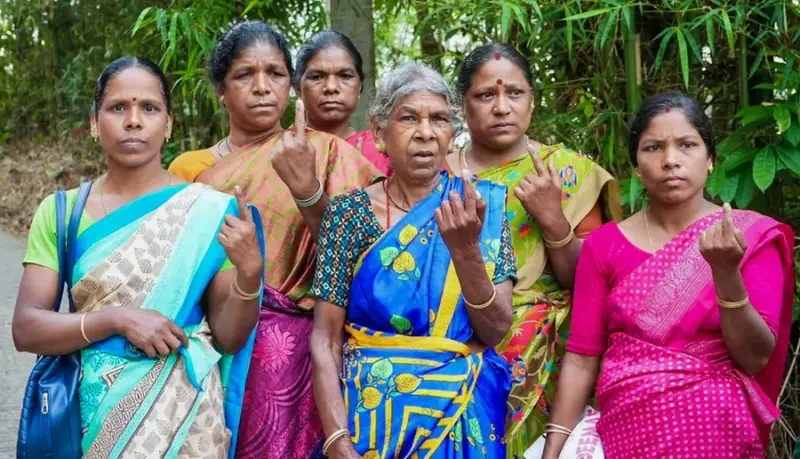

Thiruvananthapuram: Predicting election outcomes based on fluctuations in polling percentage has long been a trend in Kerala. A commonly held belief suggests that higher turnout favours the UDF, while lower turnout benefits the LDF. However, a closer look at the state's electoral history reveals that such assumptions do not consistently hold true.
Kerala's political culture, traditionally marked by a change in government every five years, was altered in 2021, when the LDF retained power under Pinarayi Vijayan. This shift has made the current election more keenly contested. In the battle for 140 Assembly seats, the LDF is aiming for a third consecutive term, while the UDF, led by V. D. Satheesan, is determined to regain power. The NDA has also stepped up its campaign, deploying national leaders more actively than before.
Although higher turnout is often seen as favourable to the UDF, historical evidence suggests otherwise. For instance, in 1987-when a record 80.54% voter turnout was recorded-and in 1996, when turnout dropped to 71.16%, the LDF came to power in both elections.
Over the past four decades, all nine Assembly elections in Kerala have recorded voter turnout above 70%. Between 1982 and 2021, the UDF formed the government four times, while the LDF did so five times. Turnout exceeded 75% in both 2011 (75.12%) and 2016 (77.35%), with the UDF winning in 2011 and the LDF in 2016-again indicating no direct correlation between turnout and electoral victory.
For the UDF, the rise in polling percentage has boosted confidence, with leaders claiming strong anti-incumbency sentiment at the grassroots level. The LDF, however, rejects this argument, asserting that its cadre votes have been fully mobilised and that voting patterns remain consistent with previous elections.
The BJP, meanwhile, is optimistic about its prospects, particularly in constituencies such as Nemom and Kazhakoottam in Thiruvananthapuram, and Chathannoor and Karunagappally in Kollam. The party claims that higher turnout in several constituencies reflects its growing presence, especially in triangular contests.
Reports indicate that the increase in turnout this time is not entirely surprising. A key factor is the Special Intensive Revision (SIR) of electoral rolls, which removed duplicate and deceased voters. This naturally raises turnout percentages, making it difficult to clearly assess which front stands to benefit.
The election has recorded one of the highest turnout levels in Kerala's history. Kozhikode district leads with 81.26%, with several constituencies crossing the 80% mark. Traditionally, a challenging region for the Congress, this high turnout could prove significant.
Other northern districts also witnessed strong participation; Kasaragod recorded 78.94%, Kannur 78.48%, and Wayanad 78.81%. Political developments in Kannur, including factional issues within the CPM, make constituencies like Payyannur and Taliparamba particularly important.
Palakkad saw a high turnout of 80.54%, reflecting intense competition, especially in Palakkad town and Thrithala. Malappuram recorded 79.70%, with voters queuing late into the night in constituencies like Tirur.
Urban voter apathy appeared to decline in Ernakulam, where constituencies such as Kunnathunad, Paravur, Thrikkakara, and Tripunithura saw large turnout, pushing the district close to 80%.
Thrissur recorded 77.10%, with heightened political interest following the BJP's Lok Sabha success. Idukki saw 77.15%, while Kottayam lagged slightly at around 75%, raising questions about voter sentiment.
In Alappuzha (77.40%), the Ambalappuzha constituency has drawn attention due to internal CPM divisions and the candidacy of G. Sudhakaran as a UDF-backed independent. Pathanamthitta recorded a relatively lower turnout of 70.76%, though this is still considered an increase given the district's usual voting trends.
Kollam (76.27%) and Thiruvananthapuram (77.05%) also saw strong turnout, driven by intense triangular contests in key constituencies.
Ultimately, recent trends in Kerala elections suggest that polling percentage alone is not a reliable indicator of victory. Whether turnout is high or low, it does not consistently favour any particular front, making predictions based solely on voter participation increasingly unreliable.