
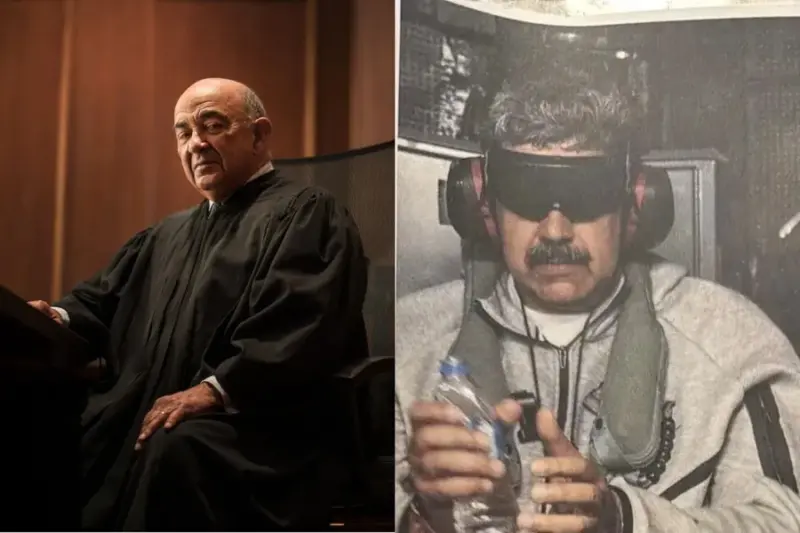

Alvin K Hellerstein, the veteran US federal judge now overseeing the explosive criminal case against ousted Venezuelan leader Nicolás Maduro, has become a central figure in one of Washington's most consequential international prosecutions in recent years.
The 92-year-old jurist, long regarded as a meticulous and fiercely independent voice on the bench, questioned Maduro and his wife Cilia Flores on Monday as the two were arraigned on narco-terrorism and weapons charges in Manhattan.
Maduro, who was seized by US military forces in Caracas over the weekend and flown to New York, told the court, "I'm innocent. I'm not guilty." His remarks came as he insisted he had been "kidnapped since January 3, Saturday."
The highly sensitive case now sits before a judge who has spent decades handling some of America's most politically fraught legal battles.
Judge with military legal background
Born in New York in 1933, Hellerstein graduated from Columbia University School of Law before beginning his career as a clerk in the same federal district where he now sits. He went on to serve in the US Army's prosecution service from 1957 to 1960, later entering private legal practice.
His path to the federal judiciary came in 1998, when then-President Bill Clinton nominated him to the Southern District of New York (SDNY). Over more than 25 years on the bench, he has become known for delivering carefully reasoned judgments and is considered one of the longest-serving judges currently active in the federal system.
Hellerstein, an Orthodox Jew and respected figure within his community, has earned a reputation for independence and balance. International outlets, including El País, have highlighted his standing for fairness and impartiality in high-pressure cases.
Major and sensitive cases
Hellerstein has been at the centre of several major legal battles over the past two decades. He oversaw key civil litigation linked to the 9/11 Al-Qaeda attacks, repeatedly clashing with government secrecy efforts and, in 2015, ordering the release of photographs documenting abuse of detainees in Iraq and Afghanistan.
He has also had repeated legal run-ins with Donald Trump. As president, Trump sought to move his New York hush-money case to federal court - a request Hellerstein rejected. Trump later acknowledged the judge's stature after learning he would oversee the Maduro proceedings, saying, "He is very respected."
Hellerstein further blocked a Trump-era attempt to expel alleged Venezuelan gang members without hearings, and in 2023 halted deportation plans targeting demonstrators who protested against Israel's war in Gaza - rulings that underscored his willingness to check executive power.
Fraud trials, global financial cases and major sentencing decisions
In recent years, Hellerstein has handled several major white-collar crime trials:
- He sentenced start-up founder Charlie Javice to more than seven years in prison for fraud involving a $175 million JPMorgan Chase acquisition.
- He handed an 18-year sentence to Archegos Capital Management founder Bill Hwang in one of the most significant financial fraud cases in recent US history.
- He presided over a trial in which French bank BNP Paribas was found to have assisted Sudan's former dictator Omar al-Bashir's regime, with three Sudanese plaintiffs awarded $20.75 million in damages.
His courtroom has also hosted key stages of the long-running case involving former Venezuelan intelligence chief Hugo Armando "Pollo" Carvajal, who pleaded guilty last year to multiple narcotics-related crimes and is expected to be central to the prosecution against Maduro.
Why Hellerstein matters in Maduro's case
Hellerstein has presided for nearly 15 years over elements of the sprawling drug trafficking investigation that first ensnared senior Venezuelan officials. Maduro, Flores, their son, and multiple former government insiders now face four counts filed by the US Attorney General: conspiracy to commit narco-terrorism, conspiracy to import cocaine, possession of machine guns and destructive devices, and conspiracy linked to those weapons offences.
Prosecutors allege Maduro enriched himself through his government roles and sought to "flood the United States with drugs."
The Venezuelan leader appeared in court wearing an orange shirt and beige trousers, speaking softly as he made his plea. He told the judge, "I'm president of the Republic of Venezuela and I'm here kidnapped…"
Flores also entered a not-guilty plea. Hellerstein ordered both to remain in custody at Brooklyn's Metropolitan Detention Centre, a facility long criticised for its conditions. The next hearing is set for 17 March.
Barry Pollack joins defence team
Meanwhile, Maduro's lawyer Barry Pollack - a seasoned Washington trial attorney with more than three decades of experience - has taken charge of crafting the former Venezuelan leader's defence strategy. Pollack, widely recognised for representing WikiLeaks founder Julian Assange in his espionage prosecution, previously secured a plea agreement that spared Assange extended imprisonment in the United States.
Over the years, he has built a reputation for navigating complex, politically charged cases involving corruption, national security breaches, financial crimes and fraud. His involvement in Maduro's team indicates that the ousted president is preparing an aggressive and highly technical challenge to both US jurisdiction and the sweeping charges filed against him.
Global fallout after Maduro's capture
Maduro's detention, which Venezuela's new interim leader Delcy Rodríguez has condemned as an "illegitimate military aggression," has ignited an international firestorm. Rodríguez said during her swearing-in ceremony, "I come with sorrow for the suffering inflicted upon the Venezuelan people following an illegitimate military aggression against our homeland."
Maduro's son, Nicolás Maduro Guerra, warned, "If we normalise the kidnapping of a head of state, no country is safe… This is not a regional problem. It is a direct threat to global political stability."
The United Nations Security Council held an emergency meeting on Monday, where senior officials warned the operation may have breached international law and highlighted the deep humanitarian crisis still gripping Venezuela.
(With inputs from agencies)