




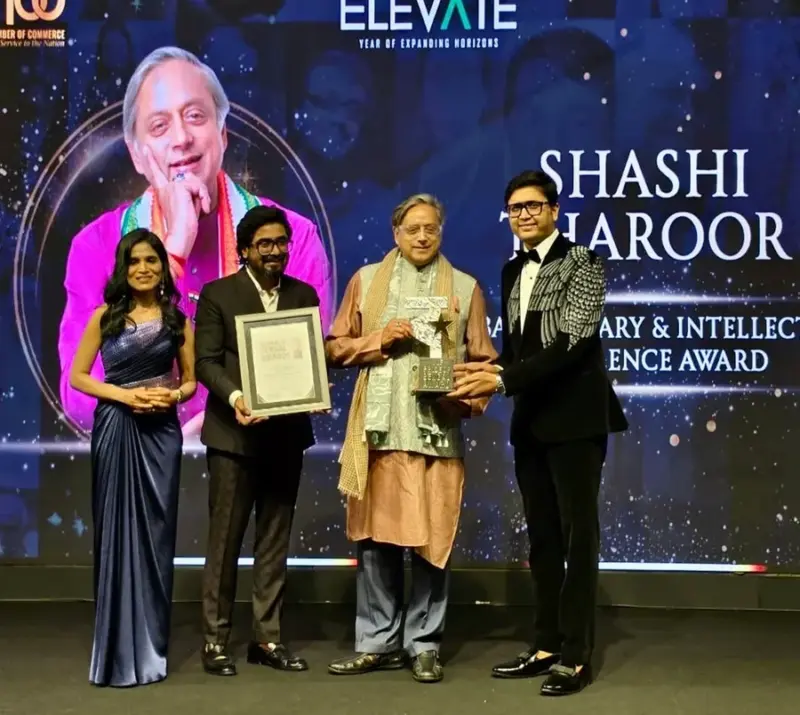

For a son of Kerala to receive a "Pride of Bengal" award is no routine matter, and when I did so earlier this month in Kolkata, I had to thank the Indian Chamber of Commerce and the Young Leaders Forum for this very kind honour.
I must confess, it was all the more flattering (as well as mildly intimidating) that the award was accompanied by a citation for "Global Literary and Intellectual Excellence", but I was unabashed enough, and truly grateful, to accept it.
I'll be honest, though-standing in Kolkata that night, I feel a bit like a person who walked into a puchka stall asking for "no mishti jol" and somehow walked out with the fullest belly.
I am, of course, not Bengali by birth. But as I realised, most of those presenting the award weren't Bengali by birth either. And yet, here we were, gathered together in the capital city of India's most volatile state, to celebrate the "Pride of Bengal." It was, in many ways, a testament to the magic of this city. Kolkata doesn't care about your passport or your mother tongue; it only cares about how much of your heart you're willing to leave behind on its streets.
My association with Kolkata, and thereby with Bengal, began in high school. Back then, I thought I was just passing through. I thought I was just another student navigating the humidity and the chaotic brilliance of Park Street. Yes, it was the home of the immortal Satyajit Ray, the theatrical genius of Badal Sircar and Utpal Dutt, and the other-worldly compassion of Mother Teresa. But it was also more than that. I didn't realize then that Kolkata isn't a place you visit; it's a condition you contract.
There is a famous line by the poet Pritish Nandy that has haunted me since I first read it: "Calcutta, if you must exile me, blind my eyes before I go."
For a long time, I thought that was a bit dramatic. But as the years have passed, I've realized he was right. Once you have seen the way the light hits the Hooghly at dusk, or felt the intellectual electricity of a roadside adda, you are ruined for anywhere else. If you took the city away from me now, I'd still see it every time I closed my eyes.
I fled the campus violence of the city in the early 1970s for college at St Stephen's in Delhi. My parents stayed on, of course; my father, Chandran Tharoor of the venerable Statesman newspaper, founded, in his spare time, the Bengal-Kerala Cultural Society, focused on the many cultural affinities between our states. A fondness for art, literature, cinema, music, endless conversation and Communism doesn't quite begin to sum it up. My parents would often tell me that Bengalis were the most Malayali people in India outside Kerala. And not just when they went on strike or rampaged through hartals!
But whether you are Malayali or not, Bengal has this incredible, quiet power to adopt you. There's a beautiful sentiment in Dwijendra Lal Ray's famous song, Amar Janmabhoomi, that resonates with me, even as an adopted child of the Bengali soil:
"Emon deshti kothao khunje pabe nako tumi,/ Shokol desher rani shey je, amar jonmobhoomi."
["Nowhere else shall you ever find a land such as this, /The queen of all nations is she, the land of my birth."]
Now, it might not be my literal birthplace, but in terms of where my spirit grew up, where my ambitions took flight, where the Shashi Tharoor they honoured as a Pride of Bengal began to take shape, and where I learned that leadership or achievement is nothing without culture- Bengal and Kerala are absolutely both my janmabhoomi.
This is why I found the honour of a "Pride of Bengal" award impossible to decline. To be recognized by your peers is wonderful, but to be told by Kolkata that you belong to her? That is the greatest award I could ever receive.
It was especially meaningful to receive this recognition in Bengal, a land that has shaped so much of India's intellectual and cultural life. From Tagore to Amartya Sen, this is a place where ideas have never been in short supply, and where words have always carried weight.
I have spent much of my life working with words, sometimes in diplomacy, sometimes in politics, and often in writing. Along the way, I have learned that words can illuminate, but they can also provoke, challenge, and occasionally get one into trouble. I suppose I have experienced all of the above.
If anything I have written or said has encouraged a little more curiosity, a little more debate, or even a little more disagreement, then I would consider that a worthwhile contribution. After all, a healthy society is one that continues to question itself.
So in expressing my sincere thanks to the organisers, and to all those who attended the award ceremony and gave me a standing ovation, I accepted this honour not just with gratitude, but with a renewed sense of responsibility to keep thinking, writing, and engaging. That, in many ways, would be the finest possible tribute to Bengal.
I promised to keep trying to live up to the "Pride" part of the trophy, even if my Bengali largely starts and ends with "Ami bhalo achhi."(I am well). I had a Malayali uncle who, smitten by the beauty of Bengal and the Bengali ladies, but conscious of the temper of their male relatives, thought it prudent to learn just two Bangla phrases - "Ami tumake bhalo bhashi" (I love you) and "amake mero na" ("don't hit me"). The two sentiments summed up much of what many Malayalis like him felt in, and about, Bengal. I just want to tell him now - there is so much more to it! And though I may or may not be a Pride of Bengal, I am indeed proud of Bengal.