




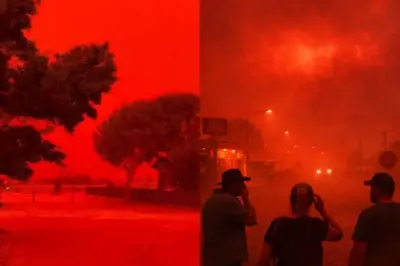

Two days ago, residents of Western Australia witnessed a striking and unusual phenomenon as the sky transformed into an intense, almost apocalyptic red.
The dramatic scene, captured in a viral video posted by AccuWeather on X, quickly circulated around the globe. Social media users described the sight as "otherworldly," with some likening it to dystopian or end-of-the-world scenarios, due to the deep crimson hue that seemed to envelop the entire sky.
Why the red colour?
Meteorologists say the phenomenon was caused by high concentrations of dust particles in the atmosphere, which alter the way sunlight is scattered. Under normal conditions, shorter wavelengths of light, such as blue, scatter more efficiently and give the sky its characteristic colour. However, when the atmosphere contains larger particles like dust, these shorter wavelengths are scattered less effectively, allowing longer wavelengths such as red and orange to dominate.
This effect can create dramatic visual shifts in the sky, particularly during sunrise or sunset when sunlight passes through a greater thickness of atmosphere.
In Western Australia's case, the effect was intensified by the influence of Cyclone Narelle striking than typical dust-related colour changes.
Authorities in Perth and surrounding areas have emphasised that the phenomenon, while visually dramatic, posed no immediate danger to residents. Dust storms, though capable of reducing air quality and causing temporary disruptions, rarely create conditions that threaten public safety in this way. Still, the vivid colouring and the sheer scale of the transformation have captured public imagination and generated worldwide attention.
Scientists and meteorologists note that such an intense crimson sky is rare, even in a country like Australia that frequently experiences dust storms. The combination of high iron content in the soil, strong winds from a cyclone, and the precise atmospheric conditions required for extreme light scattering created a momentary, extraordinary natural spectacle. For many observers, the event has served as a vivid reminder of the powerful and sometimes surreal effects of natural weather systems on the environment.
In short, the apocalyptic red sky over Western Australia was the result of a perfect storm of natural factors: a dust-laden atmosphere, iron-rich soil particles, and the force of Cyclone Narelle, all coming together to produce a rare and unforgettable visual display.