




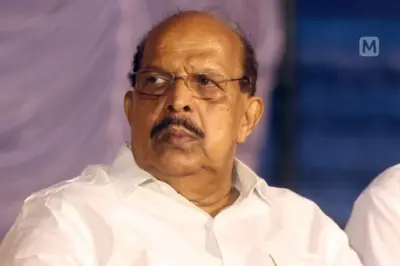

Alappuzha: G Sudhakaran, a veteran leader of the CPM, built his political life from modest beginnings in rural Alappuzha district, eventually rising to become a four-time MLA and two-time minister in Kerala.
Known for his outspoken style and reputation for administrative discipline, Sudhakaran has often been described by colleagues and political opponents alike as a leader who kept a distance from corruption and maintained strict control over governance.
Early political journey and giving up party membership
Sudhakaran first joined the Communist movement while studying in the 10th standard at Vallikunnam School in southern Alappuzha. However, he later gave up the party membership he had obtained during his school years.
His early political journey was also shaped by a personal tragedy in the family.
His brother, G Bhuvaneswaran, a student leader and unit secretary of the Students Federation of India (SFI), was attacked by political rivals at NSS College Pandalam on December 2, 1977. He died five days later from injuries sustained during the assault.
Sudhakaran later said the incident deeply affected the family. Their father, who had been associated with the Indian National Congress, grew closer to Communist ideas after the attack. The episode also contributed to the expansion of the SFI student movement in Alappuzha.
Growing up in poverty
Sudhakaran was born in Vedaraplavu in the Thamarakkulam panchayat. His father, P Gopalakurup, supported a family of five children through small-scale farming on about 50 cents of land. The family later moved to Punnapra.
Financial hardship marked his childhood. His father often taught him to 'nilathezhuth', a traditional method in which the alphabet is written on the ground. On special occasions, he also visited homes to read the Ramayana.
Struggling to pay school fees, Gopalakurup once sold 20 cents of land to support his children's education. During the rainy season, Sudhakaran and his siblings walked to school, covering themselves with banana leaves. Until the 10th standard, he relied on second-hand textbooks passed down from senior students.
Before going to school each day, he fed grass to the cow. In the evenings, he helped sell agricultural produce and other items in the local market. During the summer months, he often travelled long distances to fetch water for the household while continuing his studies.
Student life and political activism
Sudhakaran completed his undergraduate degree at NSS College Pandalam before joining SN College Kollam to pursue a master's degree in English.
While active in student politics in Kollam, he had already lost the party membership he once held in his hometown. He later rejoined the Communist Party in Kollam in 1967.
Arrest during Emergency
After completing his postgraduate studies, Sudhakaran enrolled for an LLB course in Thiruvananthapuram. However, his studies were interrupted during the Indian Emergency (1975-1977).
On July 1, 1975, he was arrested for participating in protests against the Emergency declaration. The arrest took place on the premises of University College Thiruvananthapuram along with 22 other students.
The protest gained international attention and was reported by Time magazine.
Senior Communist leaders, including E M S Namboodiripad and A K Gopalan, visited him in Central Jail after his arrest. Gopalan later raised the issue in Parliament, pointing out that Sudhakaran had been jailed on the day his final examination was scheduled.
When Sudhakaran produced his hall ticket in court, the judge considered the time he had already spent in jail as sufficient punishment and ordered his release. He later completed the examination.
Political rise in Kerala
After finishing his studies, Sudhakaran returned to Alappuzha following party instructions and became active in local politics.
His political career progressed steadily. He first served as the opposition leader in the Alappuzha municipality and later became the district council president.
Over the years, Sudhakaran was elected to the Kerala Legislative Assembly four times and served twice as a minister in the state government, establishing himself as a senior leader within the CPM in Kerala.