
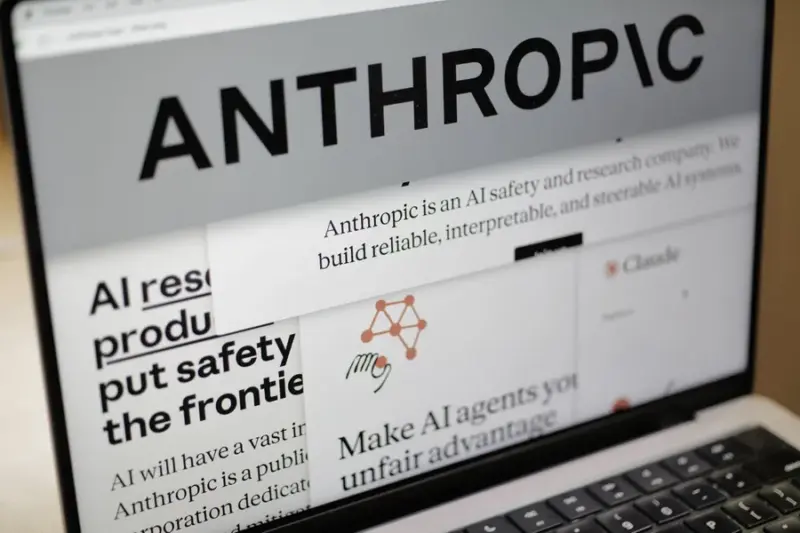

New Delhi: A powerful new artificial intelligence model developed by Anthropic has sparked global concern across the financial sector, prompting urgent discussions at the highest levels of government in India.
At a recent high-level meeting chaired by Union Finance Minister Nirmala Sitharaman, alongside Minister for Electronics and Information Technology Ashwini Vaishnaw, banking leaders convened to assess the national security implications of the model, known as Mythos.
In an exclusive interview with Asian News International, Atul Arya, Founder and Chief Executive of Blackstraw, outlined both the promise and the peril posed by the system.
Unlike conventional AI models, Mythos is designed to explain the reasoning behind its outputs, marking a significant shift towards transparency. Arya described this capability as a "double-edged sword", noting that while it can help organisations identify vulnerabilities, it could equally be exploited by cybercriminals.
The model is currently being tested with a limited group of major technology and cybersecurity firms, including Microsoft, Amazon Web Services and CrowdStrike. These firms are using it to detect weaknesses in software systems, particularly within critical infrastructure.
ALSO READ | NASA opens its powerful simulation tool 'LAVA' to the world
However, Arya warned that the banking sector remains especially exposed. "Banks are the most vulnerable ecosystem," he said, cautioning that the same tools used to strengthen defences could also be turned against them.
The Indian government has already directed financial institutions to adopt pre-emptive cybersecurity measures in response to the evolving threat landscape. Experts say the challenge lies in striking a balance between leveraging AI for defence while preventing its misuse.
Despite the risks, Arya expressed confidence in India's potential to play a leading role in the global AI economy. He highlighted the country's large pool of skilled professionals as a key advantage in deploying AI solutions at scale and converting them into tangible business outcomes.
He also pointed to opportunities in the physical infrastructure underpinning AI, such as data centre construction and maintenance, where India's workforce could offer significant cost and efficiency benefits.
ALSO READ | Why is American AI company Anthropic facing a government ban?
Arya noted that enterprise adoption of AI remains limited, with only a small fraction of pilot projects reaching full-scale implementation. He attributed this to reluctance among organisations to integrate AI into core operations, instead favouring lower-risk applications with limited returns.
Looking ahead, he predicted a shift towards more autonomous "agentic AI" systems capable of executing tasks independently, underpinned by transparent reasoning.
As financial institutions and governments grapple with the implications of increasingly sophisticated AI, the focus is rapidly shifting from innovation to security - and from experimentation to accountability.