




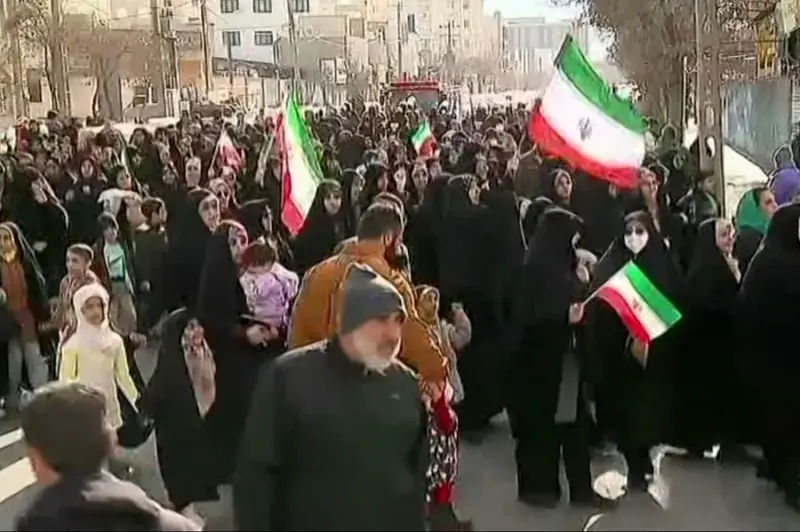

Tehran: Iran has witnessed repeated cycles of protest over the past two decades, typically marked by rapid mobilisation, forceful repression and a return to uneasy stability.
The current wave of demonstrations, which began in late December 2025, appears to be breaking that pattern.
Analysts say what sets this moment apart is not only the scale of unrest but its economic roots and the breadth of social groups now involved.
The immediate trigger was the collapse of the Iranian rial to around 1.4 million to the US dollar, a historic low that coincided with inflation crossing 50 per cent and food prices rising more than 70 per cent year-on-year. Wages, already under strain, lost purchasing power almost overnight. Protests erupted first in Tehran's Grand Bazaar, the traditional centre of Iranian commerce, before spreading rapidly to all 31 provinces.
Read more: 'Some rioters want to please Trump': Khamenei breaks silence on Iran unrest
Observers note that previous uprisings, including the 2009 Green Movement, the 2019 fuel protests and the 2022-23 "Woman, Life, Freedom" demonstrations, were driven primarily by political grievances or social outrage. In contrast, the current unrest reflects a breakdown in everyday economic life. When prices cannot be set, imports cannot be planned and salaries evaporate before payday, the state's ability to regulate daily existence weakens sharply. Analysts quoted by international media have described the moment as a collapse not just of the currency, but of trust.
Another defining feature of the current protests is the speed with which a broad social coalition has emerged. Bazaar merchants, students, professionals, labourers, women and ethnic minorities have all been visible from the early days of the unrest. Smaller towns and economically marginal regions have joined faster than in previous protest waves, underscoring how deeply inflation and currency collapse have affected society.
Slogans heard across major cities increasingly call for an end to the Islamic Republic itself, rather than reform within the system. Reports from international agencies note chants praising Iran's pre-revolutionary monarchy and references to Crown Prince Reza Pahlavi, language that would once have been swiftly and brutally suppressed. While there is no clear consensus on an alternative political model, analysts say the shift reflects growing exhaustion with gradual reform.
Comparisons with Syria have surfaced as protests intensify, but experts caution that Iran's trajectory may be more unpredictable. Unlike Syria, Iran lacks clear ethnic or sectarian strongholds that could act as pressure valves in the event of state fragmentation. The ruling elite itself draws from multiple ethnic backgrounds, and analysts warn that any weakening of central authority could lead to rivalry within security institutions rather than a unified response.
Iran's leadership has acknowledged public hardship while continuing to blame foreign interference. Supreme Leader Ayatollah Ali Khamenei has recognised economic suffering but framed the unrest as part of a Western "soft war". That narrative appears to be resonating less on the streets, where protesters increasingly link domestic economic misery to Iran's regional and nuclear ambitions.
The protests are unfolding at a time when Iran's external position is also weaker. Regional allies have suffered setbacks, nuclear facilities have faced damage from strikes, and economic pressure has intensified. Analysts say the regime's long-standing approach of repression combined with limited concessions no longer restores confidence, even if it still instils fear.
In the short term, a tougher crackdown remains likely. However, analysts widely agree that these protests represent a legitimacy crisis with fewer shock absorbers than in the past. Iran's leadership faces a population that increasingly sees no viable future within the current system, while the opposition remains fragmented and the security forces heavily armed.
History offers no clear outcome. Some regimes endure despite deep illegitimacy; others collapse into prolonged instability. For now, Iran appears caught between those paths, with economic collapse exposing structural weaknesses that repression alone may no longer be able to contain.