




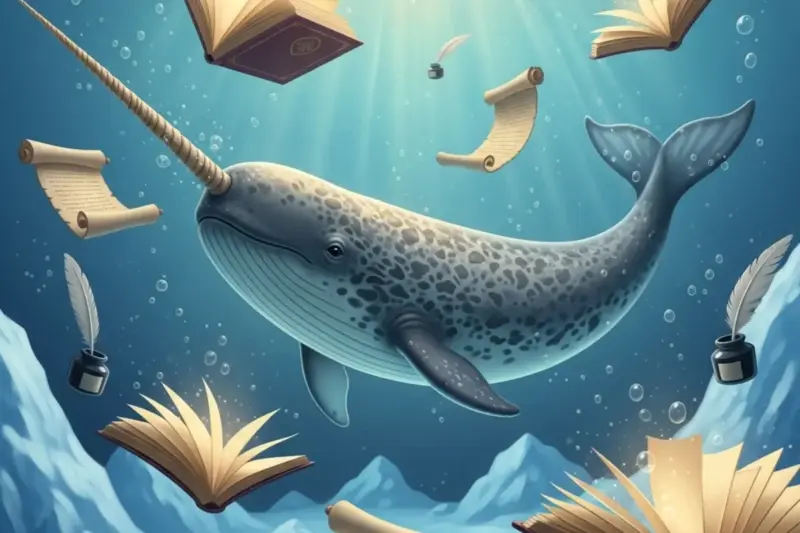

Word of the day: NARWHAL Pronunciation: nar·whal UK/ˈnɑː.wəl/ and US/ˈnɑːr.wəl/
Meaning:
A narwhal is a medium-sized Arctic whale known for its long spiral tusk, which looks like a unicorn horn.
The tusk is actually an elongated tooth that can grow up to 3 metres long.
Example for daily use:
- The narwhal's long tusk makes it one of the most unique animals in the ocean.
- Scientists travelled to the Arctic to study narwhal behaviour.
Origin and history:
The word "narwhal" comes from the Old Norse word "nāhvalr", which translates to "corpse whale". The term combines nār ("corpse") and hvalr ("whale"), likely referring to the animal's pale, dappled grey skin, which resembled the color of a drowned sailor or a dead body.
Early Scandinavian sailors named it this because the whale's grey, mottled skin looked like the pale colour of a drowned body.
Also read word of the day
Cultural significance and modern usage:
- For thousands of years, the narwhal has been vital to Inuit life in Canada and Greenland. Almost every part of the animal is used: meat for food, blubber for fuel, and skin (muktuk), which is a crucial source of vitamin C. The narwhal is considered a key element of cultural identity and traditional, regulated subsistence hunting continues today.
- In mediaeval and Renaissance Europe, narwhal tusks were highly prized, sold as legitimate unicorn horns, and believed to have magical properties, such as detecting poison or curing diseases.
- Due to their extreme rarity and value (sometimes worth more than their weight in gold), tusks were used to create royal items, including the Danish coronation throne and Queen Elizabeth I's scepter.
- Researchers use the narwhal's unique tusk (which has up to 10 million nerve endings) to study sensory capabilities. They are also closely monitored to understand the impact of climate change, as they rely on Arctic sea ice.
- Listed as "Least Concern" by the IUCN, they are still considered "Near Threatened" or of "Special Concern" by other groups due to their sensitivity to climate change and noise pollution from shipping.
- In modern times, the narwhal is often portrayed in media as a "cute" or "enchanting" creature. It is frequently used in popular culture, such as in movies (Elf), cartoon merchandise, and as a symbol of the unique and fragile nature of the Arctic ecosystem.
Interesting facts
- The tusk of a narwhal has millions of nerve endings, which help to sense temperature, pressure, and salinity in water.
- Only male narwhals usually have the tusk; a few females grow smaller tusks, but it is rare.
- Narwhals can dive up to 1,500 metres (nearly a mile) while hunting fish and squid.
Examples from literature:
- He's incredible but real-a narwhal, not a unicorn. - The Mona Lisa Vanishes by Nicholas Day
- "I wonder what happens if you scare a narwhal. Maybe karma gives you a gigantic zit in the middle of your forehead and you get called an ugly unicorn for a month. "- Aru Shah and the End of Time by Roshani Chokshi
- What happened when all the new animals in the north killed off the arctic foxes and belugas and narwhals and polar bears that already lived there? - Two Degrees by Alan Gratz
Synonyms:
- Mammal
- Porpoise
- Baleen
- Beluga
- Cetacean
Read more word of the day here.