
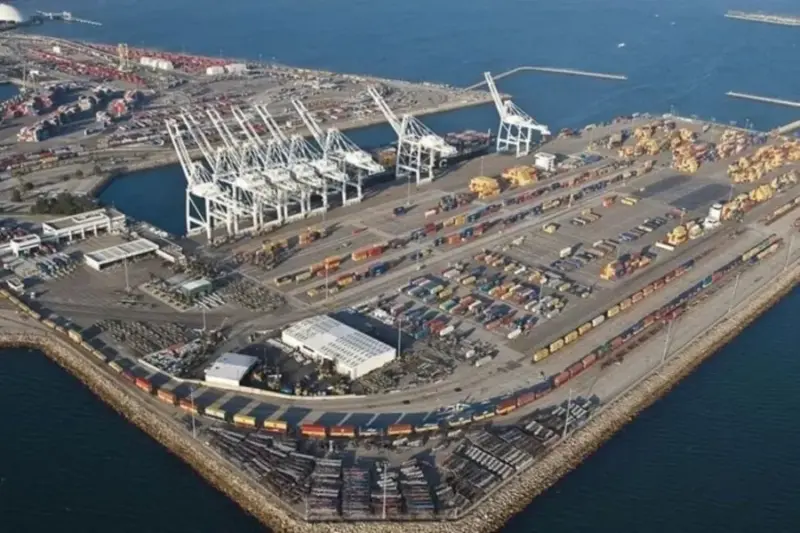

New Delhi: India has intensified its monitoring of the escalating unrest in Iran, as nationwide protests across more than 100 cities threaten the stability of the Islamic Republic and New Delhi's $500 million strategic investment in the Chabahar Port.
Officials in the capital expressed deep concern Friday regarding the continuity of operations at the Shahid Beheshti terminal. While a government official suggested that protesters are unlikely to target the infrastructure directly, the primary fear remains that a protracted crisis or a change in regime could result in indefinite delays for the flagship project.
A Strategic Corridor at Risk
The Chabahar Port serves as India's vital bypass to Pakistan, providing a direct maritime-to-land gateway for its "Connect Central Asia" policy. The port is intended to facilitate trade with landlocked nations, including Kazakhstan, Turkmenistan, and Uzbekistan, which are currently reliant on routes through Chinese or Pakistani territory.
The project is the linchpin of the 7,200-kilometre International North-South Transport Corridor (INSTC). By linking India to the Caspian Sea, Russia, and Europe through a multimodal ship-rail-road network, the corridor is designed to slash transit times by 40% and reduce logistics costs by nearly 30%.
The current volatility, however, threatens the completion of the 628-km Chabahar-Zahedan railway line. Officials noted that internet blackouts and supply chain disruptions in Iran have already slowed infrastructure development and cargo handling, potentially undermining the corridor's long-term efficiency.
Security and Regional Rivalry
The internal situation in Iran has placed immense pressure on security forces. Reports indicate a dip in morale among lower-ranking cadres of the Islamic Revolutionary Guard Corps (IRGC) due to the country's deepening economic crisis. This instability has fostered a sense of insecurity among the port's labour force, who fear they could be caught in the crossfire of anti-government actions.
The geopolitical stakes are amplified by the "Great Game" with China. Located just 170 kilometres away is the Chinese-operated Gwadar Port in Pakistan. For New Delhi, Chabahar is not only a commercial hub but a strategic outpost to monitor Chinese naval movements in the Arabian Sea and Indian Ocean.
"India is mindful that the Chinese are scaling up operations in Gwadar," an official said, adding that any delay at Chabahar allows Beijing to consolidate its regional influence further.
Roots of the Crisis
The mass demonstrations, which began on Dec. 28, 2025, were initially sparked by a collapse of the Iranian Rial and surging costs for food and fuel. What began as a strike by bazaar shopkeepers has evolved into a broader societal movement involving students and the general public, with many now explicitly demanding an end to the current government.
With inputs from IANS