




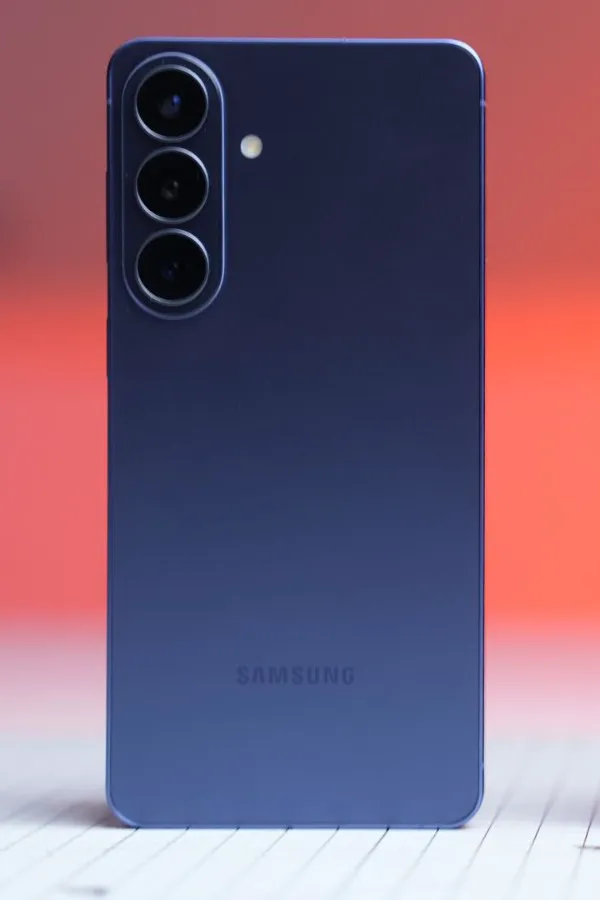

Samsung's Galaxy S26 and S26+ are not the kind of phones that are going to blow you away in a spec sheet comparison.
At ₹87,999 for the vanilla S26 and ₹1,19,999 for the S26+, these are not cheap phones, and on paper, they look remarkably similar to what Samsung was selling last year.
But that is not quite the full story.
 © Hook.Online
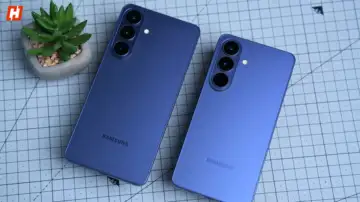
What Samsung has done here is take two already excellent phones and quietly make them better in ways that matter - tighter camera refinements, a surprisingly capable Exynos 2600 chipset that genuinely caught me off guard, and displays that continue to be among the best on any Android device.
The S26 remains one of the finest compact flagships you can buy, and the S26+ sits comfortably above it without asking you to go all the way to Ultra territory. The question is whether that is enough at these prices in 2025.
Samsung Galaxy S26+ and Galaxy S26's Design: Familiar and refined
On the surface, the Galaxy S26+ and the Galaxy S26 look pretty much the same as the phones they replace.
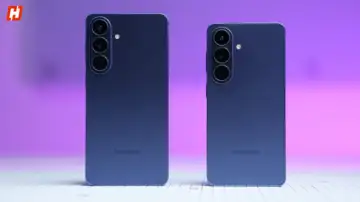
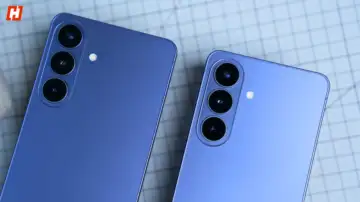
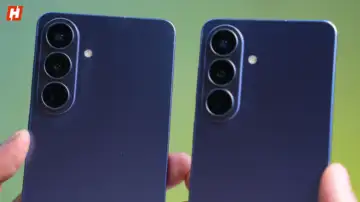
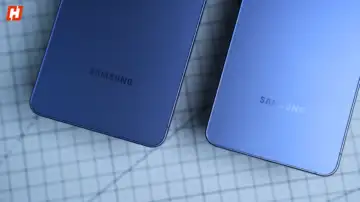
The most noticeable change is the camera module, where the lenses now sit on top of a small raised plateau rather than directly on the back. The deco rings around the cameras are slimmer this year and come in the same colour as the body, making the whole thing look noticeably more polished and refined.
 © Hook.Online
But honestly, beyond that, I had a really tough time telling these apart from last year's models at first. The S26 continues to be one of the best compact Android flagships around, and the S26+ remains that awkward middle child between the vanilla S model and the Ultra.
The dimensions tell a similar story. Both phones carry over the same thickness from last year: the S26+ sits at 7.3mm and the S26 at 7.2mm. That makes both of them significantly slimmer and more manageable than the S26 Ultra, particularly if you have smaller hands.
Weight stays almost identical too. The S26+ comes in at 190 grams, same as the S25+, while the S26 nudges up ever so slightly from 162 to 167 grams.
All of this familiarity is not a bad thing, though. Upon picking up the device, I immediately got the sense that these two are just as well-built as last year's devices. The Armour Aluminium frame and the matte glass back feel grippy and satisfying in hand, and both phones are cold to the touch in a way that feels genuinely premium.
The S26, because of its smaller footprint, is especially comfortable to hold for longer stretches. The matte finish also does a solid job of hiding fingerprints, the Cobalt Violet colourway in particular.
One thing worth flagging: the camera plateau causes a slight wobble when the phones are laid flat on a table. The S26+ wobbles a touch more than the S26, but it is not significantly worse than what we saw last year, so nothing to lose sleep over.
 © Hook.Online
Protection credentials are strong across both phones. You get Gorilla Glass Victus 2 on the front and back, an Armour Aluminium frame, and IP68 water resistance throughout.
Connectivity is well sorted too. Both phones come with WiFi 7, Bluetooth 5.4, NFC, and a USB 3.2 Type-C port with DisplayPort 1.2 support, which remains a rare feature even among flagships. The only miss is an IR blaster, which, for the life of me, I still don't understand why Samsung skips out on.
Colour options in India are Cobalt Violet and Black for the S26+, with Pink Gold and Silver Shadow available on Samsung's website. The S26 adds Sky Blue and White to that list.
Samsung Galaxy S26+ and Galaxy S26's Displays: Solid, as always
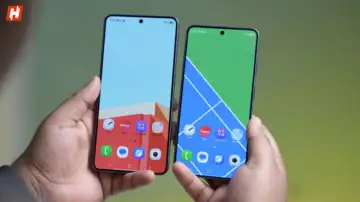
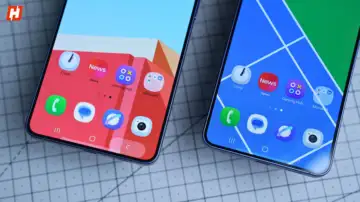
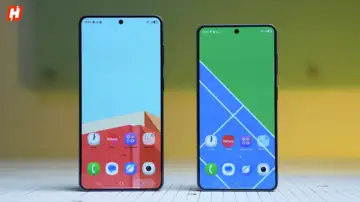
Like design, Samsung has reserved most of the display upgrades for the Ultra. The S26+ carries over its 6.7-inch panel from last year, while the vanilla S26 gets a slight bump to 6.3 inches, up from 6.2 inches.
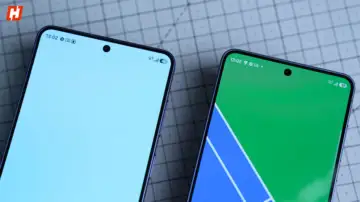
I found the bezels on both phones are razor thin and appear to have shrunk further, though Samsung is yet to share official numbers.
Beyond that, it is largely the same story on both phones. You get 120Hz refresh rates, a peak brightness of 2600 nits, and HDR10+ support across the board.
Both panels are also LTPO, meaning refresh rates shift dynamically between 1Hz and 120Hz depending on what is on screen. At 1Hz, the display can power an always-on clock or you can quickly take a look at notifications without meaningfully touching the battery.
 © Hook.Online
Resolution is where the two phones diverge. The S26+ holds on to its 1440p panel, while the S26 stays at 1080p. That said, on a 6.3-inch screen, I think 1080p is more than adequate, as you land at a pixel density of 411ppi.
The S26+ though, is the sharpest phone in the S26 lineup, edging out even the Ultra with a pixel density of 516ppi against the Ultra's 500ppi.
And for those of you wondering if you get the Privacy Display, it remains exclusive to the Ultra.
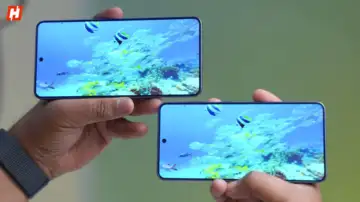
Living with it, though, I really cannot complain about these displays. Both are Dynamic AMOLED 2X panels, so colour reproduction is among the best I have seen on a smartphone, regardless of what the spec sheet says.
Even though these are 8-bit panels, colour banding is handled surprisingly well. The blacks are deep and inky, colours are vivid, and streaming content looks genuinely stunning. There is no Dolby Vision certification, but with HDR10+ doing the heavy lifting, HDR content on Netflix held up brilliantly during my time with both phones.
 © Hook.Online
Outdoor visibility was equally impressive, even under Delhi's punishing summer sun, I had no trouble reading maps, texts or music apps without any strain.
Both phones also hide an ultrasonic fingerprint scanner under the display, positioned well and easy to reach. It was quick, accurate, and did not fail me once during testing.
Rounding out the multimedia experience, both the S26 and S26+ come with stereo speakers. The S26+ has a slight edge here; its larger size gives the audio a bit more depth and body, though both get impressively loud. There is no headphone jack, but wireless audio is well catered for, thanks to codecs like aptX, aptX HD, Samsung's SSC, and your standard codecs like AAC, SBC and LDAC.
Samsung Galaxy S26+ and Galaxy S26's Cameras: Still impressive
Samsung has taken a refinement-first approach with the cameras on the S26 and S26+ this year. On paper, not much has changed. Both phones come with the same familiar triple camera setup: a 50MP main sensor, a 12MP ultrawide, and a 10MP 3x telephoto.
On the front, you get a 12MP selfie camera, though with a slightly wider field of view this time around, which I found genuinely useful for framing.
 © Hook.Online
It is not a dramatic overhaul, but after spending time with both phones, it is clear that Samsung has focused on consistency and reliability over headline-grabbing spec bumps.
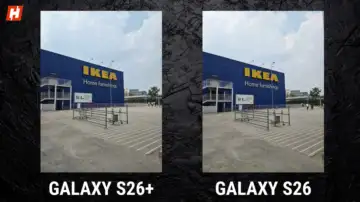
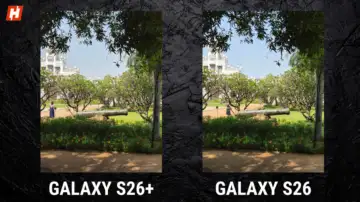
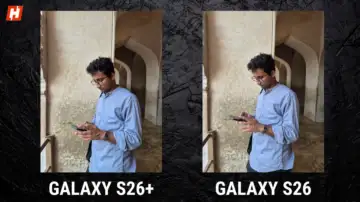
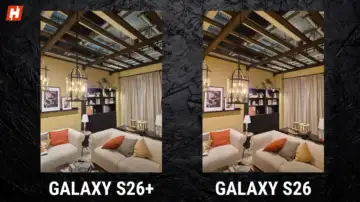
In daylight, the main camera is excellent. Photos come out detailed, with natural textures, well-balanced colours, and strong dynamic range. Highlights and shadows are both handled confidently, and there is a subtle grain in darker areas that actually makes images feel more natural rather than over-processed. Portrait shots are clean, with accurate skin tones and solid subject separation, though the background blur can occasionally feel a touch heavy-handed.
 © Hook.Online
 © Hook.Online
 © Hook.Online
 © Hook.Online
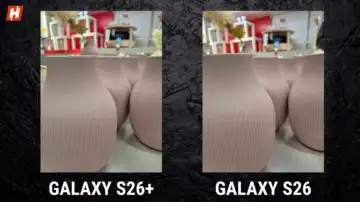
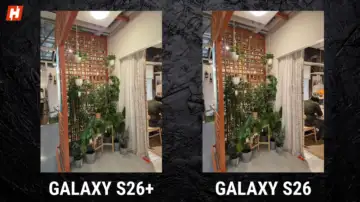
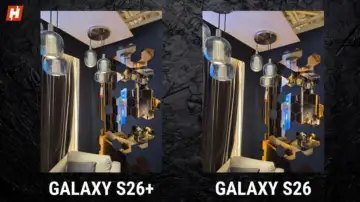
The 2x crop from the main sensor is something I found myself reaching for more than I expected, particularly for portraits, where it delivers strong detail without any meaningful quality drop. The 3x telephoto holds its own too, although its not the most detailed in its class, but colours and dynamic range are solid enough for everyday use. They top out at 30x, but to be honest, I have seen better water coloured postcards than what you get at that magnification.
 © Hook.Online
 © Hook.Online
 © Hook.Online
 © Hook.Online
The ultrawide is at its best outdoors, capturing vibrant colours and decent detail for landscapes and group shots. I would not lean on it for close-ups, but for wide scenes it does the job well. Selfies were one of the highlights of my time with both phones: sharp, well-exposed, and the wider lens made framing noticeably easier.
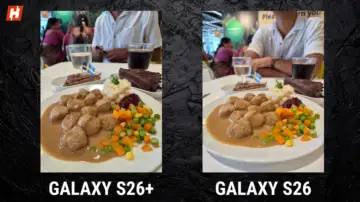
Low light is where things get interesting. Samsung's new automatic Night mode runs in the background and does a good job when it engages properly, pulling in more detail and reducing noise. That said, I found manually triggering it gave more consistent results. For those who want deeper control, the Camera Assistant app unlocks additional options worth exploring.
 © Hook.Online
 © Hook.Online
Video is another strong suit. You can shoot up to 4K at 60fps across all three cameras, and 8K on the main sensor. Daylight footage looks sharp and well-graded, low-light video holds up reasonably well, and stabilisation is reliable throughout. Like the S26 Ultra, the S26 and the S26+ also support Horizon Lock. And yes, like the Ultra, you also get the ability to shoot in Log, and use LUTs.
The S26 and S26+ cameras are not trying to reinvent anything. What they are doing is delivering a dependable, polished experience that holds up consistently - and in daily use, that matters more than chasing specs.
Samsung Galaxy S26+ and Galaxy S26's Performance: Exynos' unbelievable surprise
Performance is where things get interesting, and there is at least one result in here that genuinely caught me off guard.
Unlike the S25 and S25+, Samsung has gone back to Exynos for the non-Ultra models this year, with the new Exynos 2600 powering both the S26 and S26+. Samsung has done this before, but after the Snapdragon 8 Elite for Galaxy on last year's non-Ultra models, it is a notable shift.
The difference in approach is clear on paper too; the Snapdragon 8 Elite Gen 5 on the Ultra is an octa-core chip, while the Exynos 2600 is a deca-core. But Samsung clearly backed this chipset with confidence, and for the most part, that confidence is justified.
Paired with 12GB of RAM across both the 256GB and 512GB storage variants, the Exynos 2600 handles everyday tasks without breaking a sweat. Scrolling through the UI, browsing social media, scrolling through reels, all of it is buttery smooth.
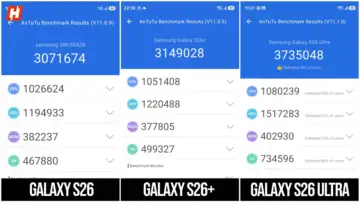
The benchmark numbers tell an interesting story.
In AnTuTu, the S26 scored 3.07 million and the S26+ scored 3.14 million, with the S26 Ultra pulling ahead at 3.73 million. No surprises here.
 © Hook.Online
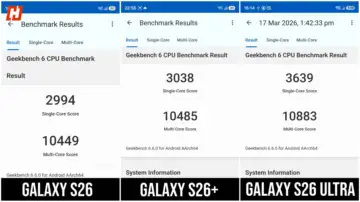
The gap narrows in Geekbench, particularly in multicore performance. The S26 posted single-core and multicore scores of 2,994 and 10,449 respectively; the S26+ came in at 3,038 and 10,485, and the Ultra topped out at 3,639 and 10,883. Again, solid numbers across the board, nothing that had me reaching for a double-take.
 © Hook.Online
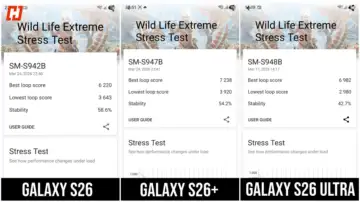
That came in the 3DMark Wildlife Extreme Stress Test.
The S26 posted a best loop score of 6,220 and a worst of 3,643, for a stability rating of 58.6 per cent. The S26+ went even further, with a best of 7,238 and a worst of 3,920, at 54.2 per cent stability.
The S26 Ultra, surprisingly, came in last on two important counts. Yes, it had a best loop score of 6,982, but more importantly, a worst score of of just 2,980, and a stability rating of 42.7 per cent.
 © Hook.Online
The Exynos phones not only outlasted the Snapdragon in sustained GPU performance, but it also failed to outscore it at the top-end. This is is not something that I expected going in.
Gaming held up well, too. BGMI and CoD: Mobile ran at a smooth 120fps with no dropped frames. The phones do get slightly warm over extended sessions, as most flagships do, but thermal management is noticeably better here.
The vapour chamber is larger and, according to Samsung, better designed than last year's models, and Samsung's new application of the thermal interface material keeps temperatures in check both in gaming and under benchmark loads.
All of this is fine for now. The real test, however, will be seeing how the Exynos 2600 holds up over the long run against the Snapdragon-equipped Ultra. Right now, though, it is putting up a much stronger fight than I had expected.
Samsung Galaxy S26+ and Galaxy S26's Software & UI: The Ultra experience, almost
Both the Galaxy S26 and S26+ run on One UI 8.5, based on Android 16, and the software experience is essentially identical to what you get on the S26 Ultra. The only thing missing here is anything S Pen-related, which is exclusive to the Ultra.
Everything else, including all of the Galaxy AI features, trickles down in full. So if you have already read our S26 Ultra review, you know exactly what to expect here.
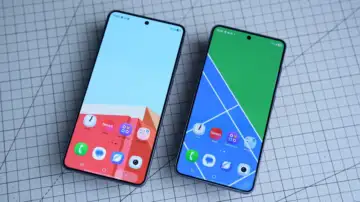
One UI 8.5 itself looks clean, fluid, and well put together. Animations are smooth, navigation feels snappy, and the overall experience is polished in a way that only Samsung and Apple consistently manage to pull off.
 © Hook.Online
That said, one old frustration refuses to go away. Samsung continues to ship two versions of essentially every core app, one from Google, one from Samsung. Two browsers, two app stores, two note apps, two voice assistants. It has been this way for years, and while it is not a dealbreaker, it is the kind of unnecessary clutter that clutters the app drawer and quietly irritates you the longer you live with the phone.
On the AI front, Samsung goes all in. Photo Assist gets a meaningful upgrade this year, letting you edit photos by simply describing what you want changed; you either type it or say it out loud. Want to swap your hat colour or remove a distracting background element? You can do it conversationally now. Samsung does slap a generated by AI watermark on the result, which I think is the right call.
Bixby gets smarter too, with better natural language understanding and the ability to pull in web results. But I will be honest, I still cannot see many people choosing Bixby over Gemini Live.
 © Hook.Online
The more interesting addition is Perplexity AI, which you can summon by saying "Hey Plex." It has access to system and third-party apps and can handle multi-step tasks, which makes it a genuinely useful alternative to the default assistant experience.
Document Scan also benefits from AI this cycle, doing a noticeably better job of correcting distortions and cleaning up scans.
And Now Brief and Now Nudge have both been refined. Brief is more proactive at organising your day from your calendar and messages, while Nudge drops contextual suggestions as you work through tasks. Subtle, but useful once you get used to it.
For updates, Samsung is promising seven years of OS updates and security patches for the entire S26 lineup. That matches Google's commitment to the Pixel series and puts Samsung among the most generous in the Android space when it comes to long-term software support.
Samsung Galaxy S26+ and Galaxy S26's Battery: Room for improvement
As far as battery and charging go, there is virtually no change on the S26+. It sticks with a 4900mAh battery, 45W wired charging, and PD 3.0, though wireless charging does see a welcome bump from 15W to 20W. The vanilla S26 gets a minor capacity upgrade, moving from 4000mAh on the S25 to 4300mAh, though charging speeds remain unchanged at 25W wired and 15W wireless.
 © Hook.Online
Both phones charge from zero to full in just over an hour. The S26 takes a hair longer despite its smaller battery, simply because of the slower charging speeds. Neither phone comes with magnets for MagSafe-style charging, so you will need Qi 2.2 cases for the S26+ and Qi 2 for the S26. Both also support 4.5W reverse wireless charging for accessories like Galaxy Buds.
Battery life has been solid on both phones. I was consistently pulling six to seven hours of screen-on time across the S26 and S26+, even with heavy, high-brightness outdoor usage in Delhi's summer heat.
However, I have a gripe. Competitors are now offering larger capacities and faster charging. Samsung needs to address this, the modest battery sizes, but more importantly, the sluggish 25W on the base S device. It just doesn't cut it anymore.
Verdict: The best compact Android, and the awkward middle child
After spending considerable time with both phones, I came away more impressed than I expected to be, particularly with the Exynos 2600's performance.
The S26 is an easy recommendation for anyone who wants a compact, well-built flagship that does everything well without demanding Ultra money. At ₹87,999, it is hard to argue with what you are getting.
 © Hook.Online
The S26+, at ₹1,19,999, is a tougher sell. Historically, it has been a tougher sell, especially because of the Ultra. The S26+ is an excellent phone, but the gap between it and the Ultra is now narrower than ever before. The middle child is now more awkward than it has ever been.
But taken as a whole, the S26 and S26+ are polished, capable, and dependable in all the ways that count. Samsung may not have reinvented anything, but it has refined nearly everything.