




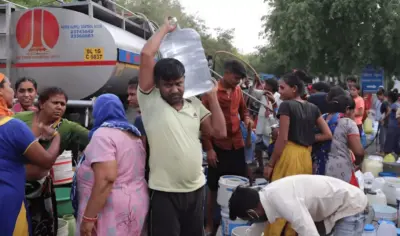

Every day, Delhi's vast water network supplies millions of homes, schools, hospitals, industries and offices by drawing water from rivers, treating it at multiple plants and distributing it through thousands of kilometres of pipelines.
As the Capital continues to grow, managing this system has become increasingly challenging. Delhi has an installed water supply capacity of nearly 1,000 MGD, but peak summer demand rises to 1,200-1,260 MGD, leaving a deficit of around 250 MGD. With over 90 per cent of its raw water sourced from neighbouring states through the Yamuna, Bhakra and Munak canal systems, the city's water security depends not only on its infrastructure but also on interstate cooperation, river flows and seasonal conditions.
Officials say the Delhi Jal Board (DJB) has estimated that the city requires an additional 528 cusecs of raw water to operate four proposed water treatment plants at Dwarka Phase-II, Chhatarpur, Iradat Nagar and Najafgarh. These projects are expected to strengthen the Capital's supply network in the coming years, but they depend on securing additional water allocations from neighbouring states.
Recent weeks have brought some relief. A visit by Millennium Post to the Wazirabad Water Treatment Plant offered a first-hand look at the scale of Delhi's water supply operations. Officials said improved inflows through the Munak canal have increased production from 890 MGD to nearly 945 MGD while continuous laboratory testing and automated monitoring are carried out to ensure treated water meets quality standards before entering the distribution network. They added that contamination complaints reported from some localities are often linked to ageing pipelines and distribution infrastructure rather than the treatment process itself.
When Daily Life Follows the Water Schedule
Behind these numbers are the everyday experiences of millions of Delhiites for whom water availability shapes daily routines. Across several neighbourhoods, residents have learnt to plan household chores, work schedules and even sleep around the hours when water is expected to arrive.
In colonies such as Tughlaqabad and Sangam Vihar, water is supplied on alternate days, often between midnight and the early hours of the morning. Families store as much water as possible because missing the scheduled supply can mean waiting another two days.
Ruksar, a resident of Tughlaqabad, says careful planning has become essential. "Our family of five depends on a 1,000-litre storage tank that has to last for two days. During summer, the stored water becomes hot, so we use it very carefully. Buying water from private suppliers costs around ₹500 for an hour's supply, which many families cannot afford."
Another resident says the household keeps multiple alarms through the night. "If we miss the supply, we have to wait for another cycle. Someone always has to stay home to operate the motor, so our routine revolves around the water schedule."
In neighbouring Sangam Vihar, Rahul says limited municipal supply has affected even drinking water arrangements. "Installing an RO system is difficult because water comes only on alternate days. We end up buying drinking water, but sometimes even that has an unpleasant smell."
For residents of Wazirabad, however, the concern is increasingly about quality rather than quantity. Several residents say that while water continues to reach their homes, its condition has changed over the past few years.
"Earlier we could drink the water after basic filtration," one resident recalls. "Now it often smells unpleasant and appears dirty, leaving us worried about using it even for daily household work."
Others say reduced pressure has made matters worse. "Sometimes the flow stops without warning, and women wake up in the middle of the night just to fill utensils. Tankers do arrive, but there are complaints that some charge more than the prescribed rates," a resident says.
Similar concerns have surfaced from other parts of the city. In Malviya Nagar, residents say water often arrives without a fixed schedule and remains available for barely half an hour, forcing families to store enough for the next day. In Gulmohar Park, while supply has improved compared to previous years, several residents complain of muddy and foul-smelling water, with some linking it to stomach and skin ailments. Households in Hauz Khas have even sent water samples for laboratory testing after repeated complaints, while residents of Defence Colony have also reported discoloured supply. In Abul Fazal Enclave, yellow-coloured water has become a familiar concern, and in Ghazipur, some residents claim clean pipeline water is increasingly rare, with occasional reports of worms in the supply.
These experiences illustrate that Delhi's water challenge is no longer defined solely by shortages. Reliability, quality and equitable distribution have become equally important aspects of the conversation.
Beyond Supply: Ensuring Every Drop Reaches Safely
Delivering water to a city the size of Delhi does not end at treatment plants. Once treated water enters the distribution network, it travels through thousands of kilometres of pipelines before reaching consumers. While some neighbourhoods struggle with irregular supply, others are increasingly concerned about the quality of the water flowing into their homes.
This summer, complaints of foul-smelling, muddy and discoloured water surfaced from several parts of South, East and West Delhi. Residents in Gulmohar Park said that although water availability had improved compared to previous years, concerns over quality persisted. Some families reported stomach ailments and skin-related issues, prompting them to rely on packaged drinking water. In Hauz Khas, repeated complaints led several residents to send water samples for laboratory testing, while households in Defence Colony also reported muddy water. In Abul Fazal Enclave, residents said yellow-coloured water had become a regular occurrence, and in parts of Ghazipur, people claimed that clean pipeline water was becoming increasingly rare, with some even reporting worms in the supply.
Officials believe many of these problems stem from ageing infrastructure rather than failures at water treatment plants. According to senior Delhi Jal Board officials, inspections in several localities have revealed pipelines that have been in service for decades and are now prone to leakages and damage. "Replacing these pipelines is a long-term exercise, but it is essential because ageing infrastructure contributes to contamination as well as reduced water pressure," an official said. Another official explained that during periods of water shortage, the department often reduces pressure across the network to ensure supply reaches tail-end colonies instead of remaining concentrated in a few areas. "It is not an ideal solution, but it helps maintain equitable distribution while infrastructure upgrades continue," the official added.
Delhi Jal Board's recent surveillance indicates that water quality remains satisfactory across most parts of the Capital while highlighting areas requiring closer attention. Between June 11 and 23, the Office of the Director (T&QC), Water Works, Wazirabad, tested 5,478 water samples, of which 5,177 (over 94%) met prescribed quality standards. The remaining 301 samples (5.5%) were found unsatisfactory, with repeated instances reported from parts of Greater Kailash, Okhla, Dwarka, Nangloi and Bhagirathi/TYR. Officials attributed the issues largely to distribution-related problems such as low residual chlorine, turbid, muddy and sewage-mixed water, underscoring the need for continued monitoring, timely maintenance and pipeline upgrades.
The condition of Delhi's distribution network is reflected in the volume of water lost before it reaches consumers. Government estimates indicate that nearly 40 per cent of treated water is lost through leakages, theft, unauthorised connections and ageing pipelines. The Comptroller and Auditor General (CAG) report pertaining to the Aam Aadmi Party (AAP) period has estimated non-revenue water losses between 45 and 53 per cent, significantly higher than the global average of around 15 per cent. The report also observed that nearly 30 lakh households remain without formal water connections, increasing dependence on illegal extraction and further straining the network.
Multiple Agencies, One Shared Responsibility
Managing water quality in Delhi involves more than one institution. While the Delhi Jal Board supplies water, the Municipal Corporation of Delhi (MCD) monitors public health by regularly testing water samples to prevent outbreaks of diseases such as cholera, diarrhoea, dysentery, hepatitis A and typhoid. Officials say residual chlorine levels are routinely checked, and whenever contamination is reported, samples are immediately sent for microbiological testing. Recent complaints have been concentrated in parts of West and South Delhi, including Dwarka, Janakpuri and Gulmohar Park. Investigation reports are subsequently shared with the Delhi Jal Board for corrective measures. "Close coordination between agencies is critical to resolving complaints quickly," an MCD official said.
Within the New Delhi Municipal Council (NDMC) area, water distribution follows a slightly different model. While NDMC supplies water to consumers, it depends entirely on the Delhi Jal Board for bulk supply. During June, repairs, pipeline leakages and reduced inflow from the Hasanpur Underground Reservoir feeder line led to temporary disruptions in localities including Vinay Marg, Sarojini Nagar, South Avenue, Teen Murti Marg and nearby government residential areas. During these interruptions, NDMC activated its 24-hour control room and deployed water tankers while advising residents to conserve water until normal supply resumed.
Building a Stronger Water Network
Even as authorities address immediate concerns, the focus is increasingly shifting towards strengthening Delhi's long-term water infrastructure. Water Minister Parvesh Verma told Millennium Post, the present challenges are the result of years of ageing infrastructure and underinvestment rather than a single season's crisis. "This is not a problem that developed overnight. Old pipelines, untreated sewage and years of inadequate maintenance have created today's situation. We have begun replacing damaged pipelines, plugging leakages, introducing GPS-enabled monitoring of water tankers and improving the overall distribution network," he said.
The Delhi government is also working on a comprehensive Water Master Plan aimed at modernising the city's water distribution system and reducing losses. Experts believe that even a modest reduction in non-revenue water could significantly improve supply without creating new sources.
To strengthen future availability, the Delhi Jal Board has approached the National Green Tribunal (NGT) for permission to operationalise more than 100 borewells along the Yamuna floodplains, which are expected to add 30-40 MGD of water during peak demand. At the same time, officials continue discussions with neighbouring states for the additional 528 cusecs of raw water required to operate four upcoming treatment plants at Dwarka Phase-II, Chhatarpur, Iradat Nagar and Najafgarh.
Delhi is also looking beyond immediate measures. The long-pending Kishau Dam Project, discussed at a meeting chaired by Union Home Minister Amit Shah, is expected to eventually provide around 372 MGD of water to the Capital. Two other proposed projects, the Giri River Project in Himachal Pradesh and the Lakhwar Dam Project in Uttarakhand, are projected to contribute another 275 MGD and 216 MGD, respectively. Although these remain long-term initiatives, officials believe they will play a vital role in meeting the city's future water requirements.
At the Wazirabad Water Treatment Plant, plans are also underway to desilt the raw water pond. The Rs.25-crore project proposes removing 3.63 lakh cubic metres of silt, which is expected to increase storage capacity by nearly 100 MGD, improving operational efficiency during periods of high demand.
Building for the Future
While managing daily water supply remains an immediate priority, Delhi is also investing in long-term infrastructure to make its water system more resilient. Over the past year, the Delhi Jal Board (DJB) has accelerated projects aimed at expanding sewage treatment, strengthening sewer networks and improving wastewater management. Officials say the objective is not only to improve sanitation but also to reduce pollution in the Yamuna and make better use of treated water.
During the current financial year, the DJB completed the upgradation and capacity enhancement of 10 sewage treatment plants (STPs) with an investment of Rs.2,014.98 crore. The projects, covering facilities at Keshopur, Kondli, Rohini, Coronation Pillar, Narela, Yamuna Vihar, Najafgarh, Nilothi and Pappankalan, upgraded 305 MGD of existing treatment capacity while adding another 70 MGD. Officials say these projects will help the city treat more wastewater while ensuring compliance with stricter environmental standards.
The government has also awarded 14 sewerage and treated-effluent projects worth Rs.498.68 crore. These include laying new sewer lines in Karawal Nagar, Hasanpur, Tajpur Khurd and Sangam Vihar, providing household sewer connections in several colonies, upgrading the Molar Band STP and expanding treated-water pipelines from the Yamuna Vihar treatment plant. In addition, large-scale desilting of Delhi's 11,450-kilometre sewer network is underway. Around Rs.200 crore has been allocated for trunk sewer cleaning through 30 packages, while 16 jetting-cum-suction machines, procured at a cost of Rs.18.6 crore, have been deployed to clean peripheral sewer lines. Officials believe these measures will reduce sewer overflows, improve drainage and minimise contamination risks during the monsoon.
Work is also continuing on improving the Interceptor Sewer Project, which was designed to divert untreated sewage away from the Yamuna and channel it to treatment plants. While officials acknowledge that delays and incomplete works affected its performance in the past, they say future improvements are being planned with better coordination between sewer interception and treatment infrastructure.
Managing Water More Sustainably
Experts believe that while expanding infrastructure is important, Delhi's long-term water security will ultimately depend on how efficiently it manages the resources already available. Although the Capital imports more than 90 per cent of its water, it receives an average annual rainfall of 744.4 mm, most of it during the monsoon. According to experts, a 100 mm rainfall event alone could help conserve nearly 17,600 million gallons of water through effective rainwater harvesting, enough to meet almost 14 days of Delhi's current demand. Despite rainwater harvesting being part of the city's planning framework since 2001, implementation and monitoring continue to lag.
Groundwater also remains under stress. According to the Central Ground Water Board, Delhi's groundwater extraction rate improved from 100.77 per cent in 2024 to 92.1 per cent in 2025, but the pressure on aquifers remains significant. Environmental experts also point to the rapid loss of natural water bodies. Some media reports reveal a University of Delhi study found that South Delhi lost nearly 97 per cent of its wetlands between 1991 and 2021, while built-up areas expanded by more than 70 per cent. In addition, over 75 percent of the Yamuna floodplain's 9,700 hectares has been encroached upon, limiting the city's natural ability to recharge groundwater and manage floods.
Wastewater reuse presents another significant opportunity. Although Delhi has a sewage treatment capacity of around 794 MGD, only about 584 MGD is currently treated. Experts say greater use of treated water for landscaping, construction, industrial operations and cooling systems could reduce dependence on freshwater and improve overall water efficiency.
Delhi's water story is no longer only about meeting rising demand, it is increasingly about managing existing resources more effectively. Investments in new treatment plants, sewer infrastructure, pipeline replacement and future projects such as the Kishau Dam, Giri River Project and Lakhwar Dam signal a long-term commitment to strengthening the Capital's water network. At the same time, experts emphasise that infrastructure alone cannot ensure water security. Reducing distribution losses, expanding rainwater harvesting, protecting wetlands and floodplains, improving wastewater reuse and encouraging responsible water use will be equally important. As Delhi continues to grow, its ability to secure every drop will depend on sustained investment, coordinated governance and active participation from both institutions and citizens.