




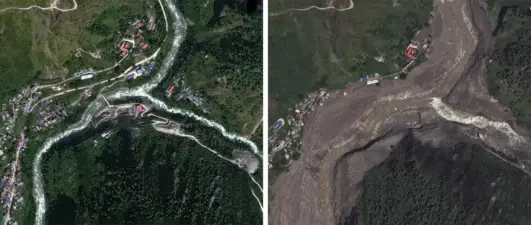

Nepal is once again racing against time. Two days after a catastrophic flash flood tore through the country's northern mountains, rescuers are digging through mud, rocks and debris in the hope of finding survivors.
The disaster, triggered by a massive glacier-and-rock collapse near the Nepal-Tibet border, unleashed a torrent through the river system, sweeping away homes, roads, bridges, power infrastructure and entire stretches of human habitation. The scale of the devastation is still unfolding, with hundreds confirmed dead and many more missing.
Watching these images, I am inevitably taken back to April 2015.
Then, Nepal was shaken by a magnitude 7.8 earthquake. The earth itself seemed to move beneath the feet of its people. Kathmandu and large parts of the country were devastated; villages disappeared under rubble, historic structures collapsed, and thousands lost their lives. Nearly nine thousand people were killed, and millions were affected.
I remember the extraordinary courage of ordinary Nepalis during those terrible days. But I also remember something else: how geography can turn a natural hazard into a national catastrophe.
The earthquake of 2015 came from beneath the earth. The disaster of 2026 has come from the mountains and the sky. One was a manifestation of Nepal's location in the collision zone between the Indian and Eurasian tectonic plates; the other was a frightening reminder of how rapidly the Himalayan environment is changing. Nepal is particularly exposed to earthquakes, floods and landslides, and is ranked among the world's highly vulnerable countries for both earthquakes and multiple hazards.
This is what makes Nepal's predicament so extraordinary. It is not simply that the country experiences disasters. It is that several hazards converge in the same fragile landscape.
The Himalayas are young, geologically unstable mountains. Steep slopes, fragile terrain and powerful rivers create an inherent vulnerability. Now climate change is adding another layer of uncertainty. Rising temperatures are accelerating glacier and permafrost melt, potentially destabilising ice and rock formations and increasing the risk of avalanches, landslides and glacial lake outburst floods. Scientists are increasingly warning that a warmer Himalaya could mean a more volatile Himalaya.
The consequences do not stop at Nepal's borders.
The rivers descending from the Himalayas flow into India and eventually Bangladesh. A disaster in the high mountains can therefore become a flood emergency hundreds of kilometres downstream. The Gandak, Kosi, Karnali and other river systems connect the Himalayan hazard zone with densely populated plains. What begins as a landslide, glacier collapse or cloudburst in Nepal can rapidly become a humanitarian and economic problem for neighbouring countries.
That is why Nepal should not be viewed merely as a country that suffers occasional natural calamities. It is becoming a kind of natural-disaster laboratory for South Asia-where tectonic instability, fragile mountain geology, extreme rainfall, rapidly changing glaciers and expanding human settlements are converging.
But there is an important distinction between a hazard and a disaster. Earthquakes cannot be prevented; glaciers cannot be ordered to remain stable; monsoon clouds cannot be controlled. What can be changed is vulnerability.
The lesson of 2015 should therefore meet the lesson of 2026. Nepal needs to move from disaster response to disaster anticipation: dense early-warning networks, real-time river and glacier monitoring, hazard mapping, resilient infrastructure, safer settlements and trained local responders. And because the rivers and mountains do not respect political boundaries, India, Nepal, Bhutan, China and Bangladesh need far greater regional cooperation in sharing hydrological, meteorological, seismic and glacial information.
The tragedy unfolding today is therefore more than another natural disaster. It is a warning. In 2015, the earth shook beneath Nepal. In 2026, the mountains themselves appear to have moved. The message is unmistakable: South Asia's disaster geography is changing, and Nepal is at its frontline. The real question is no longer whether the next disaster will come. It is whether the region will be prepared when it does.
Views expressed are personal. The writer is former NDRF DG who led India's rescue team during 2015 Nepal earthquake