




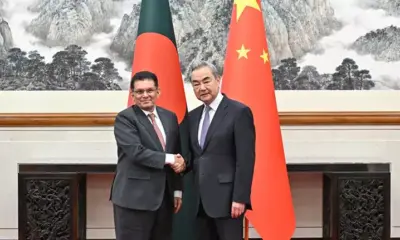

Foreign Minister of Bangladesh, Khalilur Rahman, has very recently concluded a three-day official visit to China, marking his first-ever trip to China since the new Bangladeshi government under the Bangladesh Nationalist Party (BNP) assumed office in February this year.
The visit signifies the stability, continuity, and pragmatic orientation of China-Bangladesh relations, as perceived by official circles in both countries.
In the wake of the political transition in August 2024, Bangladesh continued to maintain consistent engagement with China across official and non-governmental channels. At the governmental level, in January 2025, Touhid Hossain, then Adviser for Foreign Affairs in Bangladesh's interim government, visited Beijing and held talks with his Chinese counterpart, Wang Yi. In addition, major Bangladeshi political parties, civil society organisations, academic institutions, research centres, student associations, and media representatives have continued to engage with their Chinese counterparts in various fields. These multifaceted interactions have significantly enhanced mutual understanding and reinforced bilateral trust. These trends indicate considerable promise for further strengthening relations between the two countries.
Meanwhile, according to Zhang Xiaoyu, Director of the South Asian Communication Studies Centre at the Academy of International and Regional Communication Studies, Communication University of China, political stability is instrumental to Bangladesh's long-term development. He has opined that, following this year's peaceful general election and orderly transfer of power, Bangladesh has entered a new phase of development. Accordingly, cultivating and managing constructive relations with major countries has become a central priority for the new government. Coincidentally, this year also marks the 10th anniversary of Bangladesh's participation in the Belt and Road Initiative (BRI).
Furthermore, previous years witnessed tens of billions of dollars in committed investments, primarily directed towards large-scale infrastructure projects in transportation, energy, and information and communications technology. A series of transformative projects, some implemented directly under BRI frameworks and others enabled through BRI-facilitated financing, technical collaboration, or policy coordination, have significantly enhanced Bangladesh's transport networks and power generation and distribution capacity. Looking ahead, bilateral cooperation holds substantial potential for further refinement and deepening, particularly in emerging priority areas such as the digital economy.
In addition, the political mutual trust between the two countries manifests itself across multiple dimensions. Bangladesh firmly supports the One-China principle and opposes "Taiwan independence", a position that is particularly important for safeguarding China's core interests. The two countries have also coordinated closely on broader regional and global issues, including efforts to resolve the Middle East conflict, and have reached a shared understanding on key principles such as upholding multilateralism, resolving disputes through peaceful means, and advancing the vision of a multipolar world order.
In his meeting with Bangladeshi Foreign Minister Rahman on May 6, Chinese Foreign Minister Wang Yi clearly stated that China respects Bangladesh's independence, sovereignty, and national dignity, as well as the development path and political system chosen by its people. He reaffirmed China's support for Bangladesh in pursuing an independent foreign policy. According to Rahman, the new Bangladeshi government attaches high importance to its relations with China and stands ready to strengthen coordination with Beijing to jointly safeguard multilateralism.
During the visit, the two sides reaffirmed their commitment to the purposes and principles of the United Nations Charter, multilateralism, democracy in international relations, and the peaceful settlement of disputes. On regional issues, Bangladesh highly appreciated China's proposals for safeguarding peace and stability in the Middle East, while both sides called for an immediate and comprehensive ceasefire, protection of non-military targets, restoration of peace and security, and the maintenance of normal passage through the Strait of Hormuz. Regarding the Rohingya crisis, China stated that it would continue supporting Bangladesh and Myanmar in finding a mutually acceptable solution to the issue of forcibly displaced people from Rakhine State through dialogue and consultations. It also pledged to continue supporting repatriation efforts to the best of its capabilities. Khalilur Rahman invited the Chinese Foreign Minister to visit Bangladesh at a mutually convenient time.
Most significantly, however, the meeting highlighted that the Teesta River issue could offer an opportunity for Bangladesh to cooperate with China. Dhaka has stated that it has sought China's involvement and support in the Teesta River Comprehensive Management and Restoration Project (TRCMRP), while the Chinese side has expressed its willingness to participate proactively in the initiative. This development appears significant and cannot be ignored by strategic thinkers concerned with India's geopolitical interests.
That said, any use of China's "good offices" in the Teesta water issue may not be entirely comfortable for India. However, this is not a new development. During the tenure of former Prime Minister Sheikh Hasina, China had also expressed interest in offering technical expertise on the Teesta issue. Even today, such gestures may need to be diplomatically neutralised, with India taking the lead in addressing the matter. Now that a different provincial government is in place in West Bengal, it is possible that the issue will be handled more effectively, with complete coordination between the Central and State governments and without any significant role for China.
It would appear from the Bangladesh Foreign Minister's recent Beijing visit that the new Bangladeshi administration is moving closer to China, possibly as part of a delicate diplomatic balancing act between India and China. As Sino-Bangladesh relations continue to warm, however, there appears to be little reason for concern. Dhaka seems to be displaying a renewed sense of diplomatic maturity, while both countries are planning a series of meetings in the coming weeks. They also intend to re-engage after relations had deteriorated during Bangladesh's interim government. This intention was reflected in remarks made by India's Foreign Secretary, Vikram Misri, during an interaction with a Bangladeshi media delegation at the Ministry of External Affairs in New Delhi on May 4.
At present, the two countries maintain more than 40 bilateral mechanisms covering issues such as water sharing, trade, border management, and consular services. Many of these mechanisms remained dormant during the interim period, when India also drastically reduced the number of visas issued to Bangladeshi citizens. Following the BNP's victory in the February elections, both sides began easing restrictions. Bangladesh resumed issuing all categories of visas to Indians. India, however, has yet to fully restore visas for Bangladeshis.
Trade restrictions and political rhetoric also strained ties during the interim government. The situation began to improve after the election, with Foreign Minister Khalilur Rahman visiting India in early April and holding talks with his counterparts. Addressing the media delegation, Foreign Secretary Misri stated that India sought a constructive, positive, and pragmatic relationship with Bangladesh, placing people at the centre of bilateral engagement. Noting that the two countries share more than 4,000 kilometres of border and 54 transboundary rivers, and are major trading partners, he further emphasised that India wished to advance and modernise its economic partnership with Bangladesh.
These recent developments and statements carry hope and a marked sense of optimism that merits further consolidation of bilateral ties between India and Bangladesh. Judging by the current trajectory, any signs of Bangladesh's growing proximity to China seem unlikely to diminish the prospects for developing stronger and more robust Indo-Bangladesh relations.
Views expressed are personal. The writer is a retired IPS officer, Adviser NatStrat, and a former National Security Advisor in Mauritius