




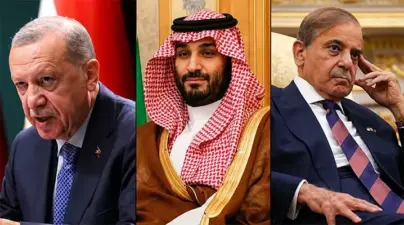

A new mutual defence pact between Saudi Arabia, Turkiye and Pakistan was signed in the holy city of Makkah on August 7, and this has raised questions about the shifting geopolitical landscape of the Middle East, where the fallout from the US-Israel war on Iran has prompted some countries to seek new arrangements to safeguard their security.
The pact has been termed the Makkah Joint Defence Agreement. Importantly, the agreement is aimed at strengthening collective deterrence against any act of aggression and stipulates that "any armed attack against any one of the three states shall be regarded as an attack against them all," a statement from the meeting states. While it is still not clear what such an agreement might look like on the ground, analysts feel the pact points to growing questions about the durability of US security guarantees. However, it appears clear that the absence of any visible US support for the protection and security of its Gulf allies during the Iran war has prompted this deal.
Meanwhile, reacting to the development, the Pakistani daily `Dawn' says in its latest editorial that, in the midst of a gruelling war between the US and Iran, currently at a stalemate, the signing of the Makkah Joint Defence Agreement is a highly symbolic development. It comes at a time when the American defence umbrella has proved of little help in protecting Saudi Arabia and the other Gulf Arab states. Rather, the presence of US military assets in these states has pulled them into the war, as the Iranians and their regional armed allies target these facilities with ferocity and a sense of vendetta. The Pakistan Prime Minister, the Saudi Crown Prince and the Turkish President were all upbeat about the new pact, and there is a reason for this euphoria which, however, may not last eternally, and only time will tell its usefulness.
Also, according to Dawn, this is not an Islamic NATO. Similar alliances have been attempted before, such as the Islamic Military Counter Terrorism Coalition, founded in 2015 and headed by former Army Chief General Raheel Sharif. It may be recalled that Pakistan-Saudi defence collaboration goes back decades, and the current pact only concretises the arrangement while also bringing Turkiye on board. But the question in many minds is what role the pact will play vis-à-vis Iran.
It is also evident that the US has shown that it is uninterested in protecting its Gulf allies, even though the latter have purchased billions of dollars' worth of weaponry from it. Yet, Pakistan's defence and political establishments are optimistic that the new defence agreement can promote unity within the Muslim world instead of adding to the existing differences.
Further, the pact's signing has raised questions about the region's changing power dynamics. Muhammad Faisal, a security and foreign policy analyst, said the agreement's value "lies in creating uncertainty for adversaries and strengthening collective deterrence, rather than specifying fixed military obligations similar to Western alliances". Kamran Bokhari, a senior resident fellow at the Middle East Policy Council, based in Washington, DC, agreed that the practical shift is minimal at this stage, calling it "a strategic signal" rather than "an operational alliance".
Faisal further said that such statements reflect real constraints rather than diplomatic caution alone. "Turkiye does not need Pakistani nuclear protection because it is a NATO member with US nuclear weapons present on Turkish territory, while Saudi Arabia is pursuing civil nuclear cooperation with the US," he said, adding that Pakistan's nuclear status "matters only as implicit strategic weight". That same ambiguity raises further questions for Islamabad. Pakistan has spent months positioned as a mediator between the US and Iran, and Bokhari believes that role could be affected following the signing of the pact.
Reacting to the agreement, Ebrahim Rezaei, a member of Iran's National Security and Foreign Policy Commission, wrote in a social media post that "a paper agreement with Turkiye and Pakistan" will not bring Saudi Arabia security, "just as years of one-sided dependence on the Americans did not bring them security".
Meanwhile, some Indian security experts, while assessing the implications of the pact for India, reckon that, with all three members of the new pact situated along critical maritime chokepoints and major sea lanes of communication, India has fresh reason to prioritise its naval expansion. The maritime disruptions triggered by Trump's Iran war have already significantly highlighted the strategic importance of securing the surrounding oceans. These are some of the initial reactions in the aftermath of the pact. More in-depth analyses and assessments are expected in the near future, meriting a more detailed study.
Views expressed are personal. The writer is a retired IPS officer, Adviser NatStrat