
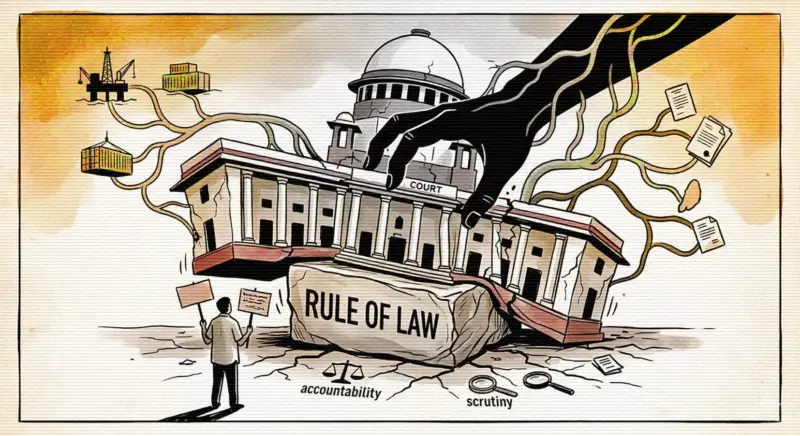

Corruption does not always begin with the vulgar spectacle of money visibly changing hands. In sophisticated administrative systems, it begins more quietly.
It begins with influence, with access, with public power exercised behind impeccable files, with decisions outwardly legal yet inwardly compromised, and with institutional prestige acting as a shield against suspicion. That is why corruption perception is not a superficial matter of image. It is a constitutional concern. A democracy begins to lose faith in the rule of law not only when corruption is finally proved, but when facts, circumstances, networks and delays create the impression that high office can negotiate with accountability from a position of power.
The story of Hero of the Public Sector is especially powerful because it does not narrate corruption as a crude morality tale. It presents a divided public life instead. On one side stands the heroic image of V. Krishnamurthy: the architect associated with BHEL, the force behind Maruti, the reorganiser of SAIL, the public-sector moderniser, the man of discipline, vision and managerial charisma. His story repeatedly shows how he came to embody the mythology of the Indian public-sector success story. It describes his rise through BHEL, his closeness to influential centres of power, his association with the Maruti project under Sanjay Gandhi, and his later transformation of SAIL into what appeared to be a new model. Yet the same story places beside this heroic narrative another one: allegations of foreign commissions, shell companies, linked associates, procurement influence, unexplained financial flows, and a prolonged investigative struggle that seemed always to move within the shadow of power. That duality is precisely where corruption is born.
The first and most important example is the use of stature as insulation. Krishnamurthy was not merely another official. He was represented as a symbol of a modern industrial giant, almost a corporate statesman. His image developed through three iconic sites of success: BHEL, Maruti and SAIL. It portrays him as someone whose personal energy, punctuality, authority and results created a near-legendary aura. But that is exactly what makes the later allegations constitutionally important. When a public figure acquires such reverence, suspicion itself begins to look improper. Inquiry appears almost like ingratitude. The danger for the judiciary lies here. Courts must be vigilant that public mythology does not, unknowingly, alter legal standards. The core lesson of his story is that the celebrated manager and the suspected beneficiary of illicit commissions can, in public imagination, occupy the same body. It is the duty of law to separate reputation from accountability.
The second example concerns procurement-linked influence. Krishnamurthy's attempted arrangements with Siemens in the late 1970s during the BHEL period, and later the much graver allegations involving Combustion Engineering (CE) and APTEN. It is found that one David Barrett, a vice-president of Combustion Engineering (CE), described Krishnamurthy as an "unpaid adviser" and said that Krishnamurthy's link with the firm went back to his BHEL days. He then introduced Benoy Jacob to CE. David Barrett also refers to negotiations around technology and cooperation that were worked out during his visits to India in 1984. What is striking here is not merely the allegation of illegality, but the classic anatomy of elite corruption: procurement decisions and technological collaborations do not appear, on their face, to be criminal; they are clothed in the language of industrial policy, efficiency, cooperation and modernisation. Yet, if a public officer uses his position to influence contracts in favour of firms connected to hidden commission structures, then corruption has infected the bloodstream of official decision-making while preserving the outward respectability of the file. That is precisely why courts must look beyond formal approvals and ask who influenced the choice, who stood behind intermediaries, and who privately benefited from ostensibly public decisions.
A third and far more concrete example of this is the role of intermediaries and shell entities. The narrative identifies Benoy Jacob and "Sandy" Chandra as pivotal figures. It describes Jacob as a Hong Kong-based operator who, along with Chandra, was alleged to have set up or used a network of shell companies, including Link Universe Company Ltd. and later Goldstride Company Ltd. The account shows that Link Universe was purchased in 1985 and that Barrett was briefly made a director before later tensions emerged. It then explains how Goldstride was formed and how shareholdings and corporate control shifted. These details are legally significant because they show how sophisticated corruption almost never moves in a straight line. It does not require a suitcase of cash. It requires structures. It requires people who can create a corporate distance between the public functionary and the money trail. It requires nominee relationships, offshore incorporations, seemingly commercial entities, and a chain of control difficult to decode without painstaking investigation. The judiciary, in dealing with such matters, cannot insist only upon naïve proof of direct personal receipt. It must be alert to beneficial ownership, the function of proxies, the timing of transactions, and the possibility that the visible company is merely a mask for invisible benefit.
The fourth example from his story is the sheer scale and multiplicity of foreign accounts. One of the most striking aspects is the list of accounts allegedly linked to Link Universe and Benoy Jacob: numerous accounts in the Bank of Credit and Commerce International, Union Bank of Switzerland, Hong Kong banks, a Standard Chartered account in Singapore, an account in BCC Australia and Macao, and even an Irving Trust account in New York in the name of another entity. The story further notes telegraphic transfers said to have been made to V. Krishnamurthy, including transfers in October 1988 and March 1989, with one reference to a remittance of USD 400,000 to International Engineering and another of USD 38,000 from a Link Universe account. Whether these were ultimately proved in court is a different matter. For present purposes, what matters is the significance of such a narrative. When a story sets out a pattern of multiple offshore accounts, layered transfers, fixed deposits, and cross-border corporate vehicles, the public no longer sees an isolated accusation; it sees a system. The constitutional injury begins when such a system appears to surround a holder of great public office while the law seems unable to produce a timely and visible resolution.
A fifth example lies in the linkage between public office and private commercial empire. The Krishnamurthy story is not seen as confined to one transaction. It expands into a broader map of associated corporate ventures. It refers to the Ergo Dyne group, to acquisitions, to business expansion through linked companies, and later to the Bharat Technologies holding structure under which the DCK group is said to have come together. It also notes allegations that large sums of money were introduced into country funds like the Krishnamurthy family investment vehicle, and that some of this money was connected with a Sanwa Bank account later frozen. This is important because elite corruption often does not remain confined to the original public contract. Once illicit or questionable influence-derived capital accumulates, it migrates. It enters new ventures, new companies, new acquisitions, new layers of respectability. The judiciary must therefore understand corruption as potentially developmental in structure: public office may serve as the source, but the proceeds may later appear in unrelated private sectors. To examine only the original file and ignore the later commercial ecosystem is to miss the full architecture of abuse.
A sixth example, directly relevant to corruption perception, is the account of alleged Japanese commissions. It refers to investigations into contracts awarded to Japanese corporations such as Sumitomo, Mitsubishi, Mitsui, Marubeni and Nissho Iwai in relation to major power and industrial projects, including the Teesta Canal Falls project, the Srisailam Left Bank Pump Storage project, the Andhra Pradesh Thermal Power project, and the Aurya Gas Turbine project.
The CBI believed V. Krishnamurthy played an important role in the award and execution of some of these contracts and that bribes may have been paid, directly or indirectly, to Link Universe. The importance of this for a judicial lecture is immense. The public sector contract is not simply a commercial event; it is an exercise of sovereign trust. When that trust is suspected to have been mediated by concealed inducements from foreign corporations, the damage extends beyond a particular balance sheet. It affects national confidence in the integrity of governance itself. The public then begins to wonder whether industrial modernisation was guided by public interest or by the invisible geometry of commissions.
A seventh example is the role of "respectable" intermediaries who normalise access. The description of Barrett, Jacob and Chandra is important in this regard. Barrett appears as the executive link from Combustion Engineering. Jacob appears as the operator in Hong Kong who set up corporate structures and managed relationships. Chandra appears as the insider with connections to the Prime Minister's Office and the Indian High Commission in Hong Kong, and later as a participant in the relevant companies. Here we see the anatomy of advanced corruption: not crude extortion, but a network of people whose value lies in translation between public office, corporate interest and international finance. None of them, in isolation, may appear to be the decision-maker. Yet together they form the mechanism through which public influence can be monetised. The law must therefore examine not just the final recipient, but the ecology of facilitation. The corruption of systems often depends less on the visible sovereign actor than on those who stand in the wings, converting authority into transaction.
An eighth example is investigative frustration and delay. The story is particularly sharp in describing the CBI's struggle to move the matter forward. It refers to the filing of an FIR in November 1992, the request for a letter rogatory, the need to seek evidence from Japanese corporations and foreign banks, and the reluctance or resistance encountered in the process. It even recounts diplomatic hesitation, including reported remarks attributed to high-ranking officials suggesting caution about cooperation with the CBI inquiry. The narrative further recalls how procedural questions over the letter rogatory and whether central government clearance was needed slowed the process. This is perhaps one of the most important corruption-perception lessons.
Grand corruption does not always survive because it is invisible. It survives because it is slow. Delay becomes an ally of influence. Public memory weakens. Documentary trails cool. Witnesses become unavailable or hostile. Complexity begins to resemble innocence. For the judiciary, this is a profound warning. Courts must ensure that the process is not turned into a mausoleum in which politically inconvenient truths are gradually buried.
A ninth example is the moral framing of the public servant who becomes indistinguishable from the sociological person. This insight is not incidental. The transformation of the public-sector titan into a figure who seemed to absorb the ethos of commission culture, licensing influence and the pursuit of power through commercialised networks represents a collapse of older distinctions between public duty and private ambition. The suggestion is that in the public sector, unlike the private market, one person's commission is often another person's abuse of office and a loss to the public exchequer. This insight should be central to judicial reasoning. Corruption in public law cannot be assessed merely by asking whether a transaction had commercial features. The relevant question is whether public discretion was exercised under a fiduciary obligation or whether it was contaminated by private interest. The public servant is not a free market actor. He holds entrusted power. The conversion of that entrusted power into a revenue-generating opportunity, whether direct or concealed, is the essence of corruption.
A tenth example, subtle but legally powerful, is the finding that image and morality may diverge. Krishnamurthy is portrayed as disciplined, energetic, visionary and transformative. Yet the narrative repeatedly asks whether precisely such success can coexist with moral corrosion. That question goes to the heart of judicial responsibility. Courts in corruption matters involving eminent figures must resist two equal temptations: the temptation of romantic exoneration and the temptation of dramatic condemnation. The former says that greatness rules out impropriety. The latter says that power itself is proof. Both are wrong. But one must be warned against the first temptation more urgently, because elite Indian public life too often mistakes achievement for innocence. A person may build institutions and still compromise them. He may modernise an industry and still monetise influence. He may deserve historical recognition for some acts and legal scrutiny for others. Constitutional adjudication must have the maturity to hold these truths together.
The challenge to the judiciary, therefore, is not merely evidentiary. It is civilisational. The court does not confront only an accused individual. It confronts a structure of reverence, power, memory, bureaucracy, diplomacy and financial opacity. If it moves timidly, the public sees weakness. If it abandons standards, it ceases to be a court. Its task is harder and nobler: to preserve due process while demonstrating that no myth, no office and no industrial legacy can place a person above scrutiny.
Corruption perception becomes especially dangerous when the citizen notices a pattern. The poor accused is investigated quickly; the powerful accused is investigated delicately. The minor official is arrested; the major one becomes the subject of international legal intricacy. The local case moves; the grand case travels through letters rogatory, diplomatic caution, jurisdictional puzzles and institutional hesitation. It is this contrast, more than any individual scandal, that wounds public faith. The citizen then asks whether justice is a principle of equality or an instrument calibrated to hierarchy. Once that question takes root, the judiciary itself comes under perceptual strain.
That is why courts must evolve a jurisprudence capable of dealing with modern corruption. They must recognise that illicit gain may travel through foreign consultancies, fixed deposits, nominee companies, cross-border transfers and trusted associates. They must appreciate that the absence of a crude cash seizure does not imply innocence where there is a pattern of hidden benefit. They must insist that investigating agencies pursue such matters with seriousness equal to the stature of the accused, not diminished by it. And above all, they must prevent time from becoming a shield for power.
The lesson of the Hero of the Public Sector is ultimately not confined to one individual. It is about the republic's recurring vulnerability: the ease with which public success can become a cloak for private suspicion, and the difficulty institutions face when they are asked to investigate those they once celebrated. That is where the judiciary must stand firm. It must not deny achievement, but neither must it convert achievement into immunity. It must not indulge suspicion, but neither must it be intimidated by eminence. Its constitutional duty is to ensure that public office remains a trust and not a franchise for concealed gain.
In that sense, corruption perception is not merely about what the public thinks. It is about what the constitutional order signals. If allegations of serious abuse linked to shell entities, foreign accounts, intermediary networks, procurement influence and delayed investigation can coexist indefinitely with public glory, then the law begins to look ceremonial. But if courts insist on transparency, equal scrutiny and disciplined adjudication, then even in the face of complexity, the republic retains its moral centre. When it does not, then as a member of the Planning Commission, when he was just minus, bereft of authority, he, V. Krishnamurthy, extorted 25 lakhs each from Harshad Mehta, the Bull, Goenka of CEC Kolkata, C. K. Birla of Birla Motors, and Vijay Mallya of Kingfisher fame, and still escaped conviction, though not prosecution by the CBI. His past image, his past aura, and his status as a former holder of high office furnished him the needed immunity from conviction. Corruption in a man of influence, a bestower of favours to his fellow travellers while in high office, aids him in remaining shielded. This was happening under Prime Minister Narasimha Rao. It became a regular feature in his tenure.
The siphoning of Rs 133 crore in the Urea scam, planned and executed by India's top bureaucrats, did not even end in their arraignment, let alone their investigation and prosecution.
Views expressed are personal. The writer is a former Joint Director of the CBI