




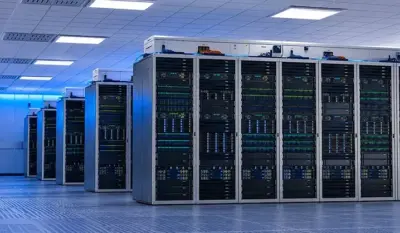

Imagine a factory covering acres of land, drawing enough electricity to power a small city, requiring enormous cooling capacity and costing billions of dollars to build.
Now imagine that, once completed, few people actually work inside it. Welcome to one of the defining factories of the AI age-the data centre. And India is preparing for these on an extraordinary scale. Its data centre footprint, estimated at 27 million sq ft in the first half of 2026, could cross 101 million sq ft by 2030. Capacity could rise from over 1.8 GW to more than 6.7 GW, backed by investments of $300 billion.
Grand numbers, reflecting something important: they may turn India into a great digital economy. With over 950 million internet users, expanding cloud adoption, digital payments, artificial intelligence and enterprise digitisation, India clearly needs domestic digital infrastructure. But the critical number in this story is not 101 million sq ft, 6.7 GW or $300 billion. It is 87 million.
That is the number of Indians aged 15-29 who were outside employment, education and training in 2021, NITI Aayog's 'Reimagining Skilling for Viksit Bharat@2047' report says. The category is complex, including women engaged in domestic responsibilities; it doesn't equate with unemployment. Yet, the scale is a reminder of India's larger challenge. The question is not whether India needs data centres. It does. The louder question is: What should India demand from them?
Hidden Appetite
Any digital economy can create the illusion of weightlessness. Data floats in a cloud. AI appears on a screen. Behind the weightlessness sits real physical infrastructure. The International Energy Agency says data centres consumed 415 terawatt-hours of electricity globally in 2024. By 2030, that could double to 945 TWh, more than Japan's total power consumption. A typical data centre can consume as much power as 100,000 households, while the largest facilities can consume 20 times that amount.
Then comes water. Servers generate heat, and heat must be removed. Berkeley Lab estimates that American data centres consumed 66 billion litres of water in 2023, excluding the wider water footprint associated with generating their electricity. This does not make data centres undesirable. Economic development always consumes resources. The caveat is that the calculation cannot stop at investment received. It must ask what is being consumed, who bears the cost and what benefits accrue.
America's Warning
That warning is already emerging in the United States. Communities that once welcomed data centres as symbols of funds and technological progress are now questioning electricity bills, water availability, noise, land use and tax concessions. Protests against data centre expansion have been reported across 42 US states. Over 100 American communities have enacted moratoriums, while hundreds of data-centre-related bills have entered state legislatures.
The lesson for India is not that America made a mistake. It is that infrastructure is easiest to regulate before dependence sets in. There is another lesson: data centres are capital-intensive, yet light on employment. A hyperscale facility can cover a million square feet and cost $1 billion, but employ only about 100 people. Construction creates jobs, as do engineering, fibre, electrical equipment and maintenance. But a billion-dollar building should not automatically be mistaken for a billion-dollar employment engine. For India, that distinction is critical.
Better Bargain
India has an advantage: it is entering the explosive phase of the data centre boom while the first generation of large host markets is revealing what can go wrong. We can, therefore, build differently. A data centre approval should be viewed not as a land or investment transaction, but as a compact with its host community. How much electricity and water will it require? Will potable water be used for cooling? How much renewable power will be added? Will the operator help finance grid upgrades necessitated by its load? How many jobs will result and how many will be trained for them?
India can encourage closed-loop and low-water cooling, treated wastewater instead of freshwater, renewable energy, transparent water-use reporting and efficiency norms. Campuses can be asked to co-invest in power, rather than leaving utilities to absorb the burden. Data centre policy can be linked to human-capital policy. If billions are invested in AI, the new ecosystem should help prepare cooling specialists, electricians, network engineers, cybersecurity professionals, technicians, green-energy workers and construction specialists the new economy will require.
This is where data centres can become more than giant rooms full of servers.
Measure Differently
Yes, India should compete for the industries of the future. Retreating from digital infrastructure would be unrealistic and desirable. For AI, cloud computing, data storage and digital services will underpin banking, healthcare, manufacturing, education, defence and government itself. But competition need not mean imitation. The next race should not be won by the country willing to offer the cheapest land, easiest water and an accommodating power supply. It should be won by one far-sighted enough to make digital infrastructure strengthen, not strain, its physical and human infrastructure.
By 2030, India may indeed have 101 million sq ft of data centres. That will make for an impressive headline. But a nation's progress cannot ultimately be measured by how much data it can store, how many acres its servers occupy or how many investment dollars cross its borders. The most valuable capacity India can build by 2030 will still be human capacity.
Views expressed are personal. The writer is a journalist & communications specialist