




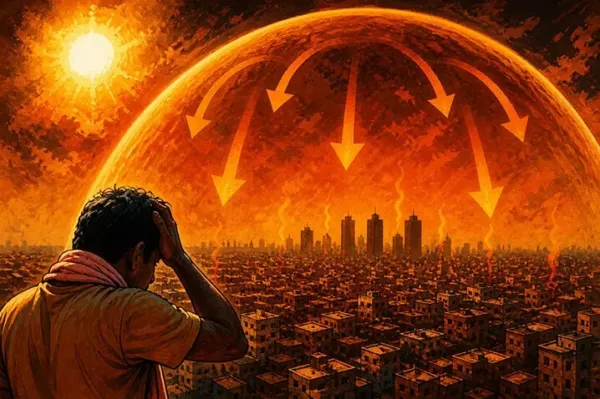

Recently, it's been so hot in Bangalore that I cannot even recognise the same city anymore. Five years ago, when I shifted here, I had switched on the air conditioner only once in the entire year; that too only for a few hours.
Blue-blood Bangaloreans reminisce about sleeping without fans; an air conditioner was never a necessity. This year's sweltering temperatures are being triggered by a "heat dome" that's literally trapping hot air over the Indo-Gangetic plains and eastern India, causing air to heat excessively before it descends. This meteorological high-pressure system is rare and cruel. Weak western disturbances, blocked sea breezes, and the "Super El Niño" that tends to weaken the Indian monsoon while leading to longer dry spells, are all contributing to this current hot pot.
Several Indian cities have seen mercury soaring between 40°C - 47°C. Akola at 46.9°C, Banda at 46°C, Nagpur 45°C, Ahmedabad 44°C - the list is uncomfortably long as a nationwide heatwave engulfs us. The gates of hell are open, the heat is on, and May is only just getting started. And to add to the anguish, we are told to brace for more impending spells of heatwave, as per the Indian Meteorological Department (IMD). Some passing showers may bring temporary succour, but back into the heat capsule we will ultimately go. Our power bills will increase, our resources will be more strained and exploited, water shortage will occur - and thus the cycle continues, but only getting worse every year. Between 2000 and 2020, over 10,000 people died due to heatwaves in India, according to the IMD. Elderly, children, migrant workers, and unorganised sector labour are the most vulnerable and exposed sections to climate-led disruptions. This year's heatwave-linked deaths have already begun.
The future that we had been discussing - of exceptionally high temperatures, erratic rainfall, and unpredictable weather patterns - is here, and is now our lived reality. For those who have been following the climate change conversation, what's happening today in India and globally, was inevitable. Therefore, now more than ever we need to build sustainably, push development alongside nature, and most urgently push the pedal on creating climate-resilient systems.
Some work has started but much remains. The Indian government has identified 310 out of 651 agricultural districts as vulnerable to climate change and are working towards promoting climate-resistant farming practices. The government is promoting climate-proof technologies through Krishi Vigyan Kendras (KVKs) in 448 model Climate Resilient Villages in 151 vulnerable districts. Artificial Intelligence (AI) and Machine Learning are being actively deployed to support and educate farmers while also helping with surveillance systems to detect pest infestations early, for instance. The UN agency, UNICEF (United Nations Children's Fund), is inviting interested parties to help develop climate-resilient WASH (Water, Sanitation and Hygiene) systems in schools and Anganwadi centres in Jharkhand. We are talking of building climate-resilient roads in the Himalayan region! Such decisions, for example, need deeper considerations and reviews by climate experts before getting the government nod.
We must stop decimating forests and green cover in the hollow name of progress. At the administrative and approval levels, this can stop only if climate becomes an election topic. In the recently concluded state elections, there were some promises of tackling floods and climate issues from political parties in Assam and some mention in West Bengal with regard to the protection of farm land from river erosion, banning the filling up of wetlands, and conservation of mangrove forests. In spite of this, except in Tamil Nadu, where climate action occupied a decisive space in party manifestos, the other states have barely scratched the surface. And the only way this can change in future elections is if we, the citizens of India, demand better air, water, greenery, and climate-proofed systems. At the community level, it breaks my heart to see the pigheadedness of people every day. So myopic are their views and selfish and ignorant their perspectives, that they don't even realise the damage they continue to do. If they stay on this path, they will leave behind an ecologically fractured world for their numerous progeny to suffer in.
As India formulates its National Adaptation Plan (NAP), we must ensure that the focus remains on a long-term strategy that includes adaptation, inclusivity, and protection of vulnerable populations. Reforestation, conservation of wetlands, and a complete ban on the destruction of green cover should be non-negotiable. Development of green infrastructure, engineered solutions such as cool roofs, vertical walls, biofilters, green buffers, and passive ventilation must become an integral part of urban planning. States, as well as the Centre, need to spend generously and act diligently to implement plans, guarantee outcomes, and enhance accountability. Without this, we are definitely doomed in this hellfire.
Views expressed are personal. The writer is an author and media entrepreneur