




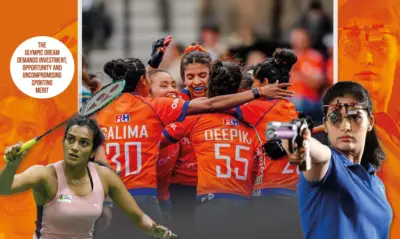

Playgrounds are more important than PlayStations. Such a message from Prime Minister Narendra Modi to athletes in India last week, while highlighting the Khelo India programme and its outreach, is important.
On August 15, during the Independence Day speech from the ramparts of the Red Fort in New Delhi, PM Modi had spoken on the performance of the Indian athletes at the Commonwealth Games in Glasgow. For the PM to again mention it, keeping in mind India's desire to host the Summer Olympics in Ahmedabad in 2036, is a realistic dream, not a voyeuristic one.
So, where does India stand today in the world of sports? For the common man who now consumes sports on television, apps, websites and more, sport is non-stop. Name it, from athletics to yachting and sailing, every sport can be watched via live stream. When India did well at the condensed Commonwealth Games recently in Glasgow, some folks said standards at the Games were not high.
That was a cynic speaking, really, since 39 medals from able-bodied and para athletes was a rich reward. Once the Games concluded in Glasgow, I had the opportunity to speak to PT Usha, President of the Indian Olympic Association, as well as Harsh Sanghavi, Deputy Chief Minister of Gujarat. Usha spoke of how India would do well in 2030, while Sanghavi, a man committed to sports, spoke of how Amdavad (Ahmedabad) would be a gracious host.
Coming back to the statement from PM Narendra Modi, he follows sports closely. It is no exaggeration: when Modi meets athletes after their return from important sporting assignments, he is well-informed and can engage with them very well. The athletes feel important and motivated. Now, Modi has mentioned how India is not even able to compete in all the sporting disciplines which figure in a Summer Olympics. It is his dream that the youth of the nation play sports and focus on playfields rather than PlayStations, which only ruin the eyes.
For the record, India competed in only 16 sporting disciplines at the Paris 2024 Olympics. The next Olympics will be held in Los Angeles in 2028. With less than two years to go, the programme shows 36 sports disciplines in LA. It is hard to imagine India will even compete in 20 disciplines in LA, as the qualification criteria are so hard. It is clear that PM Modi wants India to improve in sports so that, by 2036, there can be more representation from India.
This is not just a dream, but a vision, where the stakeholders on board have to work in unison. For those who say India has not yet touched double digits in the medal tally at the Summer Olympics, that is a cynical view. The growth cannot be calculated or predicted so easily. The world of sports is hard, where the competition is fierce. All those who said India is not a sporting nation need to change their views.
Let's sample some results, cricket aside. Treesa Jolly and Gayatri Gopichand winning a doubles bronze medal at the BWF World Championship in New Delhi is big. Agreed, PV Sindhu fell short, Unnati Hooda was raw and Lakshya Sen did not peak. There is potential and promise. In badminton, India needs to keep working hard. The next challenge will be the Asian Games in Aichi-Nagoya, Japan.
Standards at the Asian Games are very high. Of course, India can aspire and dream big. Look at how the Indian women's hockey team showed courage and finished fifth in the FIH World Cup in Amstelveen recently. Indian men's hockey is known for flair and feel. As the nation celebrated legend Dhyan Chand's birth anniversary on August 29, emotions return. Dhyan Chand would be smiling from above; the Indian girls are now peaking.
Can India win a gold medal in women's hockey in Nagoya? Well, why not? This is a committed bunch, led by coach Sjoerd Marijne, under the captaincy of Salima Tete. The kind of negativity spread before the World Cup was unwanted at home, where the change of dress from blue to orange came in for flak. What matters is the colour of performance. Indian eves did well at the World Cup, and the men will hope to make amends in the Asian Games. As defending champions and winners of two Olympic bronze medals, there is so much at stake.
In the run-up to the Asian Games, there is plenty of negative news around the selection of teams in various sports disciplines. Today, Indian sports is virtually run by babus (bureaucrats), leaving almost no room for National Sports Federations. To ride roughshod over the federations and even ad hoc committees in place is wrong. Agreed, the Indian Government is lavishly funding Indian sports. Apart from cricket, almost all sports disciplines owe it to the Sports Ministry, where the role played by the SAI (Sports Authority of India) is also important.
A stage has come now where selection matters are becoming sticky. There is a cap on participation, which means the Indian Government does not want too many athletes to go. If the selection criteria are very rigid, it will not help. The Sports Ministry has now cleared close to 500 athletes. Definitely, the numbers will go up. As it is, there has been a mess-up in the selection of tennis teams, notably doubles, women's rowing and some martial arts disciplines. How and who is clearing or chopping is well known. There are bureaucrats interfering, which means the National Sports Federations have no say.
There is still time for more athletes to be added, though football and handball are ruled out. If tennis doubles teams are being ignored, it's wrong. India does have a realistic chance. If curbing costs is the only reason for limiting athletes' participation in the Asian Games, how do we forget there was a time when former AIFF Presidents said they would pay for travel and lodging to fly out for an Asian Games?
In the next week, there is hope that the Sports Ministry will sit down and add more numbers to the list of athletes who will be cleared to fly out. Let it be based only on merit, not 'sifarish.' There is reason to believe more Indian athletes can go and attempt to win medals for India. Then again, there will be a fight over who goes as officials and support staff. It is clear that coaches and allied staff must be chosen on merit. It should not look like pleasing someone who has never been a coach or is completely out of touch with the athletes.
It is worth mentioning the positive and constructive role played by IOA President PT Usha. She has, in the past, managed to secure accreditation cards for coaches who were/are most necessary for athletes. Be it the late Jaspal Rana going as Manu Bhaker's personal coach to the Paris Olympics or, more recently, Murali Sreeshankar's and Neeraj Chopra's personal coaches getting accreditation cards, it has been positive. Manu won two bronze medals, a record effort.
Athletes have to be given top priority. Make relaxations if possible, so that India can participate and win more medals in Aichi-Nagoya. If India can win more medals in Asia, the next assault can be on the Summer Olympics, as suggested by PM Narendra Modi.
There is a need to promote sports even more. As Saina Nehwal had said in a recent interview, parents need to be sure that children being pushed into sports will be the right decision. She said only those who make it to the Top 25 in badminton can do well. There are many more sports disciplines where this applies.
Good luck, Indian athletes. May the best make the cut for the Asian Games.