

In an age obsessed with speed, disruption, and the promise of the future, heritage often risks being mistaken for nostalgia - something ornamental, something optional.
Yet, in truth, heritage is neither decorative nor dispensable. It is the invisible architecture that shapes identity, memory, and meaning. It is the quiet force that tells a civilisation who it is, even before it decides who it wants to become.
The idea of World Heritage, formally institutionalised through bodies like UNESCO and ICOMOS, is not merely about preserving monuments or cataloguing traditions. It is about recognising that the past is not behind us - it lives within us. For a country like India, this idea carries a deeper resonance. Here, heritage is not confined to museums or archaeological sites; it breathes in everyday life, in rituals, languages, crafts, and collective memory.
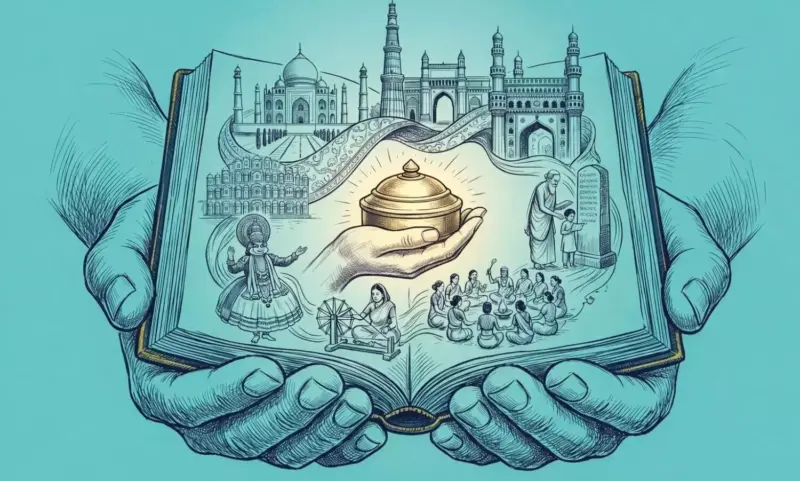
India stands apart as a civilisation where heritage is not frozen in time but is constantly in motion. The rock-cut grandeur of Ellora coexists with the living rhythm of Kathakali; the philosophical depth of the Vedas finds continuity in oral traditions that survive in villages and towns. This coexistence of the ancient and the living is what makes Indian heritage uniquely powerful - it is not something we visit, it is something we inhabit.
Yet, this richness comes with a quiet urgency. Beyond the celebrated heritage sites lie thousands of unprotected monuments, fading dialects, and endangered crafts traditions. Heritage, if not actively preserved, does not merely disappear - it dissolves silently into oblivion. Institutions like the Indian Institute of Heritage exist precisely to address this challenge: to transform preservation from an act of remembrance into a structured, forward-looking mission grounded in scholarship, education, and community participation.
One of the most defining moments in recent times that underscored the value of heritage was the return of the sacred Piprahwa relics of Lord Buddha. When these relics - bearing profound spiritual and historical significance - appeared in an international auction, it was not merely a transaction at stake; it was the question of civilisational ownership. The decisive intervention by the Government of India, under the leadership of Gajendra Singh Shekhawat, and the subsequent return of these relics after more than a century marked more than a diplomatic victory.
When Narendra Modi described the moment as one of pride, it echoed a deeper truth - that heritage is not a commodity. It cannot be priced, traded, or detached from the soil that gives it meaning. The return of these relics was, in essence, a reclaiming of narrative - a reaffirmation that civilisations must be the custodians of their own stories.
Equally significant is the realm of intangible heritage - often overlooked, yet profoundly vital. India's textile traditions, for instance, are not merely aesthetic expressions; they are repositories of history, identity, and lived experience. From Banarasi silk to Kanjeevaram weaves, from Phulkari embroidery to Rajasthan's block prints, each thread carries a story that no archive can fully capture. And yet, paradoxically, the very communities that created these traditions often remain distanced from their institutional recognition.
Bridging this gap is essential. When heritage is returned to its people - when communities recognise their lived traditions as part of a larger civilisational narrative - preservation becomes organic, not imposed. It transforms from policy into pride.
At its core, heritage is not just about conservation; it is about continuity. Without knowledge, preservation risks becoming mere sentimentality. This is why scholarship plays a crucial role. Whether it is the study of classical dance as a living tradition or new archaeological findings that reshape our understanding of ancient civilisations, knowledge ensures that heritage remains dynamic, relevant, and intellectually alive.
What emerges from this is a powerful realisation: heritage is not the burden of the past - it is the foundation of the future. It informs how a society negotiates modernity, how it understands itself in a globalised world, and how it asserts its cultural confidence. In the end, the responsibility of safeguarding heritage cannot rest with institutions alone. It belongs equally to the scholar and the citizen, the artist and the policymaker, the community and the individual. Every story preserved, every tradition sustained, every artefact protected is an act of continuity - a quiet but profound assertion that the past still matters.
Because heritage is not what we inherit, it is what we choose to carry forward.
The writer is the Vice Chancellor of the Indian Institute of Heritage