
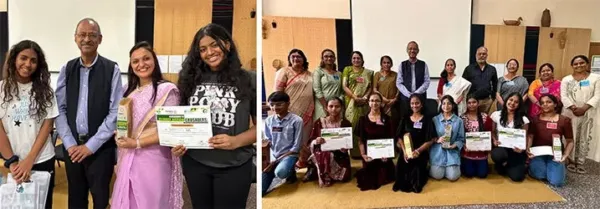

The journey to Panchgani, Maharashtra, was hectic for me as I had just returned from Indore to Delhi. Travelling again to Pune and then taking a three-hour drive to Panchgani was tough.
However, it was well worth the trouble because what I witnessed amidst the quiet but inspiring environment at Initiatives of Change (IofC) was truly amazing.
What if climate action didn't begin in boardrooms or policy circles but inside classrooms?
That is the question at the heart of the Classrooms to Climate Action Crusaders (CCAC) initiative, a pan-India program that is quietly redefining how schools engage with one of the most urgent challenges of our time.
The first cohort, running from July 2025 to April 2026, brought together 78 schools from across the country. Out of these, 50 schools carried their work through to the final stages, each one experimenting with what it means to move from awareness to action.
Organised by SrishtiZens, a pan-India network of eco clubs, Kerala Public School Trust, Jamshedpur and Rotary Club of Jamshedpur, in partnership with TERRE Policy Centre, Pune-bringing together education, community leadership, and sustainability expertise into one collaborative ecosystem.
But CCAC was never designed to be just another school competition.
Beyond Activities. Toward Ownership
At its core, CCAC challenges a familiar pattern: students learning about climate change without ever engaging with it in real, tangible ways.
Instead of limiting schools to one-off events, the initiative required sustained action. Schools worked on a mix of compulsory efforts, such as tree plantation, greening campuses, and water conservation, alongside optional initiatives like awareness campaigns, waste reduction, and community impact projects.
A defining feature of the program was collaboration. Schools were inspired to partner with organisations, NGOs, and even other schools, for each and every activity and points were allotted for it, expanding their perspective beyond campus boundaries.
What emerged was a shift.
For many participants, what started as a task evolved into something far more meaningful. Students began to take ownership. Teachers observed changes not just in knowledge, but in attitude, responsibility, and everyday behaviour.
This aligns with a deeper truth highlighted by environmentalist James Gustave Speth, who argued that the biggest environmental challenges are not purely scientific, but cultural and behavioural. CCAC directly engages with this reality by working at the level where habits and values are formed.
Recognising Meaningful Impact
At Asia Plateau Panchgani, surrounded by a landscape that quietly reflects the very ecosystems this initiative seeks to protect, the final gathering carried a different kind of energy. This was not just about results. It was about witnessing what sustained effort, collaboration, and intent can look like when schools take ownership.
The schools that emerged as leaders demonstrated not just participation, but depth and consistency in their efforts.
* First Prize (₹1,00,000): SBOA Public Senior Secondary School, Cochin, Kerala
* Second Prize: Bhavan's Munshi Vidyashram, Tripunithura, Kerala
* Third Prize: SBOA Matric Higher Secondary School, Coimbatore, Tamil Nadu
* Fourth Place: JH Tarapore School, Jamshedpur, Jharkhand
The trophies were instituted after the late Chairman, Mr APR Nair's name. While these schools stood out, the larger success of CCAC lies in the collective shift it sparked. Across participating schools, environmental action moved from being an isolated activity to a shared purpose.
Lessons from the First Cohort
The journey of the first cohort offers both validation and direction.
On one hand, it proved that schools are ready. They can build green teams, initiate environmental efforts, and collaborate meaningfully when given the right structure. On the other hand, it also revealed the next level of challenge.
There is a need to go deeper. To move beyond surface-level activities and create measurable, long-term impact. Strengthening students' understanding of environmental issues, encouraging consistent reflection, and building stronger partnerships with external organisations will be critical going forward.
The Next Phase: Scaling Impact
The vision for CCAC 2026-27 is not incremental. It is exponential.
The next cohort aims to expand participation significantly, with each school acting as a catalyst to bring others into the fold. This creates a multiplier effect, where climate action is no longer confined to individual institutions but spreads across communities.
Stronger partnerships and collaborations will continue to play a central role. With organisations like SrishtiZens and its collaborators deepening their engagement, the initiative is positioned to build a more robust ecosystem that supports schools with resources, mentorship, and real-world opportunities.
In addition, new recognition categories are being planned to celebrate diverse forms of contribution-ranging from innovation and collaboration to sustained impact.
Most importantly, the focus is shifting toward continuity. The goal is to ensure that climate action becomes embedded in the culture of schools, rather than remaining a time-bound program.
A Shift That Matters
Climate change is often discussed in terms of policies, technologies, and global agreements. But real change depends on something more fundamental: how people think, act, and take responsibility in their everyday lives. Aim big, but start small. Every step in the right direction matters.
Schools are one of the few spaces where this shift can begin at scale.
CCAC taps into that potential. It doesn't just inform students about the climate crisis, but positions them as active contributors to the solution.
And that shift from learning about change to becoming agents of change is where the real impact lies.
What was being attempted through this initiative was transformational. The model presented at Panchgani is a wonderful example of Nexus of Good. It can easily be scaled and replicated through public-private partnership. It is hoped that more and more schools will join the movement during the next few years.
Views expressed are personal. The writer is an author and a former civil servant