




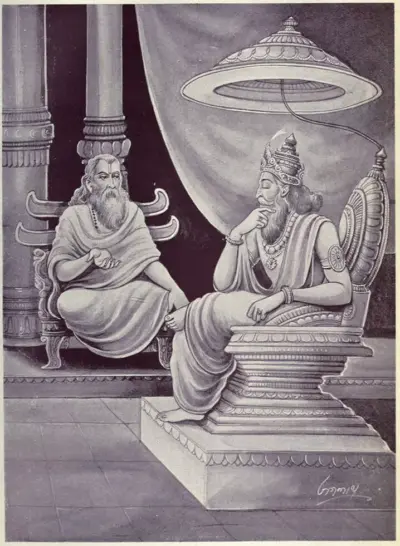

Civilisations endure not only because they build kingdoms, raise armies or create wealth. They endure because they preserve moral systems that can restrain power, correct ambition and remind authority of its duties.
When such voices are heard, institutions remain strong. When they are ignored, decline begins long before collapse becomes visible. In the Mahabharat, Vidur stands as one such voice of conscience. His authority did not come from a throne, a crown or a weapon. Vidur's authority came from integrity, independent judgement and the courage to speak truth in a court that often preferred comfort over correction.
Vidur occupies a unique place in the Mahabharat. Born through Maharishi Vyasa to a servant woman in the royal household of Hastinapur, he was connected to the Kuru dynasty but denied kingship because of his birth. Yet in intellect, judgement and moral character, he stood among the finest figures of the epic. His life offers a powerful lesson that human worth cannot be measured only by birth, status or title. True dignity comes from character, conduct and the ability to remain anchored in dharma. Vidur reminds us that excellence often exists beyond the boundaries society creates, and that institutions weaken themselves when they fail to recognise wisdom wherever it appears.
As a counsellor in the court of Hastinapur, Vidur served Dhritarashtra with loyalty, but his loyalty was never blind. This is one of the most important ethical lessons from his life. True service does not mean pleasing those in authority. It means guiding them towards what is right. Again and again, Vidur warned Dhritarashtra against injustice, attachment and the destructive ambition of Duryodhan. He saw clearly that the kingdom was moving towards disaster, not because it lacked power, but because power had lost moral direction.
The tragedy of Dhritarashtra was not that he had no access to wisdom. It was that he lacked the courage to act on the wisdom placed before him. Vidur's counsel was available, but Dhritarashtra's attachment to Duryodhan overpowered his judgement. This is a timeless leadership lesson. Many leaders know the right course, but attachment, fear or insecurity becomes their real enemy. When emotion overrules judgement, even intelligent people make destructive choices. Institutions decline when emotions overpower judgement and when leaders choose comfort over correction.
The wisdom associated with Vidur is remembered through Vidur Niti, a body of counsel on conduct, self-control, governance, justice, friendship, greed, anger and the duties of those in power. Its importance lies in its practicality. Vidur does not speak as a distant philosopher. He speaks as someone who understands how people, families, courts and kingdoms collapse when judgement is clouded by ego. Vidur Niti reminds us that ethics are not ornamental. They are instruments of survival. Intelligence without self-mastery eventually fails. Knowledge becomes dangerous when it is not guided by restraint.
A central moral value in Vidur's life is restraint. He was wise, but never arrogant. He was close to power, but never intoxicated by it. He could see further than most, but he did not use his intelligence to manipulate. This separates wisdom from cleverness. Cleverness can win arguments, exploit situations and secure short-term advantage. Wisdom protects balance, dignity and justice. Vidur's example shows that intellect becomes meaningful only when governed by conscience.
His role during the attempted burning of the Pandavs at Lakshagriha shows the quiet power of ethical action. When danger was being planned in secrecy, Vidur understood the threat and warned Yudhishthir in a coded manner. He also helped create a path of escape. This was not dramatic heroism on the battlefield, but it was leadership of a very high order. He used intelligence to protect the innocent, not to strengthen the powerful. He acted with caution, foresight and responsibility. Vidur reminds us that leadership is not always loud. Sometimes it lies in timely warning, careful planning and the courage to prevent disaster before it unfolds.
The disrobing of Draupadi in the Kuru court remains one of the Mahabharat's most painful moments. In that assembly, many great warriors were present, yet moral courage was scarce. Vidur was among the few who condemned the injustice. His protest matters because it shows that silence in the face of wrongdoing is not neutrality. It becomes support for adharma. When institutions witness injustice and remain quiet, they lose their moral centre. Vidur's voice reminds us that ethics require speech, especially when silence is easier.
A kingdom is not destroyed only by weak armies. It is also destroyed when wise counsel is ignored, when inconvenient truth is silenced and when those in authority surround themselves with approval instead of judgement. This is one of the sharpest leadership lessons from Vidur's story. Dhritarashtra heard Vidur, but did not truly listen to him. He respected Vidur's wisdom, but allowed attachment to defeat action. Advice has value only when leaders have the humility to receive it and the courage to act upon it.
This lesson applies with equal force to modern institutions. Every boardroom needs someone who speaks uncomfortable truths. Every organisation needs people who can warn against excess, question weak assumptions and protect long-term trust from short-term temptation. Growth without ethics may look successful for a time, but it becomes fragile. Ambition without restraint may produce immediate results, but it can damage credibility. Integrity means independent judgement and the courage to refuse compromises that may bring quick gain but weaken long-term trust.
As India moves towards the vision of Viksit Bharat, Vidur's lesson can be understood through the lens of institution-building and business leadership. A successful business ecosystem is built not only on infrastructure, enterprise, innovation and speed, but also on ethical decision-making, responsible leadership, fair processes and the courage to correct course before mistakes become crises. Progress becomes durable only when it is guided by conscience.
Vidur also teaches that leadership is not limited to formal authority. One can lead through advice, integrity, courage, restraint and example. A teacher who guides students honestly, an officer who refuses unfair pressure, a professional who speaks against wrongdoing, a parent who teaches values through conduct and a citizen who stands by fairness all carry forward the spirit of Vidur. Leadership begins wherever conscience refuses to remain silent.
In every age there are rulers, but only a few become civilisational voices. Vidur became one because he chose truth over power, conscience over convenience and dharma over fear. He reminds us that the strength of a society is not measured only by those who command, but also by those who counsel with integrity. His life teaches that leadership without ethics becomes fragile, wisdom without courage becomes silent and power without dharma eventually destroys itself. Vidur did not win kingdoms or command armies, yet his voice continues to endure because it was rooted in truth.
Views expressed are personal. The writer is chairperson, Bharat Ki Soch