
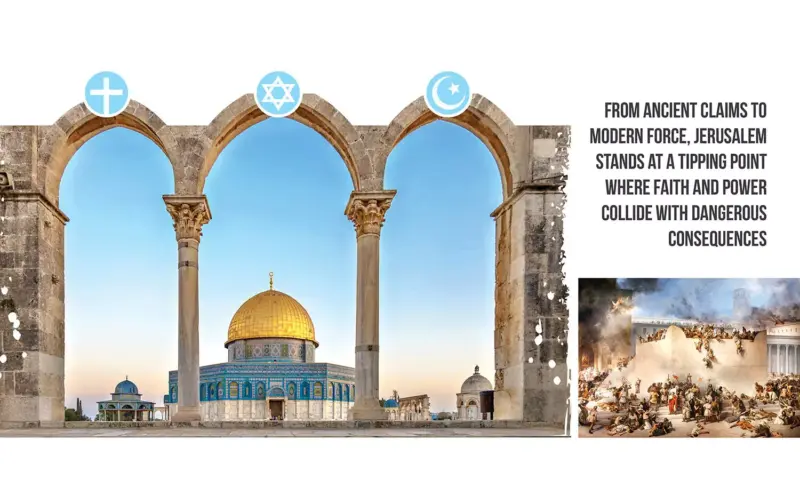

Israel is trying to change Jerusalem's religious identity and is destroying the Status Quo to establish full control over Muslim and Christian religious life at holy sites.
Jerusalem plays a central role in the spiritual and emotional perspective of the three major monotheistic religions. For the Jews, a living proof of ancient grandeur and independence and a centre of national renaissance, for Christians, it is the scene of Jesus' agony and triumph; and for Muslims, it is the goal of the Prophet Muhammad's mystic night journey and the site of one of Islam's most sacred shrines. Lately, on Holy Saturday, as Palestinian Christians tried to reach the Church of the Holy Sepulchre in Jerusalem, Israeli security forces started attacking and arresting them. On the following day, Orthodox Easter, Israeli National Security Minister Itamar Ben-Gvir and his supporters stormed into the Al-Aqsa Mosque compound, where they performed prayers despite a ban on non-Muslim religious rituals there. These incidents followed Israel's unprecedented closure of the Al-Aqsa Mosque compound and the Church of the Holy Sepulchre for 40 days under the guise of "safety" during the United States-Israeli war on Iran. As a result, prayers at Al-Aqsa did not take place on Fridays or during Eid al-Fitr.
The beginning of this conflict dates back to ancient Israelites who originated roughly in the territory of modern Israel, also known as the ancient Levant or ancient Canaan. Israelites believed that they were descendants of three people: Abraham, his son Isaac, and his grandson Jacob. The myth that bound ancient Israelites together was the Exodus narrative, when, during a period of drought, around 1500 BCE, the Israelites went down into Egypt in search of food. They were a minority and were eventually enslaved by the Egyptians, until God intervened in history through miraculous plagues to liberate them, with the help of the prophet Moses. After being freed from slavery, the Israelites were led by God and Moses on a journey through the wilderness between Egypt and Canaan. When they reached Mount Sinai- known in Arabic as Jabal Musa ("Mountain of Moses") or Jabal al-Tor in Egypt, famously regarded as the biblical Mount Sinai-where, according to the Torah, Bible, and Quran, the prophet Moses received the Ten Commandments from God. Eventually, they returned to the "Promised Land," the area of Canaan where Abraham, Isaac, and Jacob had resided centuries before.
Sacred Hebrew text- the Torah
The story of liberation from Egypt was powerful, and it bound people together as a group. Jew historians believe that migration out of Egypt around 1250 BC is the single most important event in Hebrew history. More than anything else in history, this event gave the Hebrews an identity, a nation, a founder, and a name, used for the first time in the very first line of Exodus, the biblical account of the migration: "bene yisrael," "the children of Israel."
Part of the Israelites' shared story was the revelation of a sacred text known as the Torah, which literally means, in Hebrew, "instruction" or "teaching. "In Greek, this term was translated as nomos or 'law,' and in the Christian Bible, references to 'the law' often refer to the Hebrew Torah. Today, the term "Torah" is understood to refer to the first five books of the Hebrew Bible, known in English as Genesis, Exodus, Leviticus, Numbers, and Deuteronomy. Many of the laws that are included in the Torah, like prohibitions against murder and stealing, are principles that are basic to a functioning society and are similar to those found in other legal codes of the time. But what stood out to ancient peoples when they encountered Hebrew law were three particular elements: male infant circumcision, which happens on the eighth day after birth; the observance of the Sabbath as a day of rest; and dietary restrictions, known as kashrut or kosher laws, particularly not eating pork and not mixing meat and dairy.
Ancient Greeks and Romans often mentioned that it was strange that Jews rejected the other gods and were so focused on allegiance to one God. Greeks and Romans were also suspicious of the Torah and looked down on Jewish customs. They thought that the Sabbath was a sign of laziness and often criticised Jews as lazy. They thought that circumcision was barbaric and that Jewish dietary laws were ridiculous and antisocial.
The "Golden Age" of ancient Israel was the time when King David and King Solomon ruled, from 1010 to 931 BCE. King David is associated with the foundation of the city of Jerusalem, in the centre of ancient Israel, while King Solomon is associated with the construction of the first great Temple, on the Temple Mount, in 957 BCE.
The First Temple (Solomon's Temple) was destroyed in 587/586 BCE by the Neo-Babylonian Empire, led by Nebuchadnezzar II, marking the end of the Kingdom of Judah and the start of the Babylonian Exile. The temple was burned on the 9th of Av (Tisha B'Av), a date now observed as a major day of Jewish mourning. The Judean elite were exiled to Babylon. This exile continued until 539 BCE, when Cyrus the Great allowed the Jews to return, leading to the construction of the Second Temple in 516 BCE. Around 515 BCE, the Torah was written down as a sacred text for the first time. Prior to that, it had been transmitted orally, through memorisation and recitation, as part of an oral tradition. During the First Jewish-Roman War, the Second Temple in Jerusalem was destroyed by Roman forces under Titus in August 70 CE. Following a months-long siege, the Temple was burned and dismantled, marking a defining catastrophe in Jewish history.
Start of the Jewish dispersion
Ancient Israelite society was supposedly divided between 12 tribes, 10 of them in the north of the region and two of them in the south. In 722 BCE, the 10 tribes of northern Israel were conquered by the ancient Assyrian Empire, and only the tribes of the south, in the tiny kingdom of Judea, remained as their own self-ruling political units.
In the 6th century BCE, the ancient Israelites endured another catastrophe when the Empire of Babylonia conquered the tiny kingdom of Judea. The Babylonians not only destroyed buildings and plundered wealth, but they also exiled the people who were most responsible for creating and maintaining the local culture. The Jewish diaspora began with the Babylonian exile in 586 BCE, when Nebuchadnezzar II destroyed Jerusalem and forced many Jews into Mesopotamia. Although some returned under Persian rule (c. 530 BCE), large, long-lasting communities remained, establishing the first significant settlement outside the Land of Israel, a pattern that grew for centuries.
The largest and culturally most creative Jewish Diaspora in early Jewish history flourished in Alexandria, where in the 1st century BCE, 40 per cent of the population was Jewish. About the 1st century CE, an estimated 5,000,000 Jews lived outside Palestine, about four-fifths of them within the Roman Empire, but they looked to Palestine as the centre of their religious and cultural life. Diaspora Jews far outnumbered the Jews in Palestine even before the destruction of Jerusalem and the Second Temple in 70 CE. The destruction of the Second Temple in 70 was followed by the Jews' defeat at the Bar Kokhba Revolt in 132 CE, after which Roman laws forbade Jews from entering the holy city of Jerusalem. With pilgrimage and sacrifice at the Temple no longer possible, leaders emphasised the study of the Torah, prayer, and works of piety. Rabbinic Judaism arose, and along with it, the Talmud and Midrash were written, as part of this increased focus on assiduous study. Jewish life became centred around dispersed houses of worship and study, synagogues. Thereafter, the chief centres of Judaism shifted from country to country (e.g., Babylonia, Persia, Spain, France, Germany, Poland, Russia, and the United States), and Jewish communities gradually adopted distinctive languages, rituals, and cultures.
Persecution of Jews
Throughout the history of mankind, no group has been more victimised than the Jewish people. The Jewish people survived even though they were dispersed throughout the Roman Empire and beyond. The contract with God bound the Jewish people together: if they kept his rules, then, whatever else happened, they would remain his chosen people. This belief gave a sense of faith and identity, which was to hold the Jewish people together but also to alienate them from other cultures. The strict rules that had to be followed did not always match the rules of the different societies in which the Jews now lived. The first persecutions against the Jewish people were religious. They were 'killers of Christ' and 'black magic worshippers' who did not follow or believe in Jesus, according to the major allegations. In the 19th century, religious persecution gave way to racial persecution. The Jews were seen as parasites. This change in attitude came from a volatile brew of Social Darwinism and rising European nationalism. The Jews were seen to be the outsiders who not only did not belong but also needed to be removed as a threat to society. This is the sort of emotion Hitler experienced when living in old Imperial Vienna before 1914.
During the Middle Ages in Europe, there was full-scale persecution of Jews in many places, with blood libels, expulsions, forced conversions, and massacres. In the First Crusade (1096), flourishing communities on the Rhine and the Danube were utterly destroyed during the Rhineland massacre. In the Second Crusade (1147), Jews in France were subject to frequent massacres. The Crusades were followed by expulsions. All English Jews were banished in 1290. Over 1,00,000 Jews were expelled from France in 1396. In 1421, thousands were expelled from Austria. Many of the expelled Jews fled to Poland. As the Black Death epidemics devastated Europe in the mid-14th century, annihilating more than half of the population, Jews were taken as scapegoats. Rumours spread that they caused the disease by deliberately poisoning wells. Hundreds of Jewish communities were destroyed by violence during the Black Death persecutions.
Anti-Semitism was not a creation of Hitler. It has been part of European society for over 2,000 years. The Jewish religion and the attempt to maintain it, when the Jews were expelled from their homeland by the Romans, was the key factor in their survival as a group. At the same time, being a recognisable group that had money and power, they seemed to threaten many of their adopted societies.
From 70 CE to the late 19th century, a profound transformation of Judaism, coupled with three historic encounters of the Jews - with Romans, with Islam, and with the Mongol Conquest - shaped the economic and demographic history of the Jewish people in a unique and long-lasting way. With the emergence of Zionism in the late 19th century as a political movement and the formation of a Jewish national home in Palestine, it fundamentally altered the course of Jewish history from a 'diaspora-focused existence' to a 'supremacist state'- similar to the apartheid South Africa, Nazi Germany, the white supremacist structures in the U.S.A, and Hindutva in India. One has to remember that not all Jews are Zionists and not all Zionists are Jews. Christian Zionists far outnumber Jew Zionists. Zionism, which has emerged as a major threat to global peace, demands a detailed discussion.