




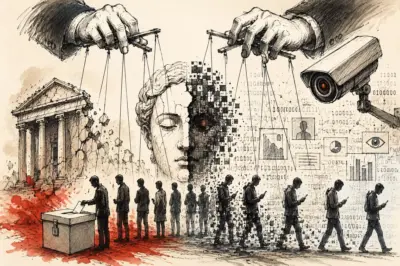

Almost all aspects of democracy registered a dramatic reversal compared to 25 years ago, observes the Varieties of Democracy Institute (V-Dem).
The 10th edition of 'Democracy Report 2026, titled "Unravelling the Democratic Era?", published in March this year, paints a stark picture of the state of democracy worldwide, highlighting that the global levels of democracy have fallen back to those last seen in the late 1970s. By the end of 2025, more countries are classified as autocracies (92) than democracies (87), and nearly three-quarters of the world's population (74 per cent) - around six billion people - live under autocratic rule. Only a small minority, approximately 7 per cent, reside in liberal democracies. The report also highlights the continued expansion of what V-Dem terms the "third wave of autocratization". Notably, this trend is no longer confined to fragile or transitional regimes but increasingly affects established democracies like India, the USA and Brazil. At the end of 2025, four of the world's most populous countries are autocracies (India, China, Indonesia, and Pakistan). The USA, under Donald Trump, is rapidly autocratising, the report says.
A third wave of autocratization -a contemporary, ongoing trend, starting around 2010, is characterized by a global decline in democratic governance, where established democracies are experiencing backsliding through gradual, legally-driven, and often electoral means rather than sudden military coups. In 2019, autocracies outnumbered democracies for the first time since 2001. Unlike the two previous, rapid autocratization waves (1920s-40s, 1960s-70s), this wave is marked by a gradual stealth- a cautious, unobtrusive, and secretive way of authoritarian shifts, intended to avoid detection. An empirical study by Lührmann, A., & Lindberg, S. I. (2019) suggests that democratic backsliding is a recurring, cyclical phenomenon rather than a solely linear progression, with projections showing global democracy may not return to its 2010 peak until roughly 2042.
Electoral autocracy is the most populous regime type in 2025, and subjects nearly half of the world population - 46 per cent (3.8 billion) - to itself. India, Pakistan, and most recently also Indonesia, are among the most populous electoral autocracies in the world.
Digital surveillance- a challenge to democracy
The rise of digital surveillance constitutes one of the most significant threats to democracy and human rights in the 21st century. Recent reports linking Microsoft's cloud infrastructure to Israeli surveillance operations targeting Palestinians raise questions over Big Tech accountability and involvement in the Gaza genocide. The Guardian revealed that Israeli intelligence agencies were using Microsoft servers to run a mass surveillance operation targeting Palestinian communications. According to the Guardian's investigation, the Israeli military secretly stored a vast database of Palestinians' phone calls on Microsoft's servers in Europe. The system, operational since 2022, was capable of storing and processing recordings of approximately one million calls per hour made by Palestinians.
Digital surveillance, once widely viewed as a hallmark of authoritarian regimes, has now permeated democratic states under the narrative of progress, economic growth, and public safety. This development presents complex risks to democracy itself, privacy rights, and civic freedoms, according to political analysts. Though historically, digital surveillance practices were seen as fundamentally incompatible with democracy, these technologies are now increasingly framed as necessary, neutral, or even beneficial for purposes like customisation of services, economic innovation, or public health.
Countries such as China, Russia, India, Turkey, and the United States employ facial recognition, biometric databases, and artificial intelligence to monitor populations extensively. Digital platforms have pivoted into tools for both manipulation and repression. Social media algorithms designed to maximise engagement often prioritise sensational and polarised content, facilitating the rise of misinformation and echo hollows that degrade democratic discourse. Experts note that the weaponisation of digital tools extends to silencing opposition, censoring dissenting voices, and controlling the flow of information. The mass collection and processing of personal data by states and corporations alike compromise individual autonomy, safety, and dignity-core pillars that uphold democratic society. The unchecked growth of sophisticated surveillance tools-biometrics, artificial intelligence (AI), driven monitoring, data profiling-coupled with the profit motives of tech companies, imperils the democratic project worldwide.
AI's influence on politics has evolved over the years. In the early days of artificial intelligence (AI), concerns centred on its potential to spread 'deepfakes' and propaganda in politics. Today, however, AI is reshaping the political landscape by transforming how campaigns operate and how candidates communicate. SFLC.in -a citizens' initiative that works for 'digital freedom' observed an uptick in the number of instances where various political parties - both regional and national are increasingly using generative AI tools to their aid in the recently held elections in India. The use of AI tools to push their campaigning efforts is witnessed in all types of medium - audio, video and images; across platforms. Here are a few illustrations they cited:
· In an election campaign video by Tamil Nadu Congress, the deceased politician Kamaraj deepfake appeared to urge citizens to vote for Congress. There was no disclaimer denoting the video as "AI-generated".
· In the official election campaign video from All India Anna Dravida Munnetra Kazhagam (AIADMK), there are AI-generated clips of yesterday's deceased politicians, J. Jayalalithaa and MGR, passing on their legacy to Edappadi K. Palaniswami.
· An AI-generated video shows Kerala CM and Opposition Leader attending a BJP Event in disguise and appreciating the BJP's campaigns for the upcoming election. The video lacks any clear, prominent label such as "AI-Generated".
· A video posted in X opens with AI-generated scenes showing a peaceful Hindu family engaged in daily worship. Then it abruptly shifts to riot footage showing Muslim mobs stone-throwing, burning Hindu homes, and creating chaos during protests against the Waqf Amendment Act. The clip blames the AITMC government of West Bengal for encouraging Muslim appeasement and division, framing the events as targeted anti-Hindu riots. It ends with an emotional appeal from Hindu victims seeking safety and restoration of their lives, concluding with the hashtag #BanchteChaiBJPTai ("We want to live, that's why BJP"), positioning the BJP as the party that will protect Hindus ahead of the 2026 West Bengal elections. The video lacks any clear, prominent label such as "AI-Generated", "Digitally Enhanced", or "Synthetic Content" covering at least 10 per cent of the visible area.
Time Magazine (November 21, 2025) notices that "the last decade taught us painful lessons about how social media can reshape democracy: misinformation spreads faster than truth, online communities harden into echo chambers, and political divisions deepen as polarisation grows. Now, another wave of technology is transforming how voters learn about elections-only faster, at scale, and with far less visibility. Our research suggests their influence is already rippling through our democracy".
'Capitalism is not democratic, democracy not capitalist'
Merkel, Wolfgang (2014) in his seminal article titled, "Is capitalism compatible with democracy?", argued that capitalism and democracy follow different logics: unequally distributed property rights on the one hand, equal civic and political rights on the other; profit-oriented trade within capitalism in contrast to the search for the common good within democracy; debate, compromise and majority decision making within democratic politics versus hierarchical decision-making by managers and capital owners. 'Capitalism is not democratic, democracy not capitalist', he concluded. According to Wolfgang, throughout the past two centuries, capitalism and democracy have proven themselves the most successful systems of economic and political order. Following the demise of Soviet-style socialism after 1989 and the transformations of China's economy, capitalism has become the predominant system around the world. Only a few isolated countries, such as North Korea, have been able to resist the success of capitalism through the use of brutal force. The market has become the main mechanism for economic coordination and the maximisation of profits. The global competition of economic systems has been clearly won.
After the collapse of the Soviet empire, neoliberal capitalism was able to flourish. In 1989, Francis Fukuyama wrote his famous essay on the "end of history". Fukuyama predicted this end in two respects: political and economic liberalism had finally decided the world-historical race of systems in their favour. Fukuyama was absolutely right about capitalism prevailing. But he was on the wrong track when he believed that democracy would also prevail worldwide. Since 2010, the world has been living in a phase of democratic regression. The same is not true for capitalism.
In a recent interview, citing the examples of the post-Soviet states like Russia and Ukraine with their oligarchic capitalism, Wolfgang argued that though capitalism and democracy follow different logics, under certain conditions, they can engage with each other. Then, a space of possibility emerges where they can coexist- not only with capitalism, but also with deeply autocratic systems. Politics leaves selected oligarchs a certain space in which they can operate freely- thus democracy and capitalism are forcibly married.
Globally, the concentration of wealth has significantly widened since 2010, with a dramatic acceleration in fortunes at the top of the economic pyramid. As of late 2025, the top 1 per cent of adults hold roughly 45-48 per cent of global wealth, a significant increase in concentration from previous years. The number of billionaires roughly doubled in the 10 years following the 2008 financial crisis. By 2025, billionaire wealth will have increased by 81 per cent since 2020, with fortunes growing three times faster than in 2023. The bottom half of the global adult population owns only about 1.3 per cent of total wealth, with this segment seeing a decline in its share over the past decade. Technology and Artificial Intelligence (AI) are the main drivers of inequality and rapid fortune creation. The same trend is observed in India, where the richest 1 per cent controls more than 40 per cent of total wealth, while the bottom 50 per cent own merely 3 per cent.
Since 2017, India has been categorised as an "electoral autocracy" in the V-Dem's democracy reports. This year, out of 179 countries, India ranks 105th on the liberal democracy index. Last year, it ranked 100. On the electoral democracy index, it is 106, on the liberal component index, it is 99, and on the egalitarian component index, it is 138. In an AI-dominated electoral autocracy, Indian democracy is in danger as citizens' views are constantly engineered by the autocratic state to influence the voting process. Deletion of millions of citizens from the voters' list during the Special Intensive Revision (SIR), carried out by the Election Commission of India (ECI), where AI tools were extensively used in the recently concluded elections in states of West Bengal, Tamil Nadu, Bihar and Kerala, are cases in point.