




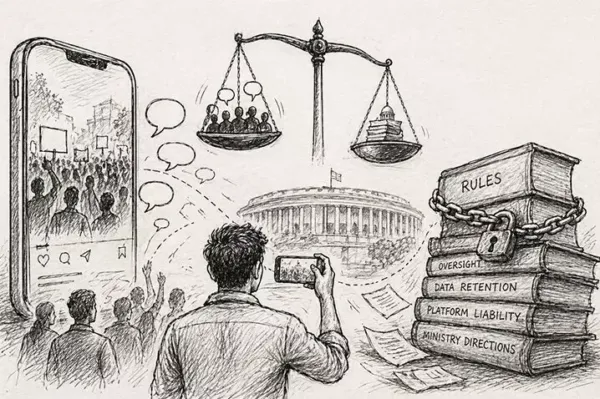

Imagine an ordinary Indian who may be a student, a farmer, or a small journalist posting a video about a local election, a crop-price protest, or a school grievance on X, Facebook, or Instagram.
Millions do this every single day. Yet, under the government's proposed amendments to the IT Rules, notified on March 30, 2026, such posts could suddenly be labelled "news and current affairs"? Would platforms then have to obey new Ministry directions or lose their legal protection?
But the changes themselves deserve a calm, honest look from every citizen. The Ministry has extended the deadline for public comments till May 7, 2026. This willingness from the Ministry to listen is a welcome step.
What the amendments aim to do
The government wants an "open, safe, trusted and accountable" internet. The draft requires platforms to follow any written clarification, advisory, or direction issued by the Ministry. It brings ordinary user posts that qualify as "news and current affairs" under the same strict oversight that applies to professional media. It also clarifies data retention and expands the role of the government's oversight committee.
The purpose of the proposed amendments is to enable effective regulation of deepfakes, hate speech, and deliberate misinformation, which spread rapidly and have the potential to cause real-world harm and disrupt public order. The proposed amendments intend to arm the authorities with necessary legal tools, which are reasonable within the ambit of Article 19(2) of the Constitution of India and the Information Technology Act, 2000.
Why every citizen should participate
The real issue is to achieve a reasonable balance in the freedom of speech and expression guaranteed under Article 19(1)(a) for our citizens. Any restriction on freedom of speech and expression must be clear and reasonable, and, to the best possible extent, the authorities must exercise great restraint in any attempt to impose restrictions on freedom of speech and expression. The Supreme Court of India defended this position and principle in the Shreya Singhal judgment, wherein Section 66A of the IT Act was held unconstitutional, precisely because of its vague language.
Former Chief Justice D.Y. Chandrachud, in the M.C. Chagla Memorial Lecture on "Speaking Truth to Power," argued that the ability of citizens to speak truth to those in authority is integral to democracy. This spirit of fearless expression is not new to India. In the
Ramayana, the sage Jabali openly questioned Prince Rama's decisions with rational dissent, yet faced no punishment. In the Mahabharata, the wise minister Vidura repeatedly spoke uncomfortable truths to King Dhritarashtra, warning him against injustice even at personal risk. These factual incidents from our epics show that the courage to speak one's mind, even to those in power, has long been part of our civilisational ethos.
A modern, smarter solution
We do need strong protection against real harms-deepfakes, hate speech, and proven misinformation. But relying only on a government committee to examine every "matter" is not the best way forward in the AI era. Instead, intermediaries may be permitted to deploy unbiased Explainable AI as their first transparent responder to audit the content posted on their platforms. This would screen content only for clearly defined illegal and harmful material-deepfakes, direct incitement to violence, or information that meets strict legal tests of falsehood. The Explainable AI must explain its reasoning in plain language to both the user and the platform before any content is restricted. Only when the AI flags a serious violation would human committee review, followed by judicial oversight, come into play.
This hybrid approach would let every citizen express themselves freely and repose their trust in the government's intentions to make such amendments. Our ancient texts reveal that Jabali and Vidura were permitted to express dissenting, even atheistic, arguments, perfectly illustrating the ancient tolerance for intellectual freedom. These incidents represent documented ethical and ancient political traditions that prevailed in our culture.
Our nation has both the constitutional wisdom and the technological prowess to lead the world. Our digital rules will honour that ancient tradition without undermining it. The proposed rules will be seen as enablers of ordinary voices with this approach and will no longer be chilled by vague directions or fear of over-removal. In my view, the 2021 IT Rules were a bold first step, and the 2026 amendments are the next. Let us ensure this step strengthens both safety and liberty by embracing transparent, explainable technology that serves the citizen, not silences them.
This is the moment for every Indian to speak clearly, factually, and without fear. Let the final rules truly reflect the best of our Constitution and our timeless tradition of open discourse.
Views expressed are personal. The writer is a Professor & Research Director, Centre of Excellence, National Law University, Jodhpur