




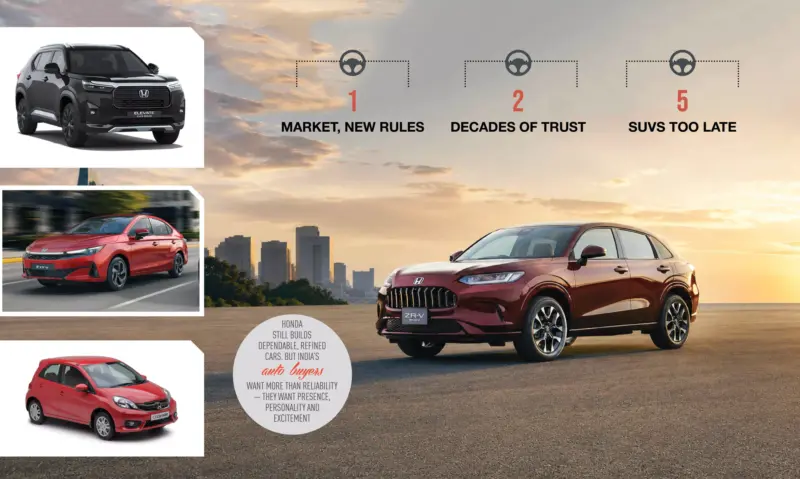

There was a time when owning a Honda meant you had arrived. This was not because Honda built the most flamboyant cars on the road. Quite the opposite.
Honda represented something subtler and more powerful in an emerging India. Aspiration. In the late 1990s and early 2000s, when India's middle class was expanding and learning to spend with confidence, a Honda became a quick showcase for success and sophistication, without spectacle.
This was the era before giant touchscreen displays, connected-car theatrics and social media-driven automobile hype… When buyers cared about engineering, refinement, reliability and credibility. Few global automakers embodied these qualities as convincingly as Honda.
Auto Mythology
It was at this time that Honda brought in products that cemented its mythology. The City became India's aspirational sedan, with the successful buying it after career leaps. Suddenly, it was found parked outside most apartments and offices with equal ease. The Civic was all flair and sporty sophistication. The Accord was luxury without complexity or intimidating service bills. The niche CR-V flaunted understated elegance among those who valued engineering over flashiness.
Honda achieved something rare. Emotional trust. Its engines became benchmarks for smoothness and refinement. The VTEC badge entered enthusiast vocabulary almost as folklore. The cars were durable, dependable and smartly engineered. Owners never needed to justify their Honda; the badge itself conveyed judgement and class.
And then, India began changing gears.
How India Changed
Today's Honda Cars occupy a peculiar position. Globally, Honda is still among the most respected automakers, admired for engineering excellence, technological capability and build quality. But in India, the company no longer dominates conversations, showroom traffic or sales charts the way it used to. This is not a story of failure or irrelevance. It is a narration of how the auto market evolved, and how a highly respected company struggled to adapt to that transformation.
No one can doubt Honda's golden legacy. Its early success in India was built on timing as much as technology. Economic reform created a middle class eager for wheels that reflected achievement without being ostentatious. Honda understood this psychology perfectly. The City, in particular, arrived at just the right moment. It was refinement, reliability and driving comfort wrapped in a package that felt premium compared to everything India's motorists had previously experienced. Sleek interiors, smooth engines and strong resale reinforced Honda's reputation for quality.
For Indians, upgrading to a Honda became a milestone.
Honda's credibility was built patiently. It was never a loud marketer, but its products spoke out. Even today, old Hondas run reliably, a testament to the engineering quality that built the brand's reputation. For two decades, that formula worked beautifully. But the market evolved faster than any auto firm anticipated.
SUV Revolution
The transformation arrived through SUVs. Consumers shifted away from sedans and clambered into taller, rugged-looking vehicles with imposing road presence. Suddenly, cars were no longer judged only by refinement, fuel efficiency or driving dynamics. Design language, technology, lifestyle positioning and visual appeal began driving buying decisions.
Sensing the shift, manufacturers adapted ferociously. Hyundai Motor transformed the Creta into a segment-defining blockbuster. Kia entered India with the feature-loaded Seltos and razor-sharp marketing. Tata Motors reinvented itself around design and safety. Mahindra dominated the SUV space and enjoyed runaway success. Maruti Suzuki was everywhere, outselling everyone.
By comparison, Honda's response was cautious. The BR-V and WR-V found acceptance but never became disruptors. By the time the sensible and competent Elevate SUV arrived, the segment had become overcrowded and hyper-competitive. Honda was challenged by more than simply being late to the SUV race. For the very definition of automotive value had changed.
Honda's traditional strengths - engineering refinement, reliability and driving quality - continued to differentiate the brand, but new buyers were looking through an emotional and technological lens. Touchscreens, connected features, panoramic sunroofs and bold styling began influencing buying decisions as much as the mechanics. Customers no longer wanted transportation. They wanted identity, visibility and aspiration. Honda's conservative philosophy appeared less exciting.
Quiet Strength
Despite slow sales, Honda still retains strengths that rivals have been struggling to replicate. The City is one of India's finest sedans. The Amaze is practical, refined and dependable. The Elevate offers comfort, usability and strong driving dynamics. All benefit from naturally-aspirated petrol engines that enjoy goodwill. And importantly, trust in the brand remains remarkably resilient.
Trust matters. Auto markets move in cycles. Trends may dominate temporarily, but reliability and ownership experience create long-term loyalty. Honda continues to benefit from a customer base that values these attributes. It also retains enormous technological prowess, particularly in hybrid systems, powertrain development and engineering research.
And this is beginning to show. Honda now appears to be signalling a serious hybrid-led push for renewed relevance. The just-unveiled City HEV reinforces the company's long-standing strength in refined electrified powertrains, while the upcoming Honda ZR-V HEV (deliveries are expected to begin in July) marks an ambitious attempt to enter India's premium SUV territory.
Expected to be priced upwards of Rs 40 lakh, the ZR-V will compete against the Jeep Meridian, Skoda Kodiaq, Volkswagen Tiguan and Audi Q3. The challenge now is not technological capability; it is whether Honda can translate engineering brilliance into emotional desirability and stronger market momentum.
Can it Screech Back?
Possibly, but the future demands urgency and reinvention. Honda does not need to abandon its identity. In fact, its strength still remains its credibility. Refinement, reliability and engineering mastery carry enormous value in a market crowded with feature-heavy products and marketing spiel. What Honda must do is modernise those strengths with packaging and communication.
Today's India rewards emotional engagement alongside mechanical competence. Buyers demand sharper styling, tech-rich interiors, connected ecosystems and faster product refreshes. Honda must combine its engineering excellence with a more assertive product and marketing strategy. The company also needs to leverage its hybrid tech more effectively. The City and forthcoming ZR-V HEV suggest Honda understands this imperative, though success will depend on pricing, positioning and the ability to rebuild aspirational appeal in a fiercely competitive SUV market.
Equally critical is visibility. Honda once shaped India's aspirations. Today, its revival needs more than nostalgia. It must marry its enduring strengths with customers' emotional and technological expectations. Its cars should not only be dependable and refined, but also impossible to ignore. In today's India, building a good car is not enough. You must also win the conversation around it.