
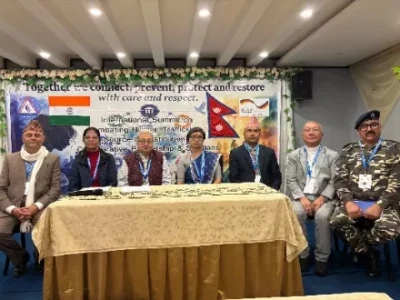

Darjeeling: A two-day long Indo-Nepal international summit on combating human trafficking concluded in Darjeeling with a strong call for institutionalised cross-border coordination, standard operating procedures for rescue and repatriation, and survivor-centric rehabilitation mechanisms emerging as key recommendations.
Organised by Anugyalaya Darjeeling Diocese Social Service Society in collaboration with the North Bengal Anti Trafficking and Child Rights Network, the summit brought together government officials, law enforcement agencies, civil society groups and grassroots actors from India and Nepal to address trafficking across source, transit and destination regions.
Chairing the inaugural session, Tulika Das, Chairperson of the West Bengal State Commission for Protection of Child Rights stressed on stronger child protection systems and institutional mechanisms. "The open Indo-Nepal border, while historic and vital, is also being exploited by trafficking networks. We need stricter legal action, faster cross-border repatriation, stronger information sharing on missing persons and survivor tracking to prevent re-trafficking. Tackling poverty and vulnerability in border areas, along with digital safety awareness, must be central to a united response against trafficking," stated Das.
Tikaram Upadhaya, Consul at the Consulate General of Nepal Kolkata, highlighted the importance of cross-border cooperation in combating trafficking networks.
A major outcome of the summit was a set of recommendations aimed at moving beyond fragmented interventions. Delegates called for structured cross-border coordination mechanisms involving police, border forces and civil society groups, along with clearly defined SOPs for rescue, rehabilitation and repatriation of survivors.
The summit also strongly recommended a survivor-centred response, with emphasis on rehabilitation, dignity and long-term support, while urging the creation of larger collaborative networks linking source and destination regions.
Addressing the gathering, Bishop Stephen Lepcha stated: "Trafficking cannot be tackled through isolated efforts and requires sustained multi-stakeholder partnerships." Adding to this, Father Amar Rai highlighted the role of community-based child protection systems strengthened under the "Surokshit Shaishav" initiative.
Participants from India and Nepal, including organisations such as Maiti Nepal and Shakti Samuha, shared field experiences on trafficking trends, coordination gaps and best practices. Child leaders and grassroots representatives also contributed to the dialogue.
A key highlight was the "Circle of Commitment," where stakeholders collectively pledged deeper cooperation against trafficking.
Delegates said the recommendations must now translate into coordinated action on the ground, with stronger referral systems, faster response protocols and sustained bilateral engagement. Organisers described the summit as a significant step toward building a long-term Indo-Nepal collaborative platform against human trafficking.