
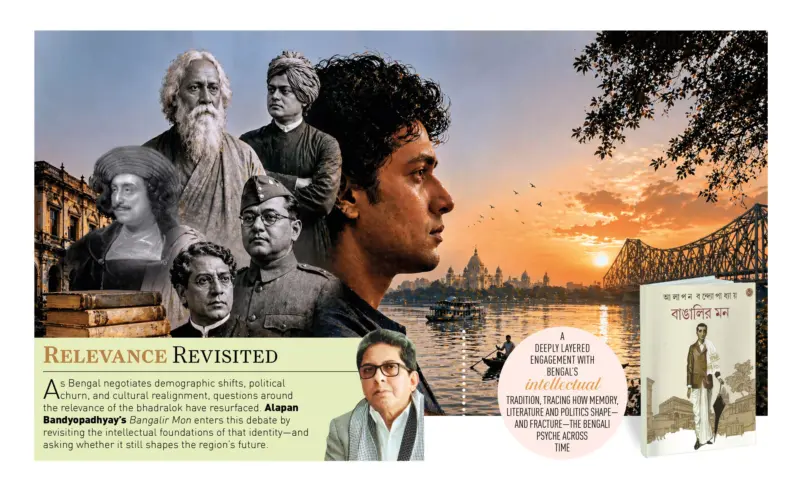

Professor Amal Bhattacharjee, a magisterial teacher of English Literature, was delivering a lecture on Robert Browning's The Last Ride Together.
After an analysis in impeccable English for one full hour, the creaseless dhoti- and Punjabi-clad Amalbabu switched over to chaste Bengali and said, "Ebare barite phire Rabindranather Sesh Basanto poro." I recalled this experience fervently, going back to the sixties of the last century at Presidency College, while I read Bangalir Mon, an excellent exploration of the Bengali psyche and weltanschauung as it developed and also declined. Why? Because Amalbabu's words crystallised the depth and diversity, as well as the dependence and inheritance, of the Bengali bhadralok. A dual inheritance, in fact, which sought its sustenance from the Charyapada and John Donne, simultaneously.
I wondered: how could an ever-busy bureaucrat like Alapan write this scholarly exegesis on such a complex and sensitive subject? How could he find the time for reading almost all scholars exploring this realm, from Sabyasachi Bhattacharya to Joya Chatterji, to mention only two? My second question is not unrelated-how could he be so interdisciplinary, with a missionary zeal, delving into history, literary texts, political theory, and social philosophy so effortlessly? He has woven all these threads into a single, masterly web.
First, I come to the literary texts to which he has devoted many pages, because I am myself a student of the legendary Professor Taraknath Sen. Let me claim, with all possible candour at my command, that the author's explication of Apu's destiny in Pather Panchali, scarred by the deaths of his dearest ones, and Debu Pandit's transformation into a vibrant, rural political leader in Panchagram are two superb examples of the sociological treatment of creativity. I have only one question-wouldn't we have welcomed his dissection of Putul Nacher Itikatha as well, where Sashi, tormented by vacillation in that obscure, muddy village Gaodia, is also another example of the variant Bangalir Mon?
Like Devdas and Apu, the Bengali protagonist traverses uninterruptedly; but, at the same time, he gets inescapably stuck, like Sashi and even like Srikanta-who is by far the most popular hero in Bengali literature. Recall his standing rooted to the platform, not knowing where to proceed when the train with his last heartthrob, Kamallata, departs. Let me indulge in some epistemic mischief and extend the logic further-the illustrious Bengali mind, nurtured by Claude Henri de Saint-Simon and Swami Vivekananda, can also get lamentably stuck in the suicidal cobwebs of erroneous Marxian praxis and alarmingly hyped Hindutva, which is intrinsically different from Hinduism.
What helps us to get out of this quagmire of double obscurantism is redemptive poetry, and I think Alapan could have given some more attention to the post-Tagorian poets, from Jibanananda Das to Samar Sen. Yes, Sudhindranath Dutta is difficult to comprehend at times, but I shall borrow the word 'Duruha' (difficult) from Buddhadeva Bose and not 'durbodhya' (incomprehensible) in this context. Similarly, a handful of poems by Bishnu Dey are undeniably loaded with terms that baffle. But, by and large, his poems from Baise June to Smriti Satta Bhabishyat are eminently understandable and also an ardent creative record of those turbulent times. Above all, Jibanananda evocatively expressed the excruciating agony of the forties in incomparable verse. No historical document invokes the hellish conflagration of communal devastation like his immortal elegy Chechollish-Satchollish (1946-47). Perhaps, Alapan would devote some more pages to Bengali poetry, as he had done with the novel, in the second edition, because no other idiom reveals the Bengali mind better than its irrepressible lyrical aporia, its despair, and its divinity.
The author has remained true to the kindred points of heaven and home. He has meticulously detailed the precious elements that have enriched the Bengali mind and also emphasised its severe demographic confinement, which is proceeding apace. The latter is elaborated in detail. Indeed, the figures that he tables are beyond question, and we are almost provoked to ask the very disturbing query-is the Bengali bhadralok, embodying the Bengali mind, ebbing out in the increasing welter of Namasudras, low castes, adivasis, Motuas, and the bucolic? No harm if it does ebb, because it has played its historic role, and I doubt if it will determine the sociopolitical future of the state passing through the tense phase of the election.
Appropriately enough, Alapan has referred to the existential quality in Bangladesh. And here I would like to raise a query. Could we address the secular and educated- in a word, the enlightened-Bangladeshi also as 'bhadralok', along with the conventional address 'Janab'? Is there any intrinsic difference between Sankha Ghosh and Shamsur Rahman, Ghulam Murshed and Sisir Kumar Das, Zainul Abedin and Paritosh Sen? Should we have any hesitation in labelling Kazi Abdul Odud as bhadralok? In order to answer this penetrating question, we have to read Alapan's revealing chapters on Partition and perhaps conclude with Akhtaruzzaman Elias's indictment: "The Partition was so meaningless and disastrous." It broke the Bengali mind, notwithstanding the obviously different histories of the two communities from the thirties of the last century, into two seemingly antagonistic pieces. I salute Elias as the most brilliant Bengali novelist of our contemporary moment, who is literally adored in both Bengals.
Obvious constraints of space compel me to exclude other thought-provoking themes like Udbastur Mon (Mind of the Refugee), Narir Mon (Mind of the Woman), Shikkhaker Mon (Mind of the Teacher), and others. These will be explored in a longer review in an academic journal later.
But let me end by recollecting the extremely revealing dialogue between Noam Chomsky and the author, which forms the conclusion. The most crucial comment made by Chomsky was: "On the one hand, many are underlining the importance of European unity. But, on the other hand, resisting this continental pressure, regional and even local languages are flowering as a mark of protest against this linguistic homogeneity." Memory assails. Like Alapan, I also accompanied Chomsky on a trip, though state-sponsored, which showed him the fruits of the panchayati system in my state, sown by the then regime. Once the journey ended, I asked him, "You are an unequivocal anarchist by conviction. In that case, wouldn't it have been better if you had avoided this guided tour and explored our villages all by yourself?" Chomsky did not answer; he only gave an indulgent smile.
Alapan, heartfelt thanks-you have set the readers thinking in our post-truth and demeaning world of Artificial Intelligence and Goebbelsian fabrication.