




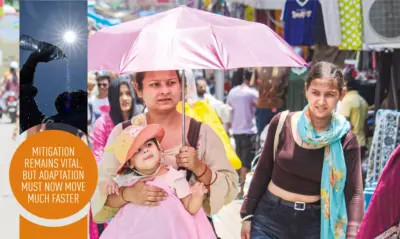

Even as global warming continues unabated and June 2026 ended up as one of the warmest Junes ever, it seems that the world has forgotten about climate change.
With the world caught up in two conflicts (in Iran and Ukraine), all attention has shifted to global oil prices and growth numbers. Add to this the uncertainty in tariffs and trade, and you have a situation where climate change slips further down the policy agenda, the world over. This article will highlight some of the issues that countries are grappling with in respect of global warming and how mitigation and adaptation efforts are being undertaken.
Grappling with extended heat waves
The heat waves witnessed globally from May 2026 onwards have been different from those in the past. In Europe, temperatures have crossed 35°C in many cities and even 40°C in some areas. This was witnessed even in areas of England, France, Italy and other parts of Europe, where cooler weather is the norm (except Southern Europe, where high temperatures have been seen in the past). Not only has this thrown day-to-day life out of gear, but it has also led to the loss of lives across Europe. The wildfires in France and Spain have led to thousands of hectares being burnt down and lakhs of people being evacuated. More generally, the unusually high temperatures have impacted agriculture, water availability, power grid stability because of the high peak loads, and public health. The main reason is that most European cities are not built to handle such heat: air conditioning is rare, and the built environment is such that heat gets trapped.
In North America, the impact of excessive heating has been felt in the form of 'heat domes', which are basically high-pressure systems that trap heat beneath them for a long duration (from a week to months). It has been reported that the USA experienced three heat domes in July 2026 alone. In fact, as The Economist reported, the 4th of July celebrations in the US took place under a 'sweltering heat dome'.
In South Asia, while peak temperatures in excess of 40°C are common, night temperatures have also risen. The high temperatures were accompanied by high humidity, leading to the 'wet-bulb' phenomenon, where sweating is less effective and the chances of heat stroke are much higher. With a large population unable to afford air conditioning, the high night temperatures did not allow the body to cool down, leading to sleep disorders and other health challenges such as dehydration, exhaustion, heart diseases, etc. The other effects include reduced school hours, rising pressure on the grid, unhealthy working conditions for manual labourers in agriculture and outdoor workers, and an overwhelmed public health system.
China, Japan and Korea also witnessed abnormally high temperatures for long durations, which were followed by extreme rainfall and flooding in rivers. As in other parts of the world, these events impacted agriculture, the power grid because of high peak demand, and public health.
What's to be done?
Climate change is stuck in a 'doom loop', with rising greenhouse gases warming the planet and the oceans, which, in turn, are leading to processes that warm the planet further. Further, it now appears that 'net zero' goals and cutting emissions are not going to be enough, mainly because the process is too slow and because there is already a high and rising amount of carbon dioxide in the atmosphere, which will continue to have warming effects. While mitigation efforts must continue, it seems that adaptation efforts have to be speeded up and prioritised, even in the rich countries. Climate-resilient agriculture, electrification of transport, infrastructure that will withstand extreme climate conditions, cheap and widespread air conditioning, power grids running on renewable energy, and coastal protection (including mangrove preservation) are some of the steps that can be implemented easily and must be taken up immediately. The more contentious interventions, such as geoengineering and efforts to reduce the albedo of the Earth, need to be discussed further.
Conclusion
With the summer of 2026 being one of the hottest ever, the urgency to deal with the deleterious effects of climate change is widespread across the world. It seems that mitigation measures such as cutting emissions will be slow, which must lead us to undertake adaptation measures without delay so that people can be provided with better working and living conditions.