




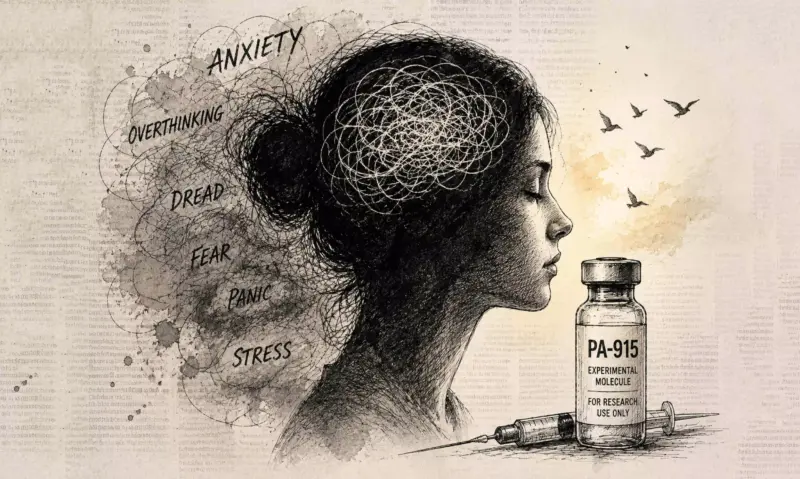

Imagine waking up one morning without dread, sitting quietly in the background. No constant overthinking. No worst-case scenarios playing in loops before your day has even begun.
Just quiet. Not because of years of therapy, not because of a pill, but because of a single injection you received weeks ago.
If I told you there was a miracle "vaccine" that could make anxiety disappear, would you take it? It sounds magical, right? Which is exactly why the internet exploded and swooned over it.
Over the past few weeks, social media has been flooded with headlines about the world's first "anti-anxiety vaccine." But there is a very important asterisk attached to that phrase.
First Things First: It Is Not Actually a Vaccine, It's a Molecule
The molecule behind the hype is called PA-915, which is being referred to as a vaccine. Technically, it is not one.
Vaccines work through the immune system. PA-915 works on the brain's stress-response system. It is a drug - a specially designed molecule developed by researchers in Japan that has so far only been tested in mice.
The word "vaccine" started circulating because researchers loosely described its potentially long-lasting effects after a single dose. Social media heard "vaccine," saw a vial, and the rest went viral.
The distinction matters gravely. Vaccines are established public-health tools backed by decades of human data, while PA-915 is still early-stage neuroscience. Confusing the two shapes public expectations in dangerous ways. When people believe a cure is right around the corner, they sometimes stop pursuing the evidence-based help already available today in the form of therapy and medications.
Why Are We All Excited?
Your brain has a built-in stress alarm system. One of the molecules involved is called PACAP, which activates a receptor known as PAC1. This pathway helps trigger the cascade associated with anxiety and depression.
Most current medications, like SSRIs and SNRIs, work further downstream by indirectly adjusting serotonin levels. PA-915 attempts something different. It blocks the PAC1 receptor itself, theoretically stopping the stress cascade before the alarm fully rings.
In mouse studies, a single dose rapidly reduced anxiety- and depression-like symptoms, with effects lasting up to eight weeks. Researchers also reported no dependency, cognitive dulling, sedation, or hyperactivity. In some stress tests, it even appeared to outperform fluoxetine, one of the world's most commonly prescribed antidepressants.
For psychiatry, where many treatments take weeks to work and a significant number of patients never fully respond, these are genuinely exciting early findings.
The Part Everyone Keeps Forgetting
Everything above happened in mice. Not humans. Not psychiatric patients. Not real-world clinical settings.
Human anxiety is far more complicated than laboratory stress models. It is shaped by trauma, relationships, sleep, finances, personality, loneliness, physical health, and life experiences. Psychiatry is also full of compounds that looked revolutionary in animals but failed once tested in humans.
PA-915 has not entered a single human clinical trial yet. The journey from promising mouse data to an approved medication usually takes many years, involving safety testing, regulatory approvals, and large-scale clinical studies.
So no, you cannot sign up for it. No, your psychiatrist cannot prescribe it. And no, it is not arriving next year.
Why This Story Went Viral Anyway
The public reaction says something important.
Anxiety and depression affect hundreds of millions of people globally. Existing treatments can be slow, expensive, inaccessible, or difficult to tolerate because of side effects. In countries like India, mental healthcare remains underfunded, while stigma still keeps many people from seeking help early.
The excitement around PA-915 is not irrational. It reflects how many people are exhausted, struggling, and desperate for something that finally works. The molecule may eventually live up to its promise. The research is absolutely worth following. But the conversation about your anxiety still belongs with a qualified clinician, not a viral reel or comment section.
And the next time social media promises to revolutionise mental health overnight, pause and take a deep breath. Wait for the comprehensive research to drop. Meanwhile, seeking help from a mental-health expert and combining the right approach of lifestyle management, therapy, and medication if needed, remains the most evidence-based approach for anxiety disorders that exists today, backed by robust data.