
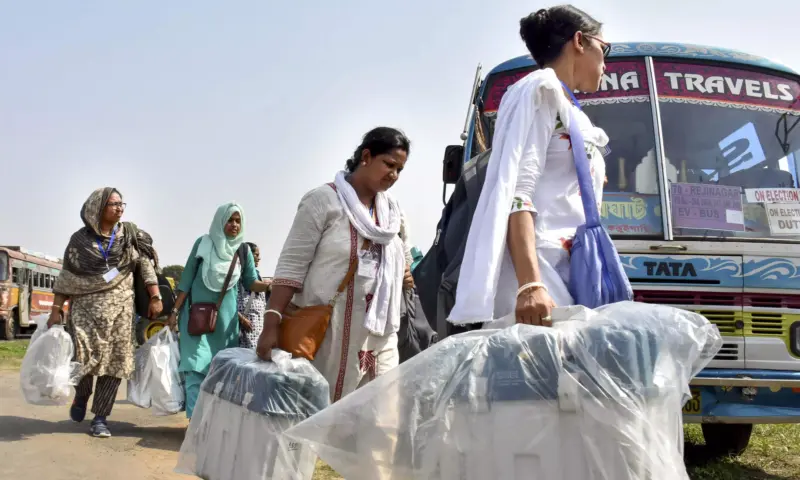

Kolkata/Chennai: Two high-stakes electoral exercises will unfold on April 23, as Tamil Nadu goes to the polls across all constituencies and West Bengal conducts its first phase of voting.
Over 5.73 crore voters in Tamil Nadu will decide the fate of 4,023 candidates, while 3.60 crore electors in West Bengal will vote across 152 Assembly segments. Both states are witnessing extensive security deployments, strict enforcement measures, and heightened monitoring to ensure smooth polling amid intense political contests and concerns over inducements and misinformation.
West Bengal's first phase will see voting across 44,376 polling stations, including 41,418 main booths and 2,958 auxiliary units, with an average of 813 voters per station. The electorate includes 1.84 crore men, 1.75 crore women, and 465 transgender voters. A total of 1,478 candidates are in the fray, including 1,311 men and 167 women.
The phase covers districts across north Bengal and western regions, including Darjeeling, Jalpaiguri, Cooch Behar, Malda, Murshidabad, Jhargram, Purulia, Bankura, Birbhum, and West Burdwan. Constituencies such as Cooch Behar Dakshin, Karandighi and Itahar have 15 candidates each, while Chandrakona has five contestants. Samsherganj has the smallest electorate at 1.61 lakh, while Daspur has over 2.96 lakh voters.
In West Bengal, the electoral contest is anchored in a fierce battle between the ruling Trinamool Congress and the Bharatiya Janata Party, with both sides seeking to consolidate their influence across key regions going to the polls in the first phase. The politically significant Nandigram constituency is among the focal points, where Leader of Opposition Suvendu Adhikari is contesting against Trinamool Congress candidate Pabitra Kar. With multi-cornered contests in several seats and between five and 15 candidates in each constituency, the phase is expected to test parties in north Bengal and the western districts, setting the tone for the second phase of voting.
Security deployment is extensive, with 2,407 CAPF companies assigned across districts. Murshidabad has the highest deployment with 316 companies, followed by East Midnapore with 273. Additionally, 2,100 Quick Response Teams have been formed, with Murshidabad having 288 teams, East Midnapore 253, and West Midnapore 248. These teams are equipped to respond immediately to incidents such as violence or booth capturing.
Authorities have enforced prohibitory orders within 100 metres of polling stations and introduced a two-tier verification system for voters. Every booth will be under 100 per cent webcasting, with cameras placed both inside and outside polling stations. An AI-based monitoring system at control rooms will flag suspicious activities in real time and alert response teams.
Officials have warned of strict action against any irregularities, stressing uniform adherence to verification protocols. With large electorates, tight security, and closely contested battles, both states are set for a significant day of polling under intense scrutiny.
In Tamil Nadu, the contest centres on a direct face-off between the DMK-led Secular Progressive Alliance and the AIADMK-led National Democratic Alliance. Chief Minister M K Stalin is seeking another term, while AIADMK leader Edappadi K Palaniswami aims to return to power after five years. According to Chief Electoral Officer Archana Patnaik, the electorate includes 2.93 crore women, 2.83 crore men, and 7,728 third-gender voters, along with 14,59,039 first-time voters.
Polling will be conducted at 75,064 booths across 33,133 locations, using 1,06,418 ballot units along with control units and VVPAT machines. A reserve of 20 per cent EVMs and 30 per cent VVPATs has been kept to address contingencies. Inclusive arrangements have also been made, including 325 all-women polling stations, 71 managed by persons with disabilities, and 29 run by youth. Nearly 3,98,513 voters aged 85 and above have been facilitated, many of whom have already used home voting. So far, 4,18,541 postal ballots have been received, and 1,10,595 Election Duty Certificates have been issued.
A strong enforcement drive has led to the interception of materials worth Rs 1,262 crore, including Rs 543 crore in confirmed seizures. Officials said 163 FIRs have been filed over violations, particularly involving digital platforms, and 2,180 online links have been removed or blocked. "We will act strictly as per law in all such cases," Patnaik said, referring to instances of alleged digital inducements such as cheque-like pamphlets.
Security arrangements include the deployment of 300 companies of Central Armed Police Forces along with 83,875 state police personnel. Of the total polling stations, 5,949 located in 3,025 areas have been identified as highly sensitive. Mobile phones have been barred inside booths, though collection facilities will be provided outside. Voting will conclude at 6 pm, with counting scheduled for May 4 at 62 centres. The election has also drawn attention due to the debut of TVK founder Vijay, who is contesting from Perambur and Tiruchirappalli East.